
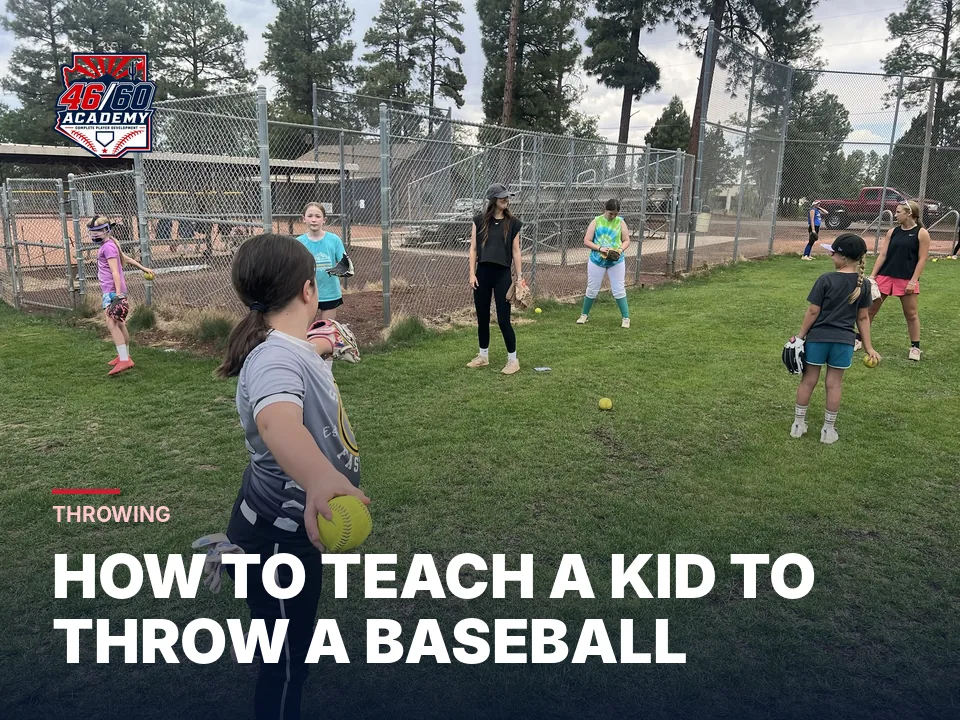
Throwing is the skill kids use on every play. A good throw makes the game more fun, and it keeps the arm healthy for years. You do not need to be an expert to teach it. You just need a ball, a partner and a few simple words.
Teach a kid to throw by using a fingers-on-top grip, turning sideways, pointing the glove at the target, stepping toward it, bringing the ball back and up, and finishing across the body. Keep distances short, warm up first and stop if the arm hurts.
Train it: 46/60 Lessons →How should a kid grip a baseball?
Start with the fingers, not the palm. Little hands want to choke the ball deep in the hand, which makes throws wobble and fly off.
- Two fingers on top: pointer and middle finger across the top of the ball, a little apart.
- Thumb underneath: right below, splitting the two top fingers.
- Space in the palm: a small gap between the ball and the palm, like holding an egg.
- Small hands: if the ball is too big, adding a third finger on top is fine.
If you can, line the fingers across the seams. It is a nice bonus, not a must at age 7.
What does "point and step" mean?
Most new throwers face the target square and push the ball like a dart. The fix is to turn sideways, just like a hitter in the box.
Teach it in two words: point and step. The glove side shoulder and glove point at the target. Then the front foot steps straight toward the target.
A fun cue for young kids: "Show the target your glove, then go say hello." Practice it slowly with no ball first. Five slow reps, then five with a ball.
Watch the front foot. If it steps off to the side, the throw usually sails that way too. Lay a jump rope or a line of tape on the ground pointing at the target, and make it a game to step on the line.
How should the arm move when throwing?
Keep the words simple. We are not building a pitcher here; we are building a kid who throws with good habits.
- Break the hands: ball comes out of the glove near the belly.
- Down, back and up: the throwing arm swings back and the ball comes up, pointing away from the target.
- Make an "L": the elbow gets up near shoulder height, with the ball above the elbow.
- Throw it over the top: the hand comes past the ear, not out to the side.
Do not rush to fix everything at once. Pick one cue a day. If the throw goes where they aimed, celebrate it.
Remind them the throw starts from the legs. A good step and a turn of the hips do a lot of the work, so the arm does not have to do it alone. That is easier on the arm and adds distance.
What is a good follow through?
The throw does not stop when the ball leaves the hand. The arm keeps going and finishes across the body, toward the opposite knee or hip.
The back foot comes around too, so the child ends up facing the target, ready to field the ball. Try a freeze game: after each throw, they freeze in the finish. You check it, then say "go" to unfreeze.
A good finish takes stress off the arm and adds accuracy. It also looks like a real ballplayer, which kids love.
Fun partner throwing games and arm care
Games make the reps fly by. Use a soft or foam ball for younger kids, start close and back up only when throws stay accurate.
- Chest target: one point for every throw that hits your partner's chest area. First to 10 wins.
- Ladder: make three good throws, then both take one step back. A miss means step forward.
- Knee throws: kneel on the throwing-side knee and throw with just the upper body. Great for the arm path.
- Around the horn: with three or four players, throw around a square. Count clean catches in a row.
Arm care matters most. Always warm up first with easy movement and short, soft throws. Keep distances short and the number of hard throws small. Give the arm plenty of rest days, especially after a busy weekend of games. If your child pitches, follow your league's pitch-count and rest rules. And if the arm hurts, stop and check in with your pediatrician.
Want hands-on help? Ask about our in-person lessons, individual or small group, for throwing and every other skill. Or start with the free Quick Check.
One thing to remember
Grip it in the fingers, point the glove, step to the target and finish across the body.
What to do this week
Play catch three times for 10 minutes, starting close after an easy warm-up. Work on one cue each day: grip, then point and step, then the finish. End with a round of the ladder game.
Parent questions
At what age can a kid learn to throw a baseball?
Many kids start playing catch with soft balls well before 7. By 7–12, most can learn the full grip, point and step, and follow through.
Why does my child throw the ball into the ground?
Usually they let go too late or do not step toward the target. Have them point the glove, step at the target and let go up by the ear.
How often should a young player throw?
Short, regular sessions with plenty of rest days work best. Warm up first, follow league pitch-count and rest rules, and stop if the arm hurts.
Sources: MLB and USA Baseball — Pitch Smart
This article is part of the 46/60 parent guide The Baseball & Softball Parent Guide. Start there for every related article and game.