
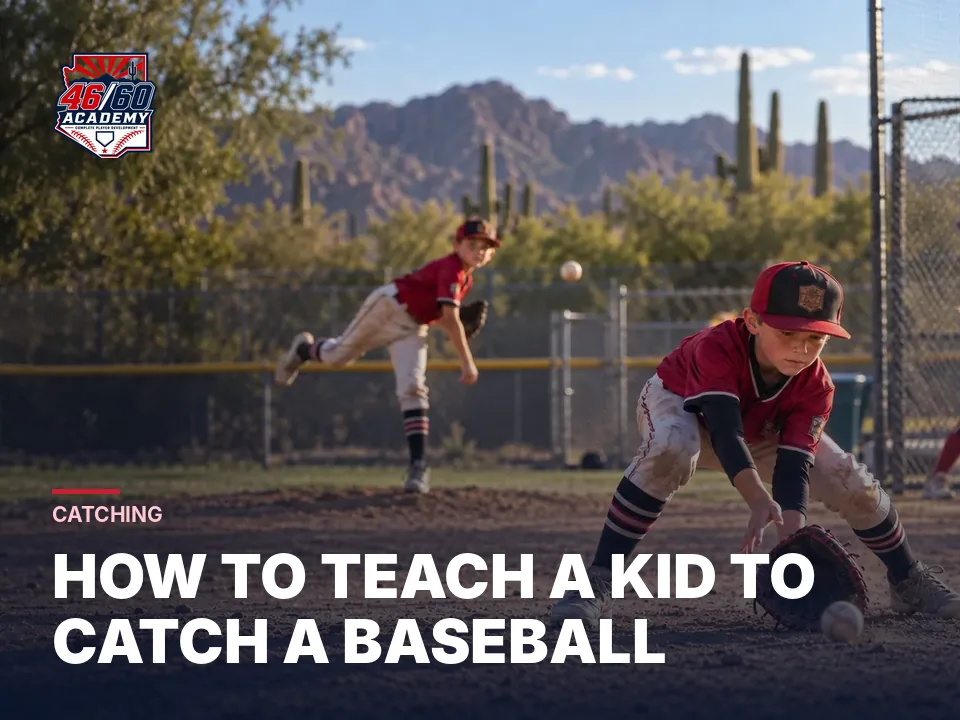
Catching is the skill that makes every other part of the game work. A kid who can catch has more fun at practice, plays more of the game and feels safer on the field. The good news: it is easy to teach at home with a soft ball, a glove and ten minutes.
Teach a kid to catch a baseball by starting close with a soft ball, getting the hands up and ready, showing a big open glove, watching the ball into the glove and covering it with the throwing hand. Back up only when catches are easy, and keep it short and fun.
Train it: 46/60 Lessons →What ball and glove should we start with?
Start soft. A foam ball, a tennis ball or a soft training ball lets your child learn without worrying about getting hurt. Little League's own backyard catching drill suggests a tennis ball or other softer ball for younger players.
Researchers who studied youth baseballs have also noted that softer balls cause less pain on impact. Less sting means less fear, and less fear means eyes stay open.
- Glove fit: pick a glove your child can open and close with one hand. A glove that is too big or too stiff is hard to squeeze shut.
- Space: outdoors, or indoors only with a foam ball and plenty of room away from windows and TVs.
- Distance: start just a few big steps apart. Close and easy beats far and scary.
- Adult tosses: you toss underhand at first so every ball is catchable.
How should a kid hold the glove to catch?
Most new catchers wait with the glove hanging down by the knee, then try to stab at the ball at the last second. The fix is simple: hands up and ready before the ball is thrown.
- Ready position: feet about shoulder-width apart, knees a little bent, both hands out in front of the chest.
- Show a big glove: the open pocket faces the ball, like a big target for the thrower.
- Above the belt, fingers up: for balls at the chest or higher, the glove fingers point up and the thumbs are close together.
- Below the belt, fingers down: for low balls, flip the glove so the fingers point down and the pinkies are close together.
- Two hands: catch it in the glove, then cover it with the throwing hand right away.
Two hands is the classic first lesson, and it is one Little League teaches in its catching basics too: hands up, eyes on the ball, catch with two hands.
A step-by-step plan for teaching catching
Move to the next step only when your child makes most catches at the step before it. Five to ten catches per step is plenty for one day.
- Bare hands, soft ball: stand close and toss underhand to the chest. Catch with two hands, like trapping a bubble.
- Glove on, kneeling: both of you kneel a few steps apart. Gentle tosses to the glove. Kneeling slows everything down.
- Standing, short tosses: same distance, now standing in the ready position. Mix chest-high and belt-high tosses.
- Move the feet: toss a little to the left and right so your child slides over and catches in front of the body, not off to the side.
- Easy pop-ups: toss the soft ball up a bit higher. Glove up, slightly in front of the head, so they can see the ball go in. Call "Mine!" every time.
Watch the eyes. The goal is to see the ball all the way into the glove. If your child looks away or turns the head, go back a step and make it easier.
What if my child is scared of the ball?
This is very common, and it is not a toughness problem. It usually means the ball is too hard, too fast or too close too soon. Go back to a softer ball and slower tosses until catching feels boring-easy.
Let your child toss to you first, so they are in charge. Praise the effort to watch the ball, not just the catch. "You watched it the whole way!" builds more confidence than "Good catch."
For more on this, read our guide on helping a child who is afraid of the ball. If your child ever gets hit and has pain that does not go away, stop and check in with your pediatrician.
Fun catching games for kids
Games turn reps into play. Keep them short and stop while your child still wants more.
- Streak: count catches in a row. Try to beat your record each day.
- High or low: say "high" or "low" as you toss. Your child shows fingers up or fingers down before the catch.
- Two-hand points: one point for a catch, two points if the throwing hand covers the ball right away.
- Step-back ladder: three clean catches and you both take one step back. A drop means one step forward.
- Mine!: toss easy pop-ups. Your child must call "Mine!" loud and early before catching.
Want hands-on help? Ask about our in-person lessons, individual or small group, for catching and every other skill. Or start with the free Quick Check to find one clear first step.
One thing to remember
Start close with a soft ball, hands up before the toss, and watch the ball all the way into the glove.
What to do this week
Play catch three times this week for 10 minutes with a soft ball. Spend each session on one step of the plan, end with a round of Streak, and write down the best streak so your child can try to beat it next time.
Parent questions
At what age can a kid learn to catch a baseball?
Many kids start catching soft balls well before age 7. By 7–12, most can learn the ready position, two-hand catches, and fingers up or down with practice.
Why does my child close their eyes when catching?
Usually the ball feels too hard or too fast. Move closer, toss slower and use a softer ball until they can watch the ball all the way in.
Should my child catch with one hand or two?
Start with two hands so the throwing hand covers the ball and is ready to throw. Coaches may teach one-hand catches later for balls out of reach.
Sources: Little League — The Basics: Catching · Little League — Backyard Tip: Reaction Pop-Up Drill · JAMA Ophthalmology — Baseball Hardness as a Risk Factor for Eye Injuries