
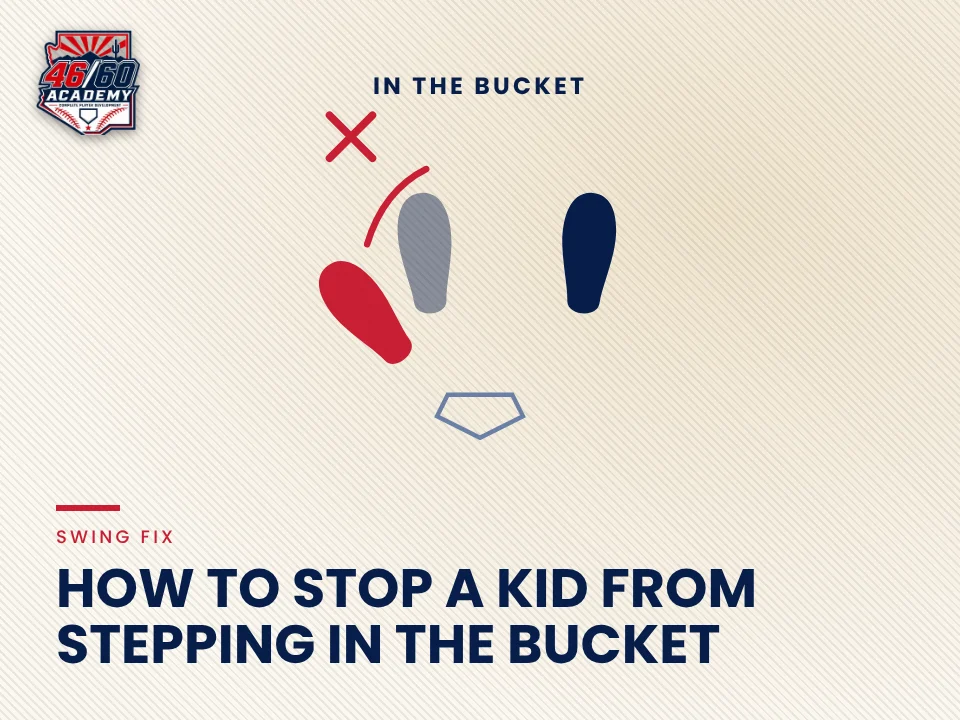
You see it from the bleachers: the pitch comes, and your child’s front foot steps away from the plate toward the dugout. Coaches call it “stepping in the bucket.” The good news is that it usually has a clear cause, and once you fix the cause, the step often fixes itself.
Stepping in the bucket usually comes from fear of the ball, a bat that is too heavy, or a stance that is too far from the plate. Fix the cause first: use softer balls to rebuild trust, check the bat with the 10-second arm test, and set the stance so the bat covers the plate. Then train a straight stride with a simple line on the ground.
Train it: 30-Day Swing Structure →Why kids step in the bucket
Before you fix the step, find out why it is happening. Most kids step away for one of these reasons:
- Fear of the ball. The body protects itself. If your child has been hit by a pitch, or the pitching just got faster, stepping away is a natural reaction.
- A bat that is too heavy. A heavy bat pulls the body open to get it moving.
- A stance too far from the plate. Some kids step out because they are reaching for the outside part of the plate anyway.
- Trying to pull everything. Kids who want to hit it far often open up early to yank the ball.
Watch a few swings in a row. If it only happens on live pitching and not off a tee, fear is the likely cause. If it happens on every swing, check the bat and the stance.
If it is fear: rebuild trust first
Telling a scared hitter to “stay in there” rarely works. Lower the stakes so the body stops expecting to get hurt.
- Use soft balls. Foam balls, tennis balls or wiffle balls let your child stand in without worry.
- Teach a safe turn. Show them how to turn the front shoulder in and drop the chin if a pitch comes inside. Kids who know how to protect themselves stop bailing out.
- Win small. Count the swings where the front foot goes straight, not the hits.
If fear is the big issue, our guide for kids who are afraid of the ball and the Scared of the Baseball Fix walk through it step by step.
Check the bat and the stance
Have your child hold the bat straight out to the side with one hand. If the barrel drops before about 10 seconds, it is probably too heavy. Our bat size calculator helps you find a better fit.
Then check the stance: when your child sets up and touches the bat to the far edge of the plate, the barrel should cover it without leaning. If they are too far away, move them in a little.
A simple drill to straighten the stride
The line drill: Lay a bat, a stick or a strip of tape on the ground pointing at the pitcher, just in front of your child’s front foot. The goal is to step along the line, not away from it. Start with dry swings, then tee swings, then soft toss.
Keep the cue simple: “step to the pitcher.” Then let them swing. Too many reminders make kids tense, and tension makes the step worse.
One thing to remember
The step is usually a symptom. Fix the fear, the bat or the stance, and the step often fixes itself.
What to do this week
Watch five swings and decide which cause fits best. Then do 10 line-drill swings a day for a week, using soft balls if fear is part of it.
Parent questions
Is stepping in the bucket always bad?
A small step toward the pitcher is ideal, but a slightly closed or open step is not a disaster for a young hitter. It becomes a problem when it pulls the body and the barrel away from the plate and the child can no longer reach outside pitches.
Should I tie my child’s foot or use a board to block the step?
We don’t recommend it. Blocking the step without fixing the cause can make a scared hitter more tense. Work on trust, the bat and the stance first.
How long does it take to fix?
If the cause is a bat or stance, it can change in a few sessions. If it is fear, give it a few weeks of soft-ball work and small wins.
START 30-DAY SWING STRUCTURE →
This article is part of the 46/60 parent guide How to Teach a Kid to Hit. Start there for every related article and game.