
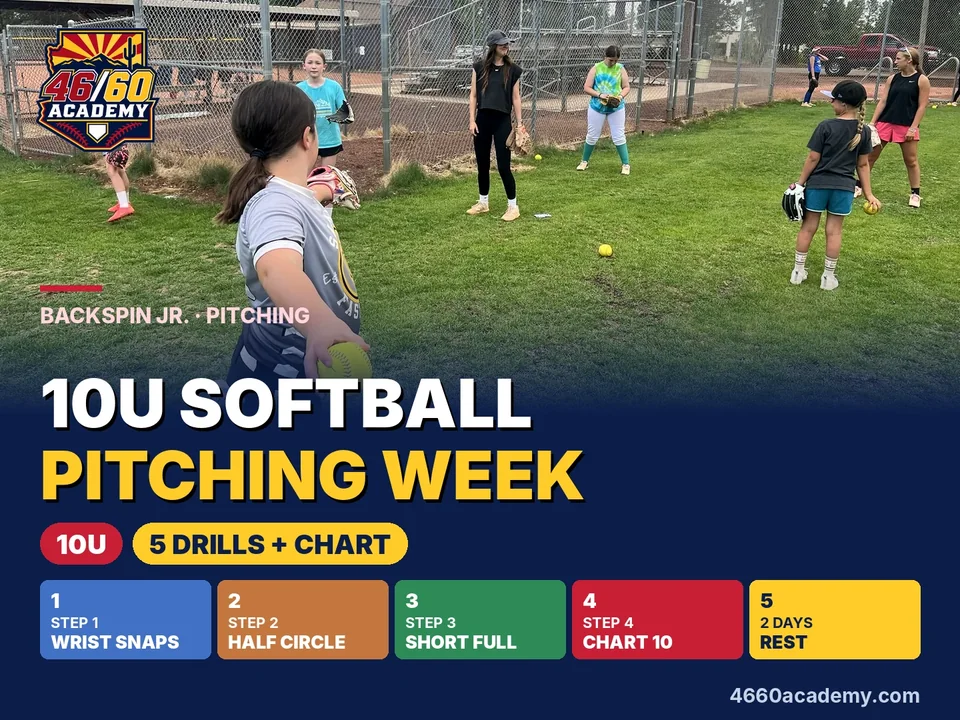
You just became the catcher. You've got a bucket of balls, a glove and a 10-year-old who wants to pitch on Saturday. Here's the exact week I'd run with her, pitch by pitch.
Good 10U softball pitching drills fit a simple week: two 20-minute sessions on days that aren't back to back, about 40 pitches each, with the drills in the same order every time. End each session with 10 charted pitches at game distance, rest at least two days a week and follow your league's pitching rules.
Train it: Command & Composure (Level 2 Pitching) → Free: Free Softball Practice Plans →What a 10U pitching week looks like
Here's the deal. A 10U fastpitch pitcher doesn't need a lot of pitching. She needs short sessions, done the same way, with real rest between them.
| Day | What she does | Pitches |
|---|---|---|
| Monday | Rest. Play catch at another position if she wants. | 0 |
| Tuesday | Session 1: drills in order, then chart 10 | About 40 |
| Wednesday | Rest | 0 |
| Thursday | Session 2: same drills, chart 10 as a game | About 40 |
| Friday | Rest | 0 |
| Saturday | Game day. No game? Run Session 1. | Game |
| Sunday | Rest | 0 |
Games on other days? Slide the sessions so she never pitches more than two days in a row and still gets at least two full days off.
How many pitches should a 10U pitcher throw?
Start with the rules, then the guidelines. Little League Softball counts innings, not pitches: in its Minor and Major divisions, a pitcher can throw up to 12 innings in a day, and 7 or more innings means one calendar day of rest. Other leagues and travel groups use their own rules, so check your league's current rulebook.
The sports medicine doctors at AOSSM's STOP Sports Injuries list 50 pitches per game for ages 8 to 10. They also say girls under 12 shouldn't pitch more than two days in a row, and pitchers need two rest days with no live pitching, batting practice included.
At home, count every pitch, wrist snaps too. Keep a 10U session to about 40. If her arm hurts, the session is over, and if the pain hangs around, call your pediatrician.
The 10U pitching drills, in order
Same order every session. Short distance first, game distance last.
- Warm-up (no pitches): jog to the fence and back, 10 arm circles each way, then 10 easy overhand throws at about 30 feet.
- Wrist snaps (10 pitches): 15 feet apart, ball at her hip, flick with the wrist only. You want backspin and a soft, straight throw.
- Half circles (10 pitches): 20 feet apart. Throwing arm starts straight up, falls down the back of the circle, brushes the hip and snaps.
- Short full pitches (10 pitches): full windmill from a few big steps in front of game distance. Stride foot lands toward you, every time.
- Chart 10 (10 pitches): back to her league's pitching distance. Ten pitches, and you write down how many were strikes.
Fix one thing per session, and only one. Ball sailing high? Back to half circles for five. Arm swinging out to the side? Do circles standing next to a fence for a minute, then move on.
How to chart strikes out of 10
My favorite word in coaching is "Exactness." For a 10-year-old, that means we stop saying "good job" and start counting something real.
- Set up: wear a catcher's helmet or mask, kneel on a knee pad and hold the glove still in the middle of the zone.
- What counts as a strike: the ball gets to your glove between your chest and your knees, and you don't move your knees to catch it.
- Write three things: the date, strikes out of 10 and one word she picks for how it felt.
- Read it monthly: one bad Tuesday means nothing. If the number creeps up over four weeks, the routine is working. If it slides, move up a few steps for a week.
Tape the chart to the fridge. She'll check it more than you do.
How to keep pitching practice fun at 10
"Less is more." For a 10U pitcher, that means 20 good minutes beats an hour of tired arms and tears.
- Call your score: before the Thursday chart, she guesses how many strikes she'll throw. Hit it or beat it, she picks Friday's dessert.
- Beat the coach: on Thursday the 10 charted pitches are a game. A strike is her point, a ball is yours.
- Stop on a good one: the last pitch of the day should be a strike, even if you have to move up two steps to get it.
- Sticker for showing up: she earns it for finishing the session, not for the number.
Need the warm-up and drill order on one page? Print a free softball practice plan and keep it in the ball bucket. When she's ready for a guided four weeks, Command & Composure is our 16-session Level 2 pitching program, built around routines, target control and smart workload habits.
One thing to remember
Two short sessions, the same drills in the same order, real rest days and one honest number on the fridge.
What to do this week
Pick your two session days with a rest day between, buy a cheap notebook and run the drill order exactly as written. Write down her strikes out of 10 both days.
Parent questions
Can a parent catch a 10U softball pitcher?
Yes, with a real catcher's mitt and a catcher's helmet or mask. Kneel, keep the glove still as a target and stay at short distance until you're comfortable.
Should my 10U pitcher practice every day?
No. Plan rest days between sessions, don't let her pitch more than two days in a row, and follow your league's pitching rules. Rest is part of the routine.
What is a good strike percentage for a 10U pitcher?
There's no magic number at this age. Watch her own chart: if her strikes out of 10 go up over a month, she's improving.
SEE COMMAND & COMPOSURE (LEVEL 2 PITCHING) →
Sources: Little League: Regular Season Pitching Rules (Softball, Regulation VI) · STOP Sports Injuries (AOSSM): 2026 Softball Injury Prevention tip sheet