
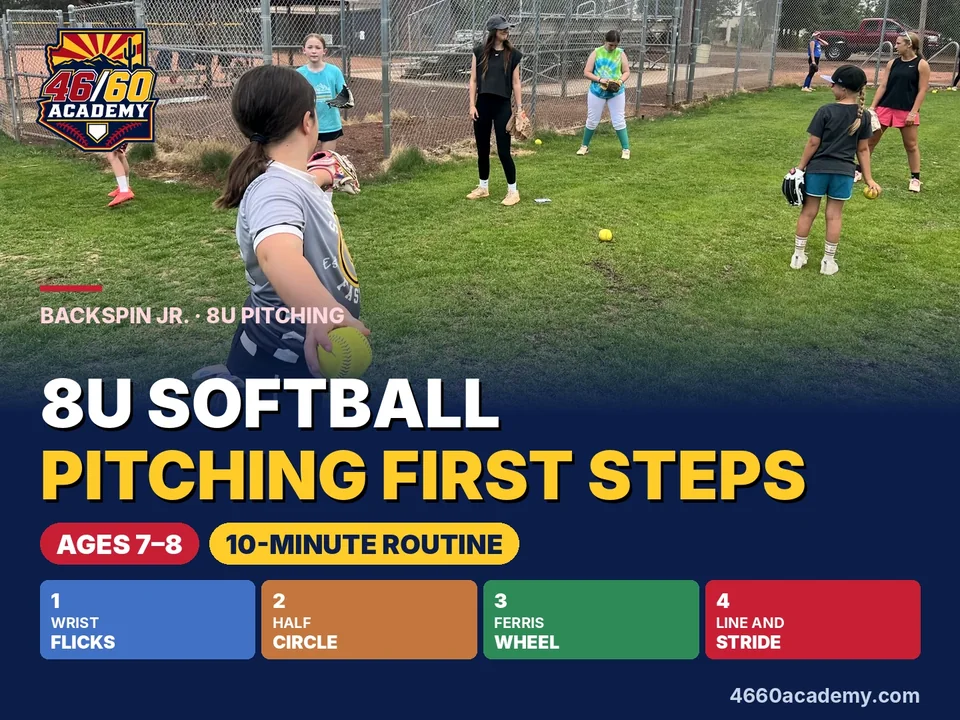
Your 7- or 8-year-old wants to pitch, and you have no idea where to start. Good news: you don't need to know much. Start close, teach the windmill in small pieces, and keep it to about 10 minutes.
Start an 8U softball pitcher with wrist snaps from close range, then a half circle, a full circle, and finally a small stride. Practice about 10 minutes, 2 or 3 days a week, aim for a target instead of speed, and stop if anything hurts.
Train it: Command & Composure (Level 2 Pitching) → Free: Free Pitching Intro Course →Is 8 too young to start pitching softball?
No. Seven and 8 is a fine time to try it, as long as it stays fun and short. Any kid who wants to learn can learn. You don't need to pick "the pitcher" on your team this early.
Know what she may see in games. Many 8U teams use coach pitch or a machine, and some start kid pitch. Little League's Minor Division, for one, can use machine, coach or player pitch. Check your league's rules for how pitching works and how far she'll throw from.
Coach BK says it this way: "Belief is the most powerful human force." At this age, that means every strike she earns in the backyard teaches her she can do this.
What should an 8-year-old pitcher work on first?
Three things, in this order. Don't move on until the one before it looks easy.
- The grip: fingertips on the seams, ball out in the fingers and off the palm. Small hands may need a smaller ball for practice; check your league's rules for game balls.
- The snap: her wrist whips the ball forward as her hand passes her hip.
- The circle: her arm stays long and loose, and it travels straight up and down beside her head.
Here's the picture we give kids. Her arm is a Ferris wheel, not a merry-go-round. If it swings out around her side, the ball goes sideways too.
What can wait: speed, radar guns and new pitches. A fastball that finds the target is the whole menu at 8U.
Four first-step windmill drills for 7- and 8-year-olds
- Wrist Flicks: she stands facing you, 8 to 10 feet apart, arm down at her side. Using only her wrist and forearm, she snaps the ball to you. 10 reps. Look for the ball spinning straight and her hand finishing out front.
- Half Circle: same distance, standing with her throwing arm straight out in front at shoulder height. She drops it down past her hip and snaps. 10 reps. Her arm should brush lightly past her hip, and that brush is her cue to let go.
- Ferris Wheel: feet still, chest facing the target, a slow full circle and a snap into a net or to you at about 15 feet. 10 reps. Every ball that reaches the target without bouncing first is a point.
- Line and Stride: draw a straight line in the dirt pointing at the target. She pushes off her throwing-side foot, takes a small step along the line and lets the ball go. 10 reps. Landing on the line beats landing far.
Move her back a step or two only when she can hit the target about half the time. If the ball starts going wild, slide closer. That's not going backward. That's how pitchers get better.
How much should an 8U pitcher practice?
| Minutes | What she does | Goal |
|---|---|---|
| 2 | Light jog and easy arm circles, then easy throws | Loose and warm |
| 2 | Wrist Flicks | Straight spin |
| 3 | Half Circle and Ferris Wheel | Arm stays beside her head |
| 3 | Line and Stride at a target | Most reach the target |
Do that 2 or 3 days a week. End on a good one, and end it while she still wants more.
Indoors, use soft balls and plenty of space. If an adult is catching real softballs, wear a mask or throw into a net. Her practice partner should be an adult at this age, not another 8-year-old.
A full plan helps if she's serious about it. Command & Composure is one of the programs in our $25/month membership: 16 parent-guided sessions over four weeks, for ages 7–12, baseball and softball. Lesson 1 is free.
Is windmill pitching safe for kids?
It's underhand, but it's not free. The American Orthopaedic Society for Sports Medicine lists shoulder tendinitis, back or neck pain, and elbow, forearm and wrist tendinitis as the most common overuse injuries for softball pitchers.
A University of Florida survey of 115 caregivers found 85% didn't know safety recommendations existed. Now you do. Here's what to follow:
- Warm up every time before throwing.
- Let her play other positions too.
- Never pitch with pain. If pain lasts a week, see a doctor.
- Follow your league's pitch limits and the society's age-based guidelines.
- Ask her how her arm feels, and believe her answer.
One thing to remember
At 8U, a loose arm and a strike at a short distance beat a fast pitch every time.
What to do this week
Pick two days and do the 10-minute routine. Stick to Wrist Flicks and Half Circle at first, and only add Ferris Wheel when her snap looks easy. Count how many reach the target and try to beat it next time.
Parent questions
How far should an 8-year-old pitch from?
Start at 10 to 15 feet in practice and move back only when she can hit the target. Game distance varies, so check your league's rules.
How fast should an 8-year-old pitch?
Don't worry about it. Accuracy, a loose arm and enjoying it matter far more at this age, and a radar gun doesn't help.
Should my 8-year-old learn a changeup?
Not yet. One fastball she can throw to a target is plenty until her motion is smooth and repeatable.
SEE COMMAND & COMPOSURE (LEVEL 2 PITCHING) →
Sources: STOP Sports Injuries (AOSSM): Softball Injury Prevention tip sheet · UF Health: Many caregivers unaware of fastpitch softball safety guidelines · Little League: Softball Divisions