
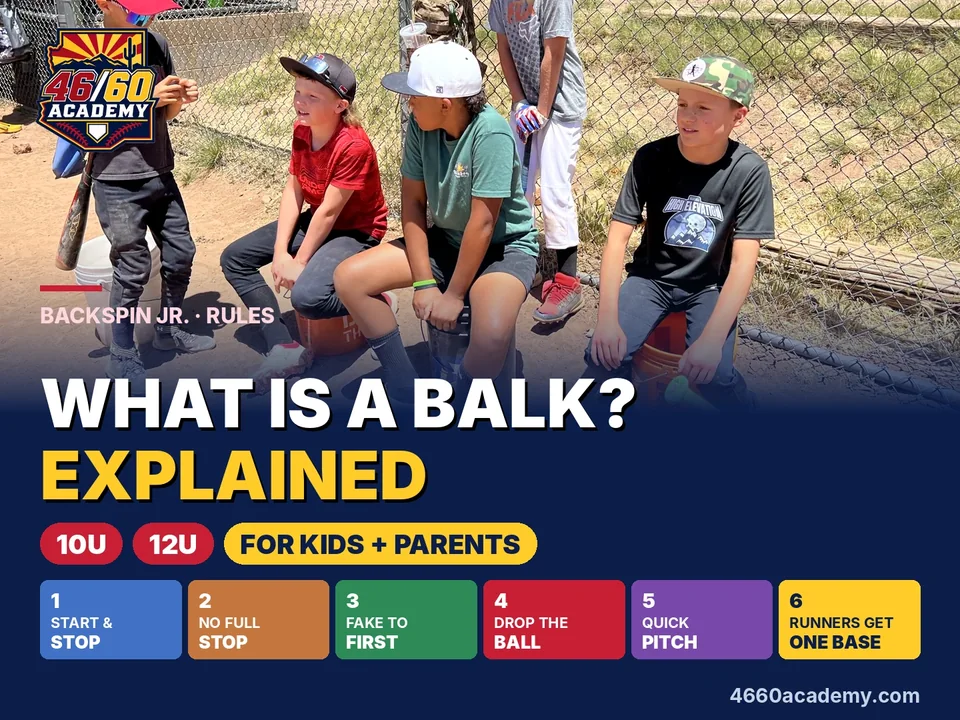
A balk is an illegal move by a pitcher with runners on base, like starting the pitch and then stopping, and the penalty is that every runner moves up one base. Picture it: the pitcher barely moves, the umpire points and every runner gets a free base. It is one of the most puzzling rules in baseball until someone explains it simply.
A balk is an illegal move by a baseball pitcher with runners on base, such as starting the pitching motion and stopping or faking a throw. The penalty is that every runner moves up one base, but many youth leagues don't call balks at all, so check your league's rules.
Train it: Command & Composure (Level 2 Pitching) → Free: Free pitching skill guide →Why does baseball have a balk rule?
The balk rule is about fairness. When runners are on base, they watch the pitcher to decide when to run. If the pitcher could pretend to pitch and then throw to a base, runners would never be safe taking a lead.
So the rule says the pitcher cannot try to trick the runners. MLB says balk rules were first added back in 1898 for exactly this reason: to stop pitchers from deceiving baserunners.
Here is the kid version: once you start a pitch, finish the pitch. If you are going to throw to a base, make it clear and step toward that base.
What are the most common balks?
The official list is long, but young pitchers usually balk in just a few ways. These come from the standard baseball rule book that most older leagues follow.
- Starting and stopping: the pitcher begins the motion toward home, then stops or hitches.
- Not stopping in the set: from the stretch, the pitcher has to come to a complete stop with hands together before pitching. Rushing through it is a balk.
- Faking a throw to first: in most rule sets, a pitcher on the rubber can't fake to first without throwing.
- Not stepping toward the base: a pickoff throw has to come with a step directly toward the base.
- Dropping the ball: if the ball slips out while the pitcher is on the rubber, it is a balk, even by accident.
- Quick pitching: pitching right after getting the ball back, before the batter is ready.
Other balks include pitching while not facing the batter and splitting the hands after coming set without pitching or throwing. Most of these happen when a nervous pitcher rushes.
Don't worry if you can't spot a balk from the stands. Many balks are tiny moves that are hard to see, even for adults who have watched baseball for years. If you missed what happened, it is fine to ask your child's coach after the game.
What happens when a pitcher balks?
The umpire calls the balk, and every runner on base moves up one base. A runner on third walks home and scores.
A balk only matters when runners are on base, because there is no one to trick with the bases empty. That is why a pitcher with nobody on can be a little more relaxed in the windup.
If your child balks, keep it small. It is a rule mistake, not a character flaw. Coach BK says it like this: "Two choices: A. Do everything in your control. B. Anything but A." For a young pitcher, it means a slow breath and a clean set are always in their control, so reset and make the next pitch.
Do youth leagues call balks?
This is where parents get confused, because it depends on the league and the age. Little League does not call balks in its Majors division and below, because runners there cannot lead off, so there is nobody to trick. Little League calls balks in its older divisions.
Other programs let 11- and 12-year-olds lead off and steal, and some of them call balks. Some give a warning first. Some teach balks but don't enforce them yet. Even where balks aren't called, certain illegal moves can still be called an illegal pitch.
So the best answer is simple: check your league's rules for your child's division, or ask the coach at the first practice.
Softball is different. Fastpitch softball does not use the balk rule. It handles a pitcher's illegal moves as an illegal pitch, with its own rules, so check your softball league's rule book.
How can my young pitcher avoid balks?
Balks are usually a timing and nerves problem. A few minutes of practice at home goes a long way, no ball even needed at first. Keep it light. The goal is a calm, repeatable routine, not a perfect move.
- Practice the set: come set, count "one-two" in your head, then pitch. Do it ten times slowly.
- Freeze game: a parent calls "freeze" anytime. If the pitcher is in the set, they should already be still.
- Step and throw: practice a pickoff with a soft ball: step toward the base, then throw. No fakes.
- Step off when unsure: teach them that stepping back off the rubber resets everything. There is no rush.
Our free pitching skill guide has age-right drills and cues for 8U, 10U and 12U. For a full plan, Command & Composure is our Level 2 pitching program, with 16 parent-guided sessions on strikes, rhythm and staying calm. It is in the $25/month 46/60 membership. As always, warm up first, follow your league's pitch-count rules and stop if the arm hurts.
One thing to remember
A balk is the pitcher tricking runners, the penalty is one base for every runner, and whether it is called depends on your league.
What to do this week
Find your league's rule book and see if balks and leadoffs are in your child's division. Then play the freeze game for five minutes so coming set becomes a habit.
Parent questions
Is a balk called with no runners on base?
A balk is about runners, so it only matters with runners on base. Some rule books still penalize certain illegal pitches with the bases empty, so check your league's rules.
Is there a balk in Little League?
Little League does not call balks in the Majors division and below, where runners can't lead off. Its older divisions do call balks.
Is there a balk in softball?
No. Softball handles a pitcher's illegal moves as an illegal pitch, with its own penalty, so check your softball league's rules.
SEE COMMAND & COMPOSURE (LEVEL 2 PITCHING) →
Sources: MLB Glossary: Balk · MLB.com: What is a balk in baseball? A definitive guide · Little League: What is a balk?