
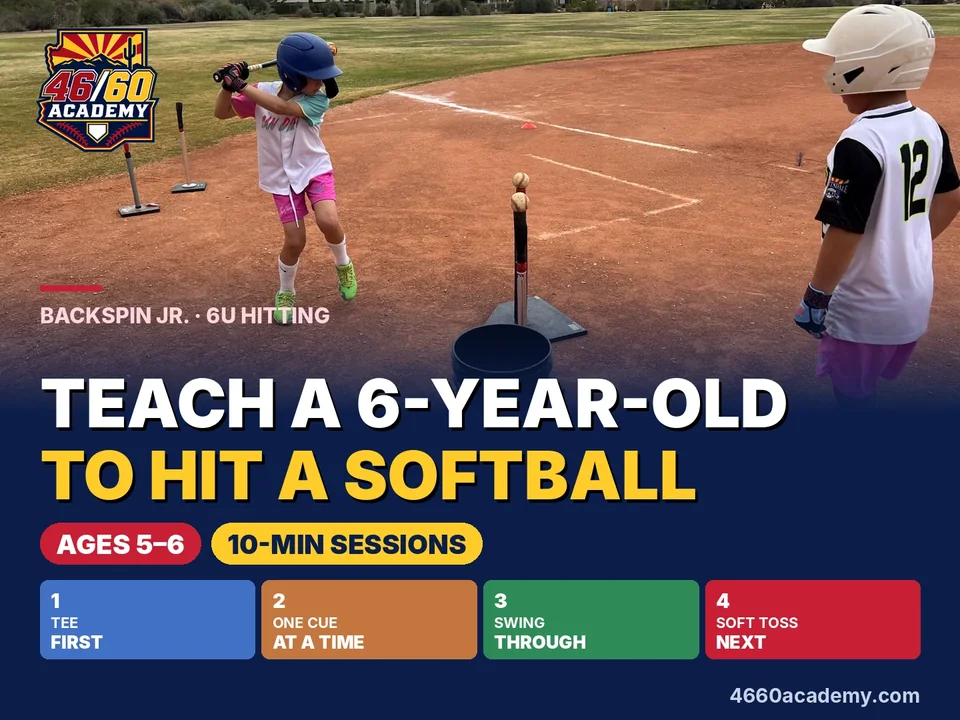
Your daughter just signed up for her first softball season, and you want to help her hit before the first practice. Good news: you don't need a cage or a pitching machine. You need a tee, a light bat, a helmet and about ten minutes.
Teach a 6-year-old to hit a softball by starting on a tee with a light bat and a helmet, giving one simple cue at a time and keeping sessions to about 10 minutes. Once she hits the tee ball solidly, move to gentle soft toss with soft balls, and turn every round into a game.
Train it: Complete Contact Builder (Level 2 Hitting) → Free: Free Hitting Intro Course →Where do I start with a 6-year-old softball hitter?
Start on a tee. USA Softball's coaching focuses for its youngest divisions list the tee and basic instruction on hitting off it, with coach pitch introduced at 6U. A ball that sits still lets her learn the swing without also learning timing.
Check her gear first. A bat she can hold straight out to the side with one hand for about 10 seconds, without the barrel dropping, is usually not too heavy. Too heavy is the most common mistake at this age. Softball sizes vary by league, so check your league's rules before you buy.
- Helmet on for every swing. Make it a habit from day one.
- A safe swing zone. Nobody stands near the hitter. Draw a circle in the dirt or grass and keep siblings and the dog out of it.
- Soft balls for anything tossed. Foam or soft training balls are perfect for the backyard.
How do I teach her the swing without overloading her?
Give one cue at a time and let her swing a bunch before you add the next one. A 6-year-old can't hold five ideas in her head at once, and she shouldn't have to.
- Grip: hands together, bottom hand near the knob, and line up the knuckles. USA Softball lists "knuckles aligned" in its early batting stance points.
- Stance: feet a little wider than her shoulders, knees bent, like she's ready to jump.
- Eyes: "Look at the ball the whole time." Put a small sticker or dot on the tee ball and ask her what color it was after the swing.
- Swing through: hit the ball and let the bat keep going all the way around. No stopping at contact.
- Finish: back heel up, belly button facing the target, and hold the finish for a count of two.
Set the tee about belt high in the middle of the plate to start. If she keeps hitting the tee instead of the ball, move her a little closer or farther until she finds the sweet spot. Praise the swing, not just the result.
What fun hitting games work for 6-year-olds?
At this age, games beat drills every time. Short rounds of five swings keep her attention and give you a natural time to reset.
- Knock down the cone: put a cone or bucket out in front. Five swings to hit the ball past it.
- Color call: use balls with different colored dots. She calls the color after each swing to prove she watched it.
- Line drive points: one point for a hit, two for a hard one on a line. Play to ten.
- Freeze finish: after every swing she freezes in her finish while you count "one, two." Good finish, bonus point.
Coach BK talks about the sound of a barreled ball: "Ball — powdered." For a 6-year-old, that means chase the loud, solid sound of good contact instead of worrying about what the swing looks like.
When is she ready for soft toss and coach pitch?
When she hits the tee ball solidly on most swings, try soft toss. Kneel off to her front side at an angle, never directly in front of her swing, and toss soft balls underhand into the spot where the tee used to be. Go slow. Ten good tosses is plenty.
After a week or two of solid soft toss, try easy underhand front toss from a safe distance, with soft balls and you behind a screen if you have one. This is how she gets ready for coach pitch in games. If she starts flinching or stepping away, go back to the tee for a few days. That is normal, not a problem.
Before her first game, Coach BK's line is a good one to share: "You got a bat, pitcher's got a ball… I'd bet on you every time!" It tells her she belongs in the box and you believe in her.
How long should a 6-year-old practice hitting?
About 10 minutes, a few times a week, is a great start. Stop while she still wants to keep going. Ending on a good swing and a smile makes her ask for the next session.
- Warm up first: jog, arm circles and a few dry swings with no ball.
- Rest when she's tired: tired swings turn into sloppy swings.
- Stop if anything hurts: hands, wrists or back. Rest and check with her coach or doctor if it keeps hurting.
Want more free help? Join the American Hitting Association, a free baseball and softball membership from the same family as 46/60.
One thing to remember
Start on a tee with a light bat and a helmet, teach one cue at a time and keep every session short and fun.
What to do this week
Do three 10-minute tee sessions with five-swing rounds and one game each time. Add a single cue each day, starting with the grip, and finish each session with her favorite game.
Parent questions
Can a 6-year-old learn to hit a pitched softball?
Yes, with time. Most start on a tee, move to gentle soft toss and then to coach pitch. Every child moves at her own pace, so go back to the tee whenever she needs it.
What size softball bat should a 6-year-old use?
Pick a bat she can control, not the biggest one she can lift. If she can hold it straight out with one hand for about 10 seconds, it's usually not too heavy. Check your league's rules for bat and ball sizes.
Should my 6-year-old swing at real softballs at home?
Off a tee in open space, regular softballs are fine with a helmet on and no one nearby. For anything you toss to her, use soft or foam balls so a miss or a mishit doesn't hurt anyone.
SEE COMPLETE CONTACT BUILDER (LEVEL 2 HITTING) →
Sources: USA Softball: Divisional Focuses (coaching focuses by age division)