
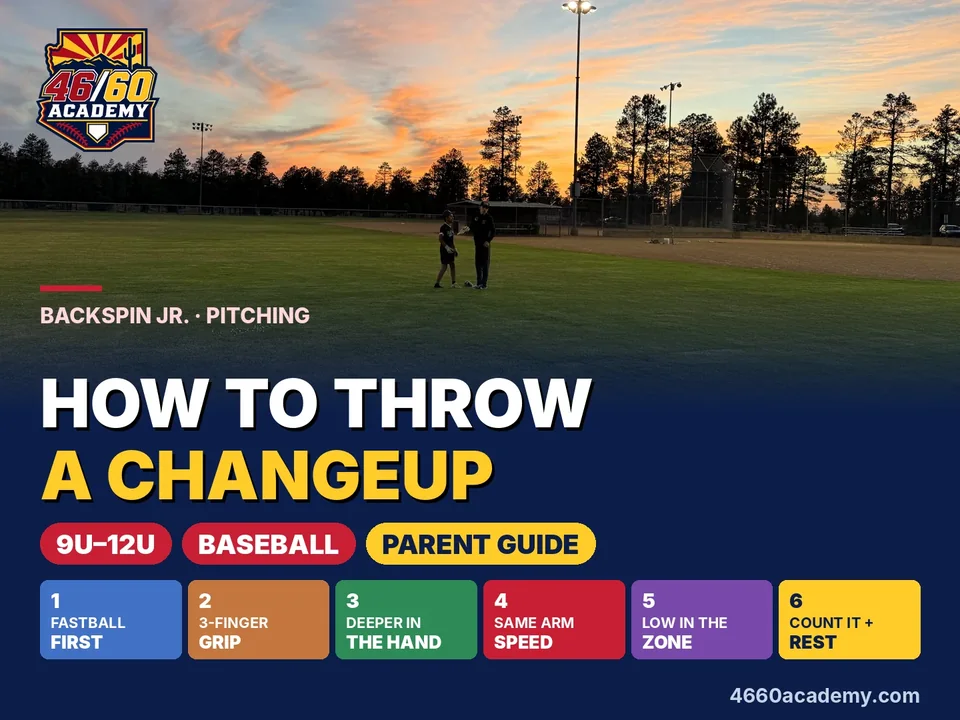
To teach a kid to throw a changeup, have them hold the ball deeper in the hand with three fingers on top and throw it with the same arm speed as the fastball, so the grip does the slowing down. Start only once your young pitcher can locate the fastball, and count every changeup as a pitch. Here's when to start, how to hold it and how to practice it without adding stress to a young arm.
To throw a changeup, a kid holds the ball deeper in the hand, often with three fingers on top, and throws it with the same arm speed and motion as the fastball. The grip slows the ball down, not the arm. Start once they can locate the fastball, and count changeups in their pitch count.
Train it: Command & Composure (Level 2 Pitching) → Free: Free pitching skill guide →When is a kid ready to learn a changeup?
The fastball comes first. A pitcher who can't throw a fastball for strikes won't get much from a second pitch. Doctors at the Hospital for Special Surgery advise young throwers to focus on locating the fastball before learning off-speed pitches, and to learn a changeup instead of throwing every pitch as hard as they can.
Signs your player is ready:
- They throw most fastballs near the catcher's glove, not just over the plate.
- They repeat the same motion pitch after pitch.
- They pitch in kid-pitch games, and hitters are starting to catch up to the fastball.
- They have no arm pain and follow their pitch-count and rest rules.
For many kids, that lands somewhere around 9 to 12. Wait on curveballs and sliders. The changeup is the off-speed pitch to learn first.
What changeup grip works for small hands?
Big leaguers often use a circle change, but small hands usually can't make that circle and still control the ball. Start with the three-finger changeup.
- Three fingers on top: index, middle and ring fingers spread across the top of the ball, across the seams.
- Thumb underneath: right under the middle finger, with the pinky resting on the side.
- Deeper in the hand: the ball sits farther back toward the palm than the fastball, instead of out on the fingertips.
- Relaxed grip: firm enough to control, loose enough that the hand isn't squeezing.
That's it. More fingers and more palm on the ball take away some speed on their own. Your player does not need to twist the wrist or flip the hand. Trying to "make it slow" with the wrist is how kids start hurting their arm or tipping the pitch.
Why should a changeup use the same arm speed as the fastball?
A changeup works because it looks exactly like a fastball. Same windup, same stride, same arm speed. The hitter gets ready for a fastball, and the ball shows up a little later.
The most common mistake is slowing the arm down to make the pitch slow. Hitters see that right away. Tell your player: "Throw it like your fastball. Let the grip do the work."
Coach BK puts it this way: "Belief is the most powerful human force." For a young pitcher, that means trusting the grip and throwing it with full arm speed, even when it feels like it will float.
How do I teach a kid a changeup step by step?
Learn it in easy catch first, not off the mound.
- Warm up fully with easy throwing first.
- Changeup catch (5 minutes): at a short distance, play catch using only the changeup grip at normal effort. Look for a ball that comes out straight and arrives softer.
- Mix it in (5 minutes): in a flat-ground bullpen, alternate fastball, changeup, fastball. Watch whether the arm looks the same on both.
- Call it out: the catcher calls the pitch, the pitcher throws it. Ten to fifteen changeups in a session is plenty while learning.
Every changeup is a pitch. Follow MLB and USA Baseball's Pitch Smart guidelines and your league's pitch-count and rest rules, and count bullpen changeups as throwing. Stop right away if the arm hurts, and check with your pediatrician if pain comes back.
When should a kid throw a changeup in a game?
Your player's coach will call or guide pitches, but here are good starter rules for kids:
- Ahead in the count is a great time, like 0-1 or 1-2.
- After a few fastballs, once the hitter has seen speed.
- Low in the zone. A high changeup is just a slow pitch to hit.
- Not too often. It works because it's a surprise. The fastball is still the main pitch.
For more age-right pitching work, try our free pitching skill guide. When you want a full plan, Command & Composure is our 16-session Level 2 pitching program for players 7–12, included in the $25/month 46/60 membership.
One thing to remember
A kid's changeup is a fastball with a different grip: same motion, same arm speed, and the grip does the slowing down.
What to do this week
Spend five minutes of two catch sessions using only the three-finger grip at a short distance. If the ball comes out straight with a normal arm, mix a few into the next flat-ground bullpen.
Parent questions
What age should a kid learn a changeup?
A kid is usually ready to learn a changeup once they can locate the fastball and repeat their motion, often somewhere around 9 to 12. The changeup is a better first off-speed pitch than a curveball.
Is a changeup safe for young pitchers?
A changeup thrown with the same motion as the fastball is the usual first off-speed pitch for young pitchers. Don't twist the wrist to make it slow, follow your league's pitch-count and rest rules, and stop if the arm hurts.
Why is my kid's changeup too fast?
A changeup that comes in too fast usually means the ball is still out on the fingertips. Move the ball deeper in the hand, spread three fingers across the top and keep the arm speed the same so the grip slows it down.
SEE COMMAND & COMPOSURE (LEVEL 2 PITCHING) →
Sources: Hospital for Special Surgery — Tips for Young Baseball Pitchers to Avoid Injury · MLB Pitch Smart — Pitching Guidelines, Ages 9–12