
Your league just sent the sign-up email, and there it is: coach pitch or kid pitch? Maybe your 8-year-old's friends are moving up, or the coach thinks they could play up. It's a big step, and it's fair to wonder if your child is ready.
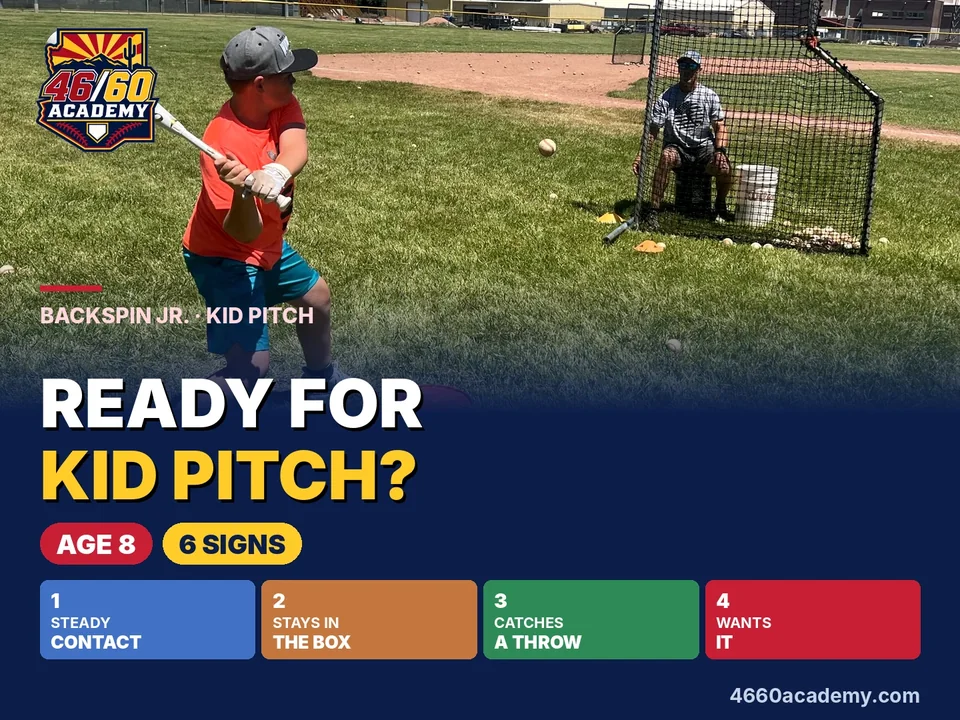
An 8-year-old is usually ready for kid pitch when they make steady contact against coach or machine pitch, catch a thrown ball reliably, stay in the box without bailing out and actually want to face real pitchers. If several of those are still shaky, another season of coach pitch is a smart choice, not a step back.
Train it: Complete Contact Builder (Level 2 Hitting) → Free: Free Hitting Intro Course →What changes when kids start kid pitch?
In coach pitch, a friendly adult tries to hit the bat. In kid pitch, another kid is trying to throw strikes, and that changes the whole game.
- Pitches are less predictable. Some are fast, some are slow, some are nowhere near the plate.
- Hitters get hit sometimes. Young pitchers are still learning control, so a pitch will find a hip or an arm now and then.
- More walks and strikeouts. Games can move slower, and kids spend more time standing in the field.
- The catcher matters. Someone has to catch real pitches, in full gear, inning after inning.
Leagues set this up differently. Little League, for example, lets each local league decide which ages play coach pitch, machine pitch or player pitch, and some 8-year-olds play up while others stay down. Check your league's rules and ask the age-group coordinator how your league does it.
Six signs your 8-year-old is ready for kid pitch
- Steady contact. They put the ball in play in most at-bats against coach or machine pitch, not just once in a while.
- They stay in the box. When a pitch comes inside, they turn away instead of stepping toward the dugout on every pitch.
- They catch a throw. They can catch a firm throw from a teammate most of the time. In kid pitch, the ball comes at them faster on defense too.
- They track the ball. They can tell a ball over their head from a strike and don't swing at everything.
- They can handle a bad day. A strikeout or a walk doesn't ruin the whole game.
- They want it. They talk about pitching or facing real pitchers. This one matters more than parents think.
Five or six of these? They're probably ready. Three or four? Talk with the coach. Fewer than three? One more year of coach pitch will help, and it's not a failure.
How to test it before tryouts
You can learn a lot in a few backyard sessions. Use a soft ball like a tennis ball or a safety ball to keep it low-stress.
- Firm front toss. From a safe distance behind a screen or net, toss firm pitches and mix speeds. Watch whether they stay balanced and keep swinging, or start backing out.
- Turn-away practice. Toss a soft ball gently at the back shoulder or hip. Teach them to tuck the chin and turn their back toward the pitch. Ten easy reps take a lot of fear out of getting hit.
- Catch check. Play catch from a comfortable distance and back up a few steps at a time. Count how many catches in a row they make.
Coach BK tells hitters moving up: "The ball ain't changing shape, I promise ya that." It's the same ball and the same swing, it just comes from a kid instead of a coach.
Should my 8-year-old pitch too?
Kid pitch also means some 8-year-olds will pitch. That's fine as long as it stays fun and safe. MLB's Pitch Smart guidelines for ages 8 and under focus on athleticism, fun and learning the game, and recommend warming up properly, following pitch-count and rest rules, and sticking to fastballs and changeups.
- Warm up before every throwing session, starting close.
- Follow your league's pitch-count and rest rules, and keep a simple log at home too.
- Avoid pitching for more than one team at the same time.
- If the arm hurts, stop. Pain is a reason to rest and see a doctor, not to push through.
What if my child isn't ready yet?
Staying in coach pitch one more year is a great plan for a lot of 8-year-olds. They get more swings, more balls in play and more confidence, which is exactly what kid pitch will need.
Use the year to build contact. Tee work, soft-toss and front toss three short times a week will make a big difference by next spring. When your child does step in against a real pitcher, remind them of another BKism: "You got a bat, pitcher's got a ball… I'd bet on you every time!" That means the hitter has the advantage, so step in ready to swing.
One thing to remember
Readiness for kid pitch is about contact, confidence and catching, not your child's birthday or what their friends are doing.
What to do this week
Do the three backyard tests above with a soft ball and count how many of the six signs your child shows. Then ask your league coordinator how coach pitch and kid pitch are split for 8-year-olds.
Parent questions
What age do kids start kid pitch in baseball?
It depends on the league. Some leagues start player pitch at 8 and others at 9 or 10, and local leagues often decide who plays up. Check your league's rules.
Is it bad to keep my 8-year-old in coach pitch another year?
No. Another year of good swings and success builds the contact and confidence kid pitch needs. Many kids move up the next season with a lot less fear.
What if my child is scared of getting hit by a pitch?
That's normal. Practice turning away from soft tosses at home, use soft balls at first and praise them for staying in the box, not just for hits.
SEE COMPLETE CONTACT BUILDER (LEVEL 2 HITTING) →
Sources: Little League Baseball divisions (minor league coach-pitch, machine-pitch and player-pitch options) · MLB Pitch Smart: Pitching guidelines, ages 8 and under