
Nine is a big pitching year. For a lot of kids it is the first season pitching to real hitters, and the mound suddenly feels very far from the plate. The good news: a few short drills, done often, help most 9-year-olds throw more strikes without wearing out the arm.
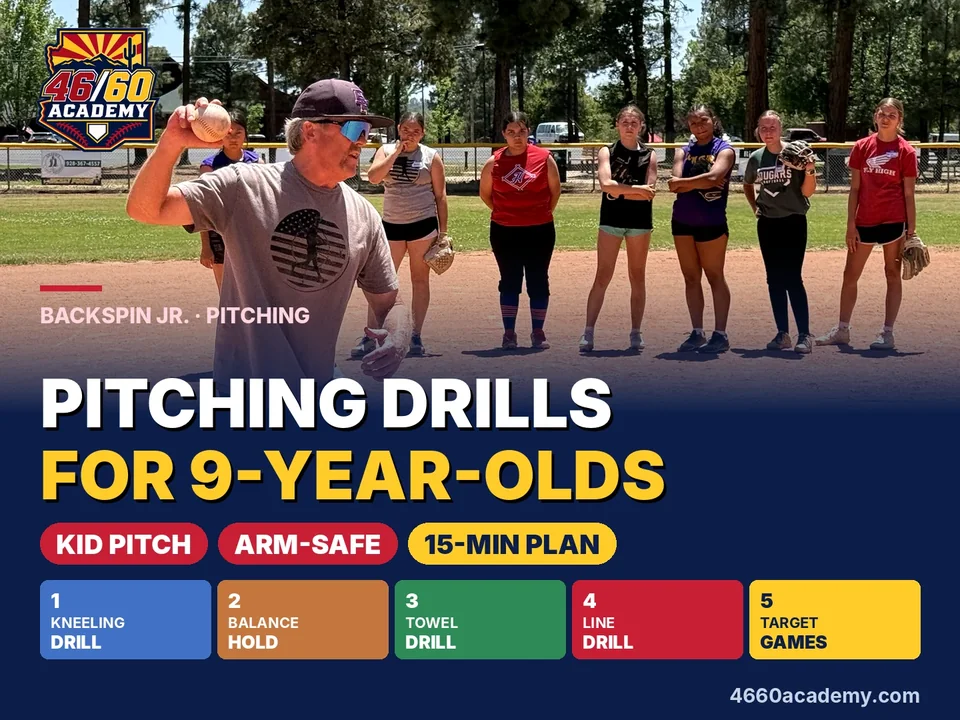
The best pitching drills for 9-year-olds are short and simple: a kneeling drill, a balance hold, the towel drill, a straight-line stride drill and target games. Throw fastballs and changeups only, keep sessions to about 15 minutes, follow your league's pitch-count and rest rules, and stop if the arm hurts.
Train it: Command & Composure (Level 2 Pitching, $49) → Free: Free Pitching Intro Course →Before any drill: protect a 9-year-old arm
At 9, the arm is still growing. Pitch Smart, the youth pitching guidelines from MLB and USA Baseball, is clear on a few things for ages 9 to 12. We follow them in every session.
- Fastballs and changeups only: Pitch Smart says to avoid other pitches at this age. No curveballs.
- Count every pitch: follow your league's pitch-count and rest rules, and count practice and backyard pitches too.
- Don't stack jobs: Pitch Smart advises against catching while not pitching and against playing for more than one team at the same time.
- Take time off: plan several months a year with no throwing at all.
- Stop if it hurts: arm pain is a stop sign, not something to push through. If it doesn't go away, call your pediatrician.
Warm up every time with a light jog, arm circles and easy, short throws before any pitching drill.
Drills 1 and 2: the kneeling drill and the balance hold
These two drills split the delivery in half. One works the arm path and aim. The other works the legs and balance.
- Kneeling drill: your child kneels on the throwing-side knee, about 20 feet from a partner, with the glove side pointed at the target. They show the ball, then throw easily to the partner's chest and finish with the throwing hand outside the front knee. Ten throws.
- Balance hold: from the mound or flat ground, lift the front knee and freeze for a count of three, like a flamingo. Head over the back foot, eyes on the target. No throw yet. Five holds, then five holds that finish with an easy throw.
What to look for: the glove side stays pointed at the target, and the player does not tip forward or fall off the back side. If they wobble, lower the knee lift a little. Balance beats a big leg kick.
Drills 3 and 4: the towel drill and the line drill
These two drills teach the body to go straight at the plate, which is where most strikes come from.
- Towel drill: your child holds the corner of a hand towel like a ball and goes through a full, easy delivery. A parent kneels about one long stride out and holds a glove up as a target. The goal: snap the towel into the glove with a good finish. No ball, so the arm gets reps without the stress of throwing. Ten reps.
- Line drill: lay a jump rope or a strip of tape on the ground from the pitcher's back foot toward the target. The game: the stride foot lands on or just beside the line. Ten pitches at easy effort.
A stride that lands way off the line pulls the ball off target. Fix the feet and the strikes usually follow.
Coach BK likes to say, "Belief is the most powerful human force." For a 9-year-old pitcher, that means confidence on the mound comes from the reps they put in at home, not from a pep talk in the middle of an inning.
Drill 5: target games that make strikes fun
Kids pitch better when they aim at something small. Hang a towel on a fence, tape a square on a net, or have a parent catch with the glove held still.
- Three-strike game: throw until you land three strikes. Count how many pitches it took and try to beat that number next time.
- Corner to corner: the catcher moves the glove to a new spot every pitch. Hitting the glove earns a point.
- Fake at-bat: a parent calls balls and strikes, out loud, like an umpire. Ball four ends it, strike three is a win. It makes the game real without a batter.
Praise one thing per session, like "great balance" or "right on the line," and let the misses go. A miss is just information.
A 15-minute pitching practice for a 9-year-old
Run this two or three times a week on non-game days, with rest days between. Keep the pitch total light and count it.
| Minutes | Drill | Look for |
|---|---|---|
| 0–4 | Warm up and easy catch, short distance | Loose arm, soft throws |
| 4–6 | Kneeling drill | Glove side to the target |
| 6–8 | Balance hold | Freeze for three, head over back foot |
| 8–10 | Towel drill | Long stride, strong finish |
| 10–15 | Line drill into a target game | Foot on the line, ball at the glove |
Want a guided start? Our free Pitching Intro Course covers balance, targets and safe habits in seven short lessons. When your pitcher wants more, Command & Composure ($49) is our four-week, 16-session Level 2 pitching program for ages 7–12, built around routines, target control and smart workload habits.
One thing to remember
At 9, chase balance, a straight line to the plate and strikes, and protect the arm before chasing speed.
What to do this week
Do the 15-minute plan twice on non-game days and write down the three-strike game score each time. Count every pitch, including backyard throws.
Parent questions
Should a 9-year-old throw a curveball?
No. Pitch Smart recommends that pitchers ages 9 to 12 throw only fastballs and changeups. A good fastball for strikes is the whole job at this age.
How often should a 9-year-old practice pitching?
Two or three short sessions a week on non-game days is plenty for most kids. Count every pitch, follow your league's rest rules and give the arm days off.
Why does my 9-year-old throw so many balls?
The usual reasons are losing balance, striding off line or trying to throw too hard. Shorten the distance, slow down to easy effort and use the balance and line drills.
SEE COMMAND & COMPOSURE (LEVEL 2 PITCHING, $49) →
Sources: MLB & USA Baseball Pitch Smart — Pitching Guidelines, Ages 9–12