
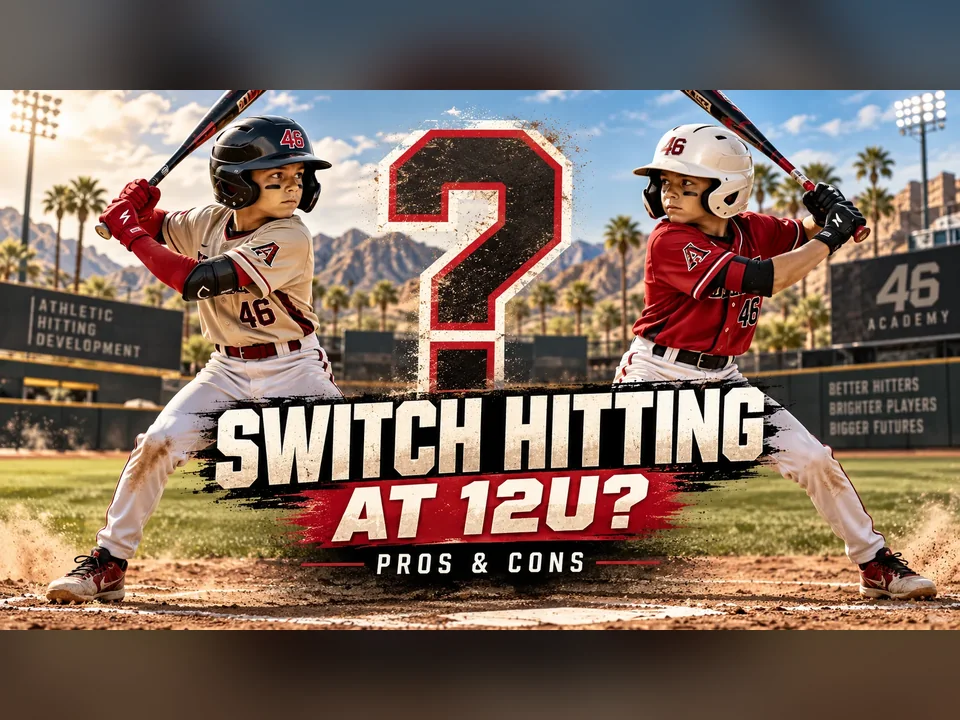
Every parent has watched a great switch hitter and thought, wouldn’t that be something if my kid could do that? It would. But learning to hit well from ONE side is already a big job for a 10-, 11- or 12-year-old. Two sides means two swings, two timing patterns and more to think about.
Let your 12U player try both sides for fun, and only commit to switch hitting if they enjoy it, show progress against moving pitches, and their stronger side keeps improving. One good swing beats two poor swings.
Train it: Level 2 Complete Contact Builder ($49) → Free: Free Hitting Intro Course →What are the pros of switch hitting at 12U?
- A better look at the pitcher. Hitting from the side opposite the pitcher’s arm can make the release and the ball’s movement a little easier to see. For most 12U hitters, seeing the ball and getting ready on time still comes first.
- More all-around coordination. Balancing, rotating and controlling the bat in both directions is a fun coordination challenge, even if switch hitting never becomes the game-day plan.
- A step closer to first base. Left-handed batters start a little closer to first. But a right-handed line drive still beats a weak left-handed grounder.
- Future flexibility. When both swings are truly competitive, a hitter can pick a side as the pitching changes. Owning two batting gloves isn’t the same thing.
- A great age to explore. Backyard Wiffle ball, tee rounds and a little opposite-side practice help kids find out whether it feels natural and fun.
What are the cons parents should know?
- Practice time gets split. Your hitter still needs balance, an athletic setup, a good gather and stride, a repeatable launch and control of the bat. Two sides can spread a short practice too thin.
- The main swing may still need work. If contact from the natural side isn’t consistent yet, give that swing a chance first.
- Timing isn’t automatic. The tee is patient; the pitcher isn’t. The new side has to learn to see it, time it, decide and attack it too. Tee success isn’t game readiness.
- Confidence can take a hit. A kid who hits well righty may feel helpless lefty against good pitching. Struggle is fine when the plan is clear, not when adults push game at-bats too soon.
- It can stop being fun. Some kids can’t get enough batting practice. Others want to field, run and play with friends. A second swing shouldn’t swallow the whole season.
Is my child ready? Coach BK’s green-light test
| Light | What you see | What to do |
|---|---|---|
| Green | Good fundamentals on the main side, natural coordination on the new side, real interest and time to practice. | Run a serious but low-pressure 30-day trial. |
| Yellow | The new side looks fun but only works off a tee. | Keep it in the backyard for now. |
| Red | Frustrated, struggling to control the main swing, or not interested in the extra work. | Build the main swing first. |
How do we try switch hitting without hurting the main swing?
Run a simple 30-day experiment. Keep the main swing in every practice, and add the new side in short, fun rounds.
- Week 1, film both sides. Check balance and whether the bat finds the ball on a tee. Ask your child how each side feels.
- Week 2, easy contact. Short rounds of Wiffle ball or easy front toss from the new side, using soft balls and plenty of space.
- Week 3, add timing. Change the speed and spot of your tosses, only if your child is succeeding and having fun.
- Week 4, decide together. Is contact improving on the new side? Is the main swing still getting better? Does your player want to keep going?
Thirty days is a trial, not a deadline. There’s no rush to take a brand-new swing into games. Our earlier guide, Should my child switch-hit or bat lefty?, helps you figure out which side is your child’s natural one first.
What happens after 12U?
Don’t push switch hitting because you think a future high school coach will love it. Those coaches want players who can really HIT. Build the hitter before building the switch hitter.
As your player moves to bigger fields and better pitching, the question changes: a second side has to hold up against real speed and movement. For players 13 and up, our partner site Athletic Hitting Development has the next step, Switch Hitting From 12U to High School: When Two Swings Make Sense.
One thing to remember
One good swing beats two poor swings, so build the hitter before the switch hitter.
What to do this week
Film one easy tee round from each side and ask your child which felt better. If the new side looks balanced and they want more, start Week 1 of the 30-day trial; if not, enjoy it as a backyard game.
Parent questions
Should every 12U baseball player learn to switch hit?
No. It’s an option for some players, not a requirement for becoming a good hitter.
Should my child switch hit in games right away?
Usually not. Start with low-pressure practice and work up to solid contact against moving pitches before trying game at-bats. Check your league’s rules for any batting-side questions.
Does practicing switch hitting improve coordination?
Practicing from both sides can challenge coordination, but it doesn’t guarantee better game hitting from either side.
YOUR NEXT STEP · YOUTH HITTING
The free Swing Check finds the one thing to work on first, in about 3 minutes.
Try Complete Contact Builder Lesson 1 free →Part of: Youth hitting drills by age →