
At 12U, double plays start showing up in real games, in both baseball and fastpitch. They look fast and fancy, but they're built from simple pieces: a good feed, a clean touch of the base and a safe throw. Here's how to teach them to 11- and 12-year-olds.
The best double play drills for 12U teach the pieces in order: short underhand and backhand feeds, catching the ball at the base, touching the bag and stepping clear of the runner, then a quick throw to first. Practice them slow and close first, then add runners and game speed, and always get the first out.
Train it: Complete Defender (Level 2 Fielding) → Free: Free Fielding Intro Course →Should 12U players work on double plays?
Yes, once they can field a routine ground ball and throw it on target. A double play is just two good plays in a row. If the first one isn't solid yet, spend more time on grounders and throws, and come back to the turn later.
The number one rule: get one sure out. A rushed throw that ends up in the dugout turns a double play chance into runners on second and third. Coach BK's line fits here: "Two choices: A. Do everything in your control. B. Anything but A." For a 12-year-old, that means knowing the outs and the runners before the pitch, so the feet are already moving the right way when the ball is hit.
The three feeds every middle infielder needs
The feed is the throw from the fielder to the player covering second. USA Baseball content on Little League University describes working on underhand feeds from about 20 to 30 feet and shorter overhand throws from a bit farther. Keep it simple for 12U:
- Underhand flip: when the fielder is close to the bag. Show the ball, keep the wrist firm and follow the toss a step toward the base.
- Backhand toss: for a fielder who gets the ball close to the bag on the glove side, with no time to turn. Short, firm, chest high.
- Short overhand throw: when the fielder is too far away to flip. Quick, chest high, no big wind-up.
- The goal for all three: a firm, chest-high ball that reaches the partner just as they get to the bag.
How should a 12-year-old turn two at second?
Get to the base early, hands ready at the chest, and catch the ball first. Then touch the bag with a foot and step off to the side, away from the runner's path, before throwing to first. Your coach may teach a different footwork pattern, and that's fine. What matters is catch, touch, clear, throw.
Safety comes first here. Players should never stand on top of the base waiting to get hit. Sliding and contact rules near second base differ by league and age group, so check your league's rules and teach your player what applies. In fastpitch, the same steps work, and the bigger ball makes a clean two-hand catch even more important.
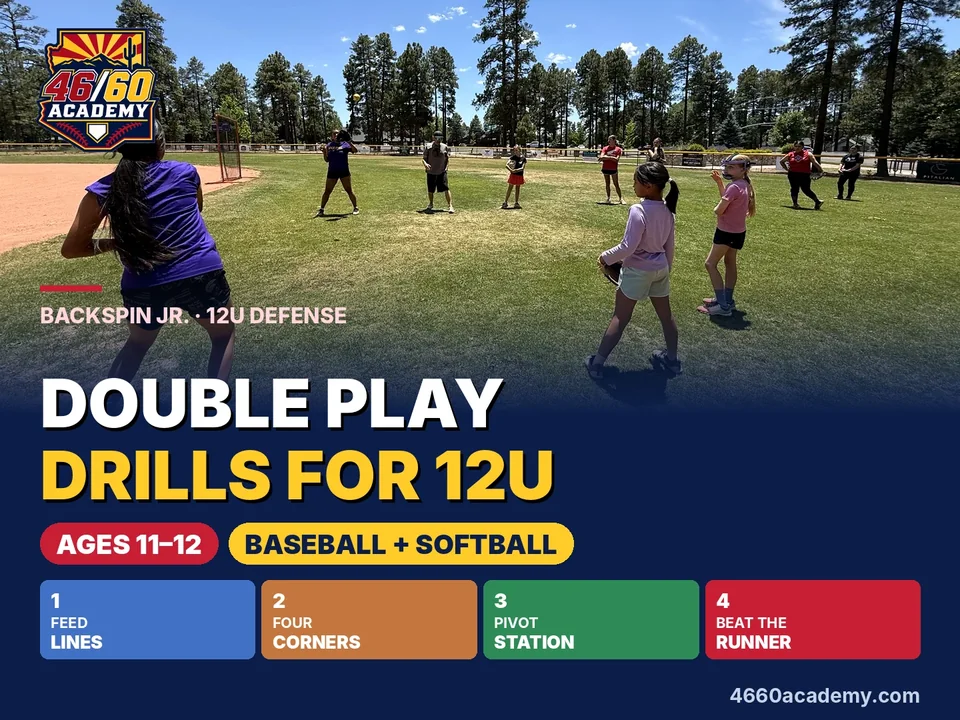
Five double play drills for 12U practice
- Feed lines (5 minutes): two lines 20 to 30 feet apart, one at a base. Roll the ball to the fielder, who flips or tosses to the partner at the bag. Count good feeds in a row.
- Four corners (5 minutes): a player at each corner of a small square. Throw around the horn, then reverse, mixing flips and short throws. USA Baseball content calls this one of the most useful infield drills.
- Pivot station (5 minutes): no hitting. A coach tosses to the player covering second, who catches, touches the bag, steps clear and throws to a target at first.
- Half-speed turns (5 minutes): a coach rolls or hits soft grounders to short and second. Fielders turn the whole play at half speed. Add a first baseman.
- Beat the runner (5 minutes): add a runner from home to first. Both teams try to win. Keep a runner going to second only when your coach can supervise and players know the safety rules.
Run these as stations so nobody stands in line. A little stopwatch competition, like timing the ball around the infield, keeps 12-year-olds locked in.
How can we practice double plays at home?
You don't need a full infield. A base or a towel in the yard, a parent and a soft ball are enough. Use soft or safety balls near people and windows.
- Flip and follow: roll a grounder; your player fields and flips it to you at the "base." Ten good flips in a row wins.
- Catch, touch, step: toss to your player at the towel. They catch, touch it, step to the side and throw to a bucket.
- Call it first: before every rep, say the outs and runners out loud. Your player tells you if it's a double play chance or a "get one" play.
Ten to fifteen minutes is plenty, and stop if the arm gets sore. Want a full four-week plan for glove work, feeds and footwork? Complete Defender is in the $25/month 46/60 Academy membership, and lesson 1 is free. Just starting out? The free Fielding Intro Course builds the ground ball basics first.
One thing to remember
Every double play starts with one sure out, so catch it first and throw it second.
What to do this week
Do five minutes of Flip and Follow on two days this week. On the third day, add Catch, Touch, Step and count how many clean throws to the bucket your player makes in a row.
Parent questions
At what age do kids start turning double plays?
Most kids start making them in games around 11 or 12, once they field and throw routine grounders on target. Younger players can learn feeds as a fun drill without pressure to turn two in games.
Who covers second base on a double play?
Usually the shortstop covers when the ball is hit to the right side, and the second baseman covers when it's hit to the left side. Your coach may adjust this, so ask what your team does.
Are double plays different in softball?
The pieces are the same: feed, catch, touch, clear and throw. Fastpitch moves quickly, so many 12U softball teams focus on getting the sure out first, and rules vary, so check your league's rules.
SEE COMPLETE DEFENDER (LEVEL 2 FIELDING) →
Sources: Little League University — Infield Drill Progression (content provided by USA Baseball) · Little League University — Team Drills Are Beneficial at Any Age