
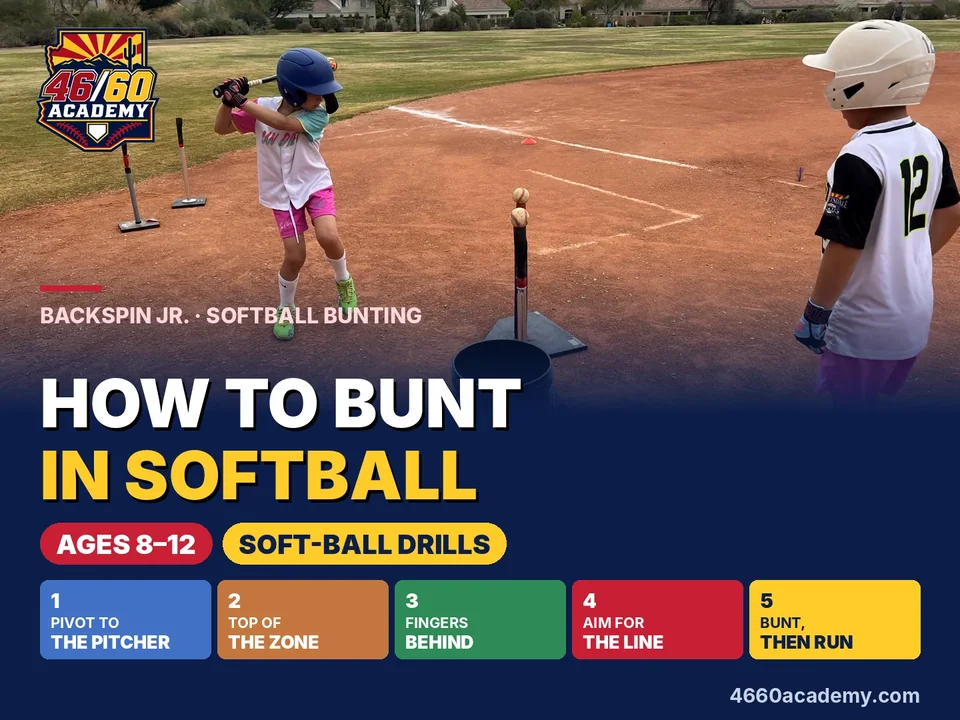
To bunt in softball, a young player pivots to face the pitcher, holds the bat at the top of the strike zone with the fingers safely behind it, and lets the ball hit the bat softly toward a baseline. Bunting is a bigger part of softball than baseball, so many 8U to 12U players are asked to bunt early. The pitcher is closer, the infield is smaller, and a good bunt puts real pressure on the defense.
To bunt in softball, pivot so your chest faces the pitcher, hold the bat at the top of the strike zone with the barrel slightly higher than the handle, and keep your fingers behind the bat. Bend your knees for low pitches, let the ball hit the bat softly, and aim it down a baseline, away from the pitcher.
Train it: Complete Contact Builder (Level 2 Hitting) →How is bunting in softball different from baseball?
The basic idea is the same: catch the ball with the bat. But softball changes a few things.
- Less time: the pitcher is closer, so the ball gets there fast. Your daughter needs to get into her bunting stance a little earlier.
- Charging corners: softball first and third basemen often play in close and charge hard. A bunt that's too firm goes right to them.
- More bunts: bunts are a regular part of the softball game, not a rare play. Many teams bunt to move runners or just to get on base.
- Rules vary: some younger divisions limit bunting. Check your league's rules.
Later, some players also learn the slap. That's a separate skill, and our post on slap hitting for 12U softball covers when it makes sense.
How do I teach a kid to bunt in softball step by step?
- Pivot: keep the feet where they are and turn on the balls of the feet so the chest and hips face the pitcher. Some coaches teach squaring around instead; both work. The pivot is quicker, which helps in softball.
- Bat at the top of the zone: hold the bat out in front at the top of the strike zone, barrel a little higher than the handle.
- Safe hands: bottom hand on the handle. The top hand slides up toward the barrel and pinches the bat, thumb on top and fingers behind it, never wrapped around the front.
- Knees bent: for a low pitch, bend the knees to go down with it. Don't just drop the barrel.
- Soft catch: let the ball hit the bat and give a little, like catching an egg.
Here's the top-of-the-zone rule: if the pitch is above the bat, it's high. Pull the bat back and take it.
Where should a kid bunt the ball?
Aim it down the first-base line or the third-base line, slow enough to die in front of the charging corners. The goal is to make a fielder move. A bunt right back to the pitcher is the easiest out on the field.
Standing near the front of the batter's box can help a bunt stay fair. Then the order matters: bunt it first, run second. A player who starts running before the ball hits the bat usually bunts it foul or pops it up.
Coach BK has a line that fits bunting perfectly: "Pitchers are basically pizza delivery guys." For a young softball player, that means the pitcher is just delivering the ball. Get set early and be ready when it shows up.
What are good softball bunting drills for kids?
Use foam or soft training softballs, toss underhand from a short distance, and make sure she wears her batting helmet (with a face guard if your league requires one).
- Catch it: she starts in the bunting stance. You toss strikes and she "catches" each ball on the bat so it drops in front of the plate. Ten tosses.
- Take or bunt: mix high tosses with strikes. High ones, she pulls the bat back. Strikes, she bunts. A point for every right choice.
- Lane targets: lay two towels or hula hoops a few steps up the first- and third-base lines. Call a side before each toss. Points for bunts that stop in the target.
- Bunt and go: she bunts a toss, then sprints hard through first base. This builds the habit of bunting first, running second.
Ten minutes, two or three times a week, is plenty. Stop if anything hurts, and keep it fun.
What are common softball bunting mistakes, and how do you fix them?
- Jabbing at the ball: she pushes the bat at the pitch. Fix: "catch it," and keep the bat still.
- Popping it up: the bat started below the ball. Fix: start at the top of the zone and only bunt pitches below the bat.
- Fingers in danger: top-hand fingers wrapped around the bat. Fix: pinch the bat, thumb on top, fingers behind.
- Bunting with two strikes: in most leagues a foul bunt with two strikes is a strikeout. Check your league's rules and listen to the coach's sign.
Want a coach-built path? Complete Contact Builder, our Level 2 hitting program for baseball and softball, is 16 guided sessions, in the $25/month 46/60 Academy membership.
One thing to remember
A softball bunt is a soft catch with the bat at the top of the zone, aimed away from the pitcher.
What to do this week
Practice the pivot and the safe grip ten times in the living room with no ball. Then play "take or bunt" with soft balls for ten minutes, two days this week.
Parent questions
What age should a softball player learn to bunt?
Many girls can start learning the basics around 7 or 8 with soft balls. Check whether your league allows bunting at your daughter's age.
Should my daughter pivot or square around to bunt?
Both work. The pivot is quicker to get into and easier for many young players, which helps with the shorter softball pitching distance. Follow what her team coach teaches.
Can you bunt with two strikes in softball?
You can, but in most leagues a foul bunt with two strikes is a strikeout. Check your league's rules and follow your coach's sign.
SEE COMPLETE CONTACT BUILDER (LEVEL 2 HITTING) →
Sources: Little League University (content from USA Baseball): Bunting 101, The Bunting Progression · Coaches Insider: Quick Tips to Improve Bunting Skills (softball) · Team USA (USA Softball): Keys to the Short Game