
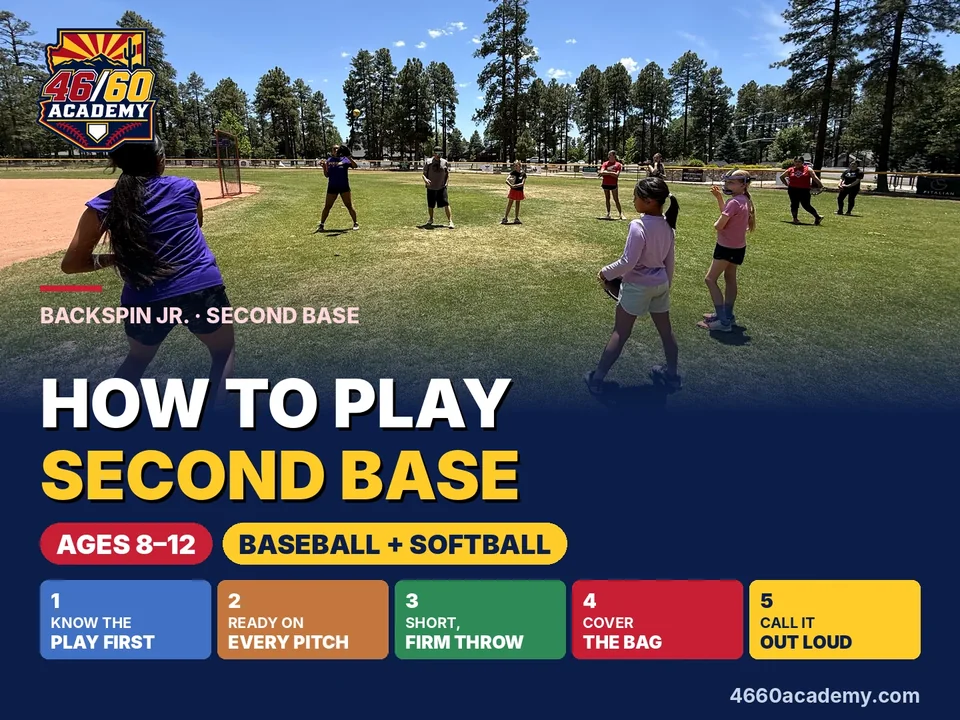
To play second base, a kid stands between first and second, a little closer to second, gets ready on every pitch and knows where to go before the ball is hit. The job comes down to four things: field it, make the short throw to first, cover a base and help on throws from the outfield. Second base is a great spot for 8- to 12-year-olds to learn the game, and here's how to practice it at home in baseball and softball.
A second baseman stands between first and second base, a little closer to second, gets ready on every pitch and knows ahead of time where to go if the ball is hit. The four jobs are fielding grounders and pop-ups, making the short throw to first, covering a base, and helping on throws from the outfield.
Train it: Complete Defender (Level 2 Fielding) →Where does a second baseman stand?
The second baseman plays between first base and second base, a little closer to second, usually toward the back of the infield dirt. That's how MLB describes the spot, and it's a fine starting point for kids too. Younger or newer players can move a few steps in, so they have time to get to the ball and a shorter throw.
Your child's coach may shift them around for different hitters. That's normal. The habit to build is simple: look at where you're standing before every pitch, and know which way you'll move.
Second base is a good fit for a player who moves well side to side and catches the ball cleanly. Because the throw to first is short, it doesn't take the strongest arm on the team. It does take a player who pays attention.
What are the four jobs of a second baseman?
- Field it: ground balls and pop-ups hit to the right side of the infield. Get in front of the grounder when you can and use two hands.
- Throw it: the throw to first is short, so there's no need to rush or throw it hard. Set your feet, point your front shoulder at first and make a firm, chest-high throw. When you're very close, a soft underhand toss is fine.
- Cover a base: sometimes your job is to go stand at a base and catch a throw. On a bunt, for example, the second baseman often runs to cover first while the first baseman charges the ball.
- Help on throws from the outfield: when the ball goes to right field or the right-center gap, the second baseman often goes out to be the target for the outfielder's throw, then turns and throws it in.
Who covers which base on steals, bunts and hits to the outfield changes by team and age group. Ask your coach how your team does it, and practice that.
What should my kid think about before each pitch?
This is where good second basemen are made. Before the pitch, your player should know three things: how many outs there are, where the runners are, and where the ball goes if it's hit to them. Coach BK says it this way: "Two choices: A. Do everything in your control. B. Anything but A." For a 9-year-old, that means doing the thinking before the pitch, so their feet know where to go when the ball is hit.
Then get ready as the pitcher starts. Feet a little wider than the shoulders, knees bent, weight on the balls of the feet, glove out front and open. A small step or hop forward as the pitch reaches the plate helps them move fast in either direction.
And talk. Second basemen call for pop-ups ("Ball! Ball!" or "I got it!"), tell the shortstop who's covering second, and remind the team how many outs there are.
What second base drills can kids do at home or practice?
Use a soft ball or a safety ball, especially for younger players and indoors. Keep sessions short, and stop if your child's arm hurts.
- Right-left-field rolls (5 minutes): kneel 15 to 20 feet away and roll grounders a little to each side. Your player shuffles over, fields with two hands and brings the ball to the belly button. Count clean catches in a row.
- Short throw to a target (5 minutes): set a bucket or a parent at "first" about the distance of the real throw. Field, set the feet, step and throw chest high. Score a point for every throw that hits the target.
- Bunt cover race (5 minutes): on "Bunt!" your player sprints to a cone that stands in for first base, turns to face you with the glove up and catches your toss. Then do it with a ball rolled to them instead, so they practice both jobs.
- Where's the play? (5 minutes): before each roll, call out the outs and the runners. Your player says where they'll throw before you roll it. Wrong answers are fine. That's how they learn.
Is second base different in softball?
The jobs are the same: field, throw, cover and help on outfield throws. The field is smaller, so everything happens faster, and the second baseman often plays a bit closer to the batter. Covering first on bunts is a big part of the job in softball, so practice the bunt-cover race a lot.
Whatever the sport, rotate positions while kids are young. A season at second base teaches a player to think, talk and move, and that helps everywhere on the field. Want more free help? Join the American Hitting Association, a free baseball and softball membership from the same family as 46/60.
One thing to remember
A good second baseman knows the outs, the runners and their job before every single pitch.
What to do this week
Do the right-left-field rolls and the short throw drill three times this week for 10 minutes. Before each rep, ask your child the outs and where they'd throw, and let them answer out loud.
Parent questions
Is second base a good position for a beginner?
It can be. The throw to first is short, so players who catch well but don't have a big arm can do well there. It does ask a lot of thinking, so it's a great place to learn the game.
Does the second baseman cover second base on a steal?
Sometimes. On many teams the shortstop and second baseman decide based on the hitter or the coach's call. Rules and team systems vary, so ask your coach how your team handles it.
What size glove should a youth second baseman use?
Most middle infielders like a smaller glove than outfielders use, because it helps them get the ball out fast. Pick one your child can open and close easily, and ask a coach or your league for a size by age.
SEE COMPLETE DEFENDER (LEVEL 2 FIELDING) →
Sources: MLB.com Glossary — Second Baseman · Little League University — Infield Drill Progression (content provided by USA Baseball) · MOJO Sports — Softball Positions Explained