
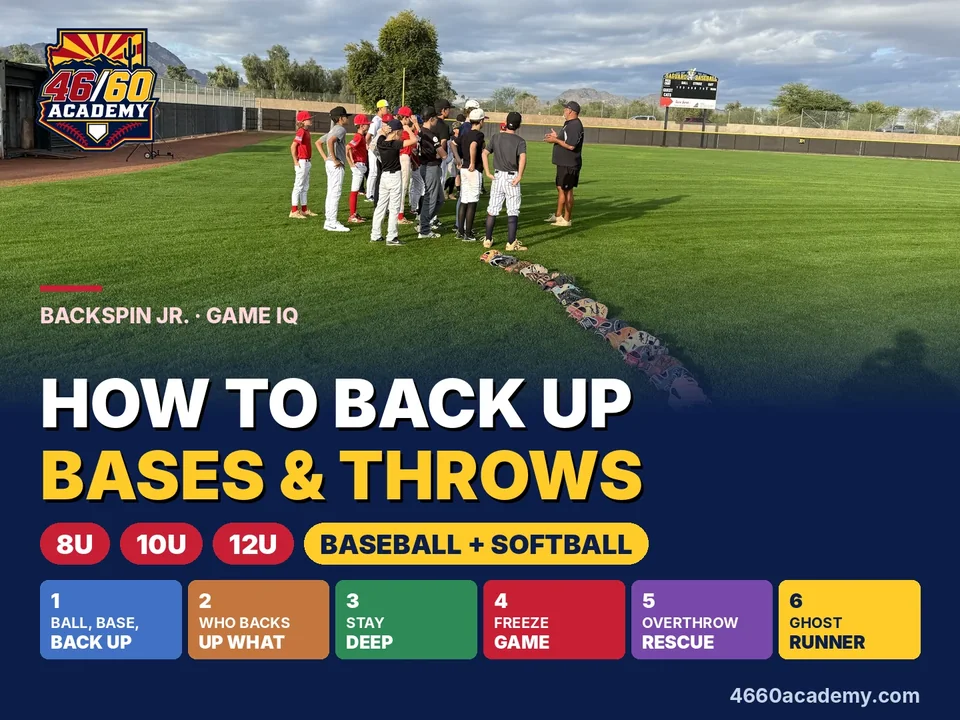
To teach kids to back up bases, give every player a job on every ball in play: one gets the ball, one covers the base and everyone else runs behind a base in line with the throw. Watch a youth game long enough and you'll see a throw sail past first and roll to the fence with nobody behind the base. Backing up is one of the easiest game-smart habits to teach, and kids love being the hero who saves the overthrow.
Teach kids that on every ball in play, one player gets the ball, one covers the base and everyone else backs up a throw. Give each position one back-up job, have them run behind the base in line with the throw and stay deep, then practice with a freeze game and soft-ball overthrow drills.
Train it: Game IQ Playmaker (Level 2 Baseball IQ) → Free: Free baseball IQ skill guide →What does backing up a base mean?
Backing up means running behind a base, or behind the player catching a throw, so that if the ball gets by, you stop it. It keeps one mistake from turning into two or three extra bases.
We teach it with three words: Ball, Base, Back up. On every ball hit, one player goes to get the ball, one player covers the base, and the rest find a throw to back up.
Backing up also gives every kid something to do on every pitch. The right fielder who might see two balls a game now has a job on almost every ground ball. That keeps kids awake, moving and part of the play.
This post is about the back-up job. Where to throw the ball and how cutoffs work are their own topics, so keep this one simple: if you don't have the ball or a base, find a throw.
Who backs up which base? A simple map for kids
Every coach adjusts this a little, and baseball and softball work the same way here. This is a good starting map for 8U–12U teams.
| Position | Main back-up job | When |
|---|---|---|
| Right fielder | Back up first base | Throws from the infield to first |
| Left fielder | Back up third base | Throws to third from the right side or the catcher |
| Center fielder | Back up second base | Steal throws and balls hit up the middle |
| Pitcher | Back up home or third | Throws coming in from the outfield |
| Catcher | Run toward first, behind the play | Ground balls with nobody on base, if your league and coach want it |
| Outfielders | Back up each other | Any ball hit to a neighbor |
For younger kids, skip the whole chart. Give each player one job for their position this week, and add a second job only when the first one is automatic.
How far back should a kid stand when backing up?
The most common mistake is standing too close. If the back-up is right behind the base, the ball that gets past the first player gets past them too.
- Get in line: stand so the base, the catcher and you are in a straight line with the throw.
- Stay deep: leave plenty of room behind the base, so you have time to react to a bounce or a deflection. On a small field, a fence may decide for you.
- Get there early: run as soon as the ball is hit. A back-up who arrives late is just a spectator.
- Be ready to stop it: glove down, body in front, knock it down first and pick it up second.
- Then look: after you stop it, find the runner and throw to the base in front of them, or run it in.
Use soft or reduced-impact balls when you practice this, since kids will be moving and the ball can take funny hops. Helmets go on anyone running the bases.
What drills teach kids to back up throws?
Kids learn backing up by moving, not by listening. Keep the talking short and the reps quick.
- Freeze game (ages 7–12): put everyone in their positions. Hit or roll a ball, let them move for a few seconds, then yell "freeze." Walk around and ask each kid, "What's your job?" Praise the kid who is in the right spot, even if they never touched the ball.
- Overthrow rescue (ages 8–12): a coach at third throws a soft ball to first, sometimes on purpose a little wide or high. The right fielder scores a point for every ball they stop. Rotate kids through right field.
- Ghost runner relay (ages 9–12): a coach calls the situation, such as "runner on first, ball to left." Hit or toss the ball and the whole team moves: ball, base, back up. Count how many kids had a job. Goal: all nine.
- Back-up tag (ages 7–8): a coach points to a base and calls "back it up!" Kids race to stand behind it in line with the coach. First one in the right spot wins the round.
Keep each drill to about five minutes and rotate kids so everyone plays the back-up spot. If a player gets hit by a bounce or has pain anywhere, stop and check on them.
For more game-smart drills by age, our free baseball IQ skill guide has 8U, 10U and 12U ideas you can run in a few minutes.
How do I get kids to move on every play?
Most kids don't skip back-ups because they're lazy. They skip them because nobody told them the play was theirs too. Make it a team value.
Coach BK says it this way: "Two choices: A. Do everything in your control. B. Anything but A." For a young player, backing up a base is one thing fully in their control, every single play.
- Name it in the dugout: after an inning, call out the kid who backed up a throw, even if the ball never came their way.
- Ask, don't tell: before a pitch, ask "Where are you going if it's hit to you? If it's not?"
- Make it a scoreboard: count back-ups in practice like you'd count hits.
Want a full plan for teaching game sense? Game IQ Playmaker is our 16-session baseball IQ program for ages 7–12, baseball and softball, and it's in the $25/month 46/60 membership.
One thing to remember
On every ball in play, every kid has a job: get the ball, cover a base or back up a throw.
What to do this week
Pick one back-up job per position and write it on a card for each player. Run the freeze game for ten minutes at your next practice, and praise every kid you catch backing up a throw.
Parent questions
Who backs up first base in youth baseball and softball?
Usually the right fielder backs up throws from the infield to first. On some teams the catcher also runs down the line behind first on ground balls with nobody on, so ask your coach about your team's plan.
What age should kids learn to back up bases?
You can start with simple versions around 7 or 8 with games like back-up tag. By 10U and 12U, most players can learn a main back-up job for their position.
Does the pitcher back up bases?
Yes. On many plays the pitcher backs up home or third when a throw comes in from the outfield. Have your pitcher practice running to foul ground behind the base, in line with the throw.
SEE GAME IQ PLAYMAKER (LEVEL 2 BASEBALL IQ) →
Sources: Baseball Positive: Ball, Base, Back-up (BBB) · Coaches Insider: Drills for the pitcher as a defensive player (backing up)