
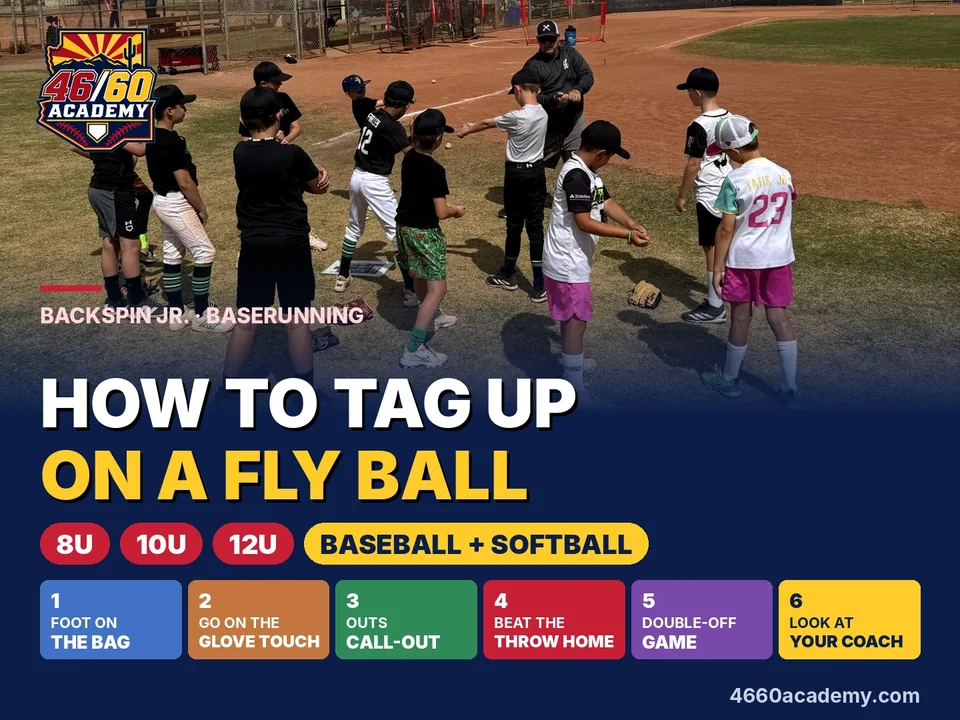
To teach kids to tag up, explain one rule: on a caught fly ball, the runner must be touching the base when the fielder first touches the ball, and then they can go. Then practice one habit, a sprinter's start with a foot on the bag. Tagging up is one of the most confusing plays for young players, but it comes down to that rule and that habit.
To teach kids to tag up, explain that on a fly ball that gets caught, a runner must be touching their base when the fielder first touches the ball, then they can run. Practice a sprinter's start with a foot on the bag, leaving on the glove touch, with fewer than two outs.
Train it: Smart Baserunner (Level 2 Baserunning) → Free: Free baserunning skill guide →What does tagging up mean in baseball and softball?
When a batted ball is caught in the air, every runner has to be touching the base they started on after a fielder first touches the ball. That is tagging up. Once they have done it, they are free to try for the next base.
If a runner leaves too early, or is off the base when the ball is caught, the defense can get the ball back to that base before the runner does. That runner is out, often called being "doubled off."
- Caught in the air: get back to your base, then you may run.
- Ball hits the ground first: no tag needed. Run if you are forced or if your coach sends you.
- Leave on the touch: the runner may go the moment the fielder's glove first touches the ball, not when the catch is squeezed.
The tag-up idea is the same in softball. Leading off and leaving early rules change a lot by age and league, so check your league's rules.
When should my kid tag up, and when should they go halfway?
This is where kids get lost. Give them a simple outs-based plan and have them say it out loud before every pitch.
| Situation | What the runner does |
|---|---|
| Two outs, ball in the air | Run hard on contact. If it's caught, the inning is over anyway. |
| Fewer than two outs, runner on third, deep fly | Get back, tag, and go when the coach says "Go!" |
| Fewer than two outs, short fly or pop-up | Stay on the base. Too short to score on. |
| Fewer than two outs, runner on first or second, fly that might drop | Go part of the way, where you can still get back if it's caught. |
| Not sure? | Look at your base coach and listen. |
Base coaches are a runner's best friend here. At 7 and 8, keep it even simpler: "Ball in the air? Look at your coach."
How do I teach a good tag-up start, step by step?
A great tag-up is not about speed alone. It's about leaving on time and not losing a step.
- Foot on the bag: keep one foot firmly on the base, body turned toward the next base like a sprinter in the blocks.
- Eyes on the ball or ears on the coach: a runner on third can often see the catch. If not, the base coach yells "Go!" when the glove touches the ball.
- First step hard: push off the base and drive the arms. No hop, no peek back.
- Listen all the way: keep running hard and listen for your coach to say "Stand up" or "Get down." Slide only if you've been taught to slide safely.
This is a habit you control, which fits one of Coach BK's sayings: "Two choices: A. Do everything in your control. B. Anything but A." For a young runner, that means being on the bag, ready and listening every single fly ball, even when nobody is watching.
What tag-up drills work at practice?
Use soft or reduced-impact balls with younger players, and helmets on every runner. Each drill takes 5 to 10 minutes.
- Glove-touch go: a coach stands 10 feet in front of third and tosses a soft ball into a fielder's glove. Runners leave on the touch. Early leavers go back to the end of the line, with a laugh, not a lecture.
- Outs call-out: the coach holds up zero, one or two fingers and yells "Fly ball!" Runners shout "Tag!", "Halfway!" or "Run!" and do it. Fast, loud and fun.
- Beat the throw home: a coach tosses or hits easy flies to outfielders while a runner tags at third. The outfielder throws to a cut or home. Both sides get reps, so keep the throws short and stop if an arm is sore.
- Double-off game: a runner leaves early on purpose now and then, and the fielders practice getting the ball back to the base. Kids learn the rule faster when they see the out.
Our free baserunning skill guide has more age-right drills you can add to these.
How much should a 7-year-old vs. a 12-year-old know?
Build it in layers so it never feels like a rulebook.
- Ages 7–8: "Caught in the air means go back." Watch the coach. Many coach-pitch games move fast, so keep it to that one idea.
- Ages 9–10: the outs plan from the table, leaving on the glove touch, and the sprinter's start at third.
- Ages 11–12: reading how deep the ball is, the arm of the outfielder, and tagging from second on a deep fly to the opposite field.
If you want a full, step-by-step plan, Smart Baserunner is our Level 2 baserunning program for ages 7–12, in the $25/month 46/60 membership. It walks through tag-ups, reads and base coach signals one short lesson at a time.
One thing to remember
Caught in the air with fewer than two outs: get back, get set, and go when the glove touches the ball.
What to do this week
Teach the outs call-out game in your backyard or at practice for five minutes. Then have your player tell you the plan before each pitch at the next game.
Parent questions
Can a runner leave before the ball is caught on a tag-up?
A runner may leave once a fielder first touches the ball, even if it is bobbled. Leaving before that touch means the defense can get them out by getting the ball to the base first.
Do you tag up on a foul ball that is caught?
Yes. A fly ball caught in foul territory is still a caught ball, so runners tag up and may then try to advance.
Is tagging up the same in softball?
The basic idea is the same: be on your base when the caught ball is first touched, then you may run. Leading and leaving-early rules vary a lot in youth softball, so check your league's rules.
SEE SMART BASERUNNER (LEVEL 2 BASERUNNING) →
Sources: Wikipedia: Tag up · Little League: Coaching the Bases