
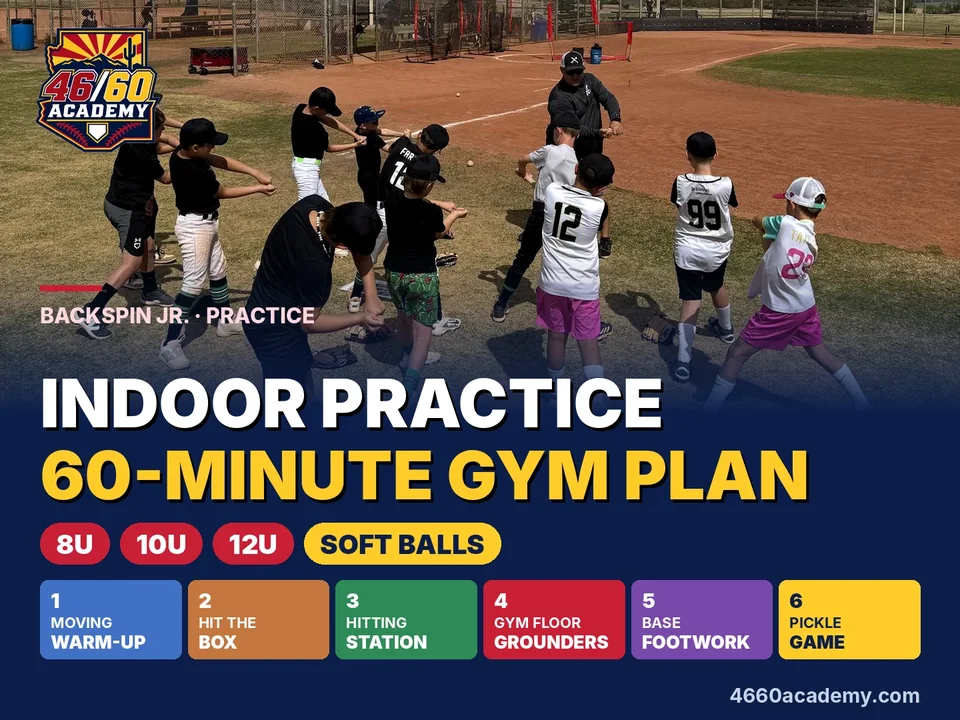
The best indoor baseball practice ideas for a youth team are soft balls, short stations and lots of reps: a moving warm-up, partner throwing, three rotating stations and a team game to finish. Rained out or stuck in a school gym for an hour? A gym can be one of your best practices of the season if you plan it right, and here's a safe, busy 60-minute plan for 8U to 12U teams.
Good indoor baseball practice ideas for youth teams use soft or foam balls, short stations and lots of reps: a moving warm-up, partner throwing, three rotating stations for hitting, fielding and baserunning footwork, then a team game. Keep everyone throwing and hitting in one direction, skip sliding on hard floors, and have adults at each station.
Train it: 46/60 Coach Playbook → Free: Free practice planner →How do you set up a gym for baseball practice?
Before kids walk in, take five minutes to set the room up. Gyms are smaller and harder than fields, so safety rules matter more.
- Soft balls only. Foam balls, plastic balls with holes, or softer training balls. No regular baseballs indoors.
- One direction. All hitting and throwing goes toward the same wall, so nobody is walking into a ball.
- No sliding. Hard floors and sliding don't mix. Practice slides on grass or a mat another day.
- Space between stations and one adult at each one. Ask a couple of parents to help before practice.
Little League's coaching resources point to gym space and whiffle-ball hitting as good ways to keep baseball skills going indoors, and remind leagues to check insurance coverage before off-season workouts. Ask your league about that and the gym's rules before you book it.
How do you warm up and throw safely in a gym? (minutes 0–20)
Moving warm-up (8 minutes). Jog the gym, then side shuffles, skips, high knees and backpedals between two lines of cones. Finish with arm circles.
Partner throwing (12 minutes). Partners line up across the gym, all throwing the same direction. Start close and back up a few steps every few throws. Then play "Hit the Box": the receiver holds the glove at the chest, and the thrower gets a point for each throw caught without moving the feet.
Keep throws easy and short indoors. A gym is not the place for long toss, and arm care rules still apply: stop any player whose arm hurts.
What stations can kids run in a gym? (minutes 20–50)
Split the team into three groups and rotate every 10 minutes.
- Hitting: soft toss or tee work into a net or a padded wall with foam or plastic balls. Hitters line up behind a cone well out of swing range. Goal: line drives that hit the wall at chest height.
- Fielding: gym floors make great ground balls. A coach rolls balls from 20 to 30 feet to the right, left and straight on. Fielders get low, field it out front and make a short throw to a partner.
- Baserunning footwork: tape or cones for two bases. Kids practice running through first, rounding a base with a banana turn and their first step on "Go!" No sliding.
For 8U, keep stations to two simple jobs each and swap helpers often. For 11- and 12-year-olds, add game calls at each station, like "runner on first, ground ball to you."
What indoor games teach baseball? (minutes 50–60)
End with a game kids will talk about in the car. Two favorites:
- Pickle in the gym: two fielders and a runner between two bases about 30 feet apart, with a foam ball. The fielders try to tag the runner out in as few throws as possible. Rotate fast so everyone runs.
- Knockout grounders: fielders line up across the gym floor. A coach rolls grounders. Field it clean and you stay; miss it and you go to the end of the line and help roll the next round.
Coach BK starts days like this with "It's a great day to be you!!" For kids stuck inside, that means showing up with energy even when it's not a field day.
What does the full 60-minute indoor plan look like?
| Minutes | Block | Coach's focus |
|---|---|---|
| 0–8 | Moving warm-up | Everyone moving, nobody waiting |
| 8–20 | Partner throwing, Hit the Box | Short, easy, accurate throws |
| 20–30 | Station 1 | Hitting, fielding or baserunning |
| 30–40 | Station 2 | Rotate groups |
| 40–50 | Station 3 | Rotate groups |
| 50–60 | Pickle or knockout grounders | Fun finish, quick wrap-up |
Want to swap stations around? Our free practice planner builds an age-right plan in a few minutes. If you're coaching all season, the 46/60 Coach Playbook ($59, one year of access) has 24 lessons with what to teach, cues, fixes and 60-minute station plans for 8U to 12U.
One thing to remember
Indoors, soft balls and one direction keep it safe, and short stations keep every kid busy.
What to do this week
Ask your league or school about gym time, round up three helpers and a bag of foam balls, and print the 60-minute plan. Run it once and note which station needs more room next time.
Parent questions
What balls should we use for indoor baseball practice?
Use foam balls, plastic balls with holes or softer training balls for indoor baseball practice. Regular baseballs are too dangerous in a gym with walls, floors and kids close together.
Can kids hit in a gym?
Kids can hit in a gym with soft balls into a net or padded wall, everyone hitting the same direction and waiting hitters well out of swing range. An adult should run the hitting station.
How many kids can practice in a gym at once?
A full youth baseball team can practice in a gym if you split into three small groups at stations with space between them. If the gym is small, cut to two stations and make them longer.
COMING SOON · JOIN THE WAITLIST →
Sources: Little League — Three Ways to Train in the Great Indoors · Dick's Sporting Goods ProTips — Baseball Hitting Drills: Indoor Soft Toss