
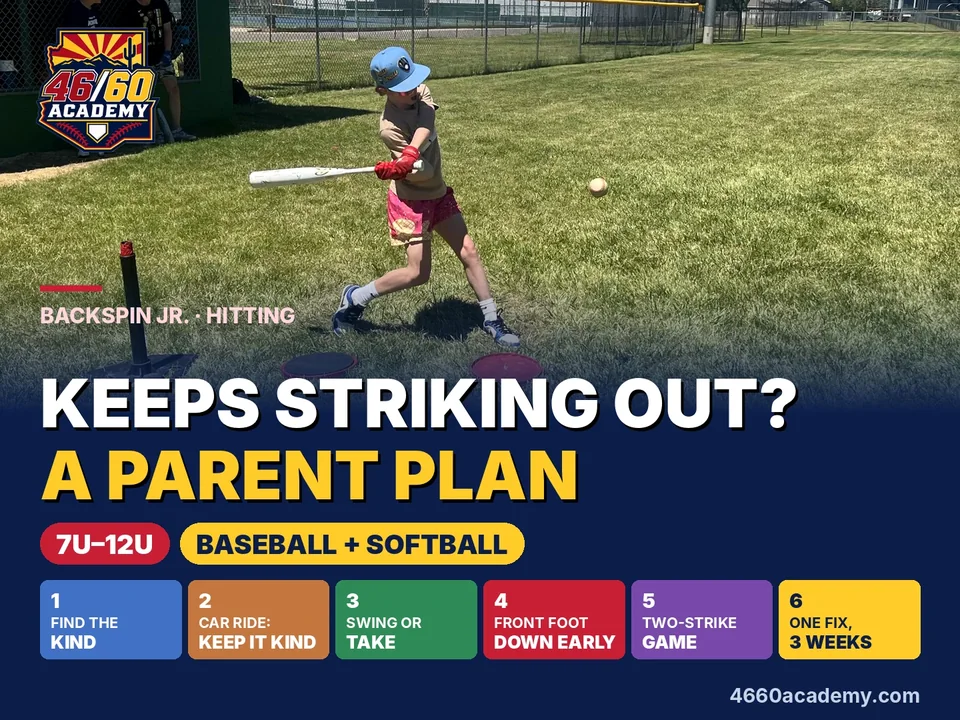
If your kid keeps striking out, figure out which kind of strikeout it is first, then practice the one fix that matches. Keep the car ride positive and judge progress by hard contact and good swing decisions, not hits. Strikeouts usually have one main cause, and once you know which one, the fix is simple.
If your kid keeps striking out, first figure out which kind it is: taking strikes, swinging late, swinging under or over, or chasing bad pitches. Then practice the one fix that matches, keep car-ride talk positive and judge progress by hard contact and good swing decisions, not hits.
Train it: Complete Contact Builder (Level 2 Hitting) → Free: Free Quick Check →What kind of strikeout is my kid having?
"He strikes out a lot" isn't something you can practice. "He's late on fastballs" is. For the next two games, quietly note how each at-bat ends. Don't share it with your player yet. Just look for a pattern.
| What you see | What it usually means |
|---|---|
| Strike three called, bat on the shoulder | Waiting too long or not sure when to swing |
| Swings, but the ball is already in the catcher's mitt | Late: starts the swing too slowly |
| Swings right at it and misses over or under | Head or body moving, or a swing that's too long |
| Swings at pitches in the dirt or over the head | Chasing: deciding late, or nervous with two strikes |
| Pulls away or steps out | May be afraid of the ball |
Most young hitters have one main pattern. Pick that one and leave the rest alone for now.
What should I say after a strikeout?
Your player already knows they struck out. They don't need a breakdown in the car. The Positive Coaching Alliance urges parents to hold off on analyzing performance on the car ride home, and Little League reminds parents that failing often is part of baseball, even for great hitters.
- Say: "I love watching you play." Then wait. If they want to talk, they will.
- Ask later, not right away: "What pitch do you want to swing at next time?"
- Praise what they control: a hard swing, a good take, a fast run to first.
- Skip: "You have to swing at that!" or replaying every at-bat.
Coach BK says it this way: "Swing at a bad pitch? No biggie. Take a good pitch to hit? Not happening." For a 9-year-old, that means a brave swing that misses is never the problem. Watching a good one go by is the habit we fix.
How do I fix each kind of strikeout?
- Taking strikes: play "swing or take" with soft toss. Call out the decision as the ball arrives. Hittable strike means swing, every time. Reward the swing, not the result.
- Swinging late: get the front foot down early. In soft toss, say "down" when the ball leaves your hand, and the front foot lands before the ball arrives.
- Missing over or under: use a tee and have them keep their eyes on the spot where the ball was for a beat after contact. Shorter, level swings come from a still head.
- Chasing: mix a few bad pitches into front toss and make taking them a point. Kids learn faster when a good take counts as a win.
- Pulling away: switch to soft or foam balls and slow speeds. Confidence comes before speed.
Keep it to one fix for two or three weeks. Changing everything at once is how a 10-year-old ends up thinking about five things in the box and hitting none of them.
What does a 15-minute home practice for strikeouts look like?
Three times a week is plenty. Use soft balls if you're close to the house or practicing indoors.
- Tee (5 minutes): 15 swings at hard line drives up the middle.
- Soft toss (5 minutes): 15 swings with today's one fix as the only cue.
- Two-strike game (5 minutes): every round starts with two strikes. Count balls put in play out of 10 and try to beat it next time.
Write the number down. Watching "4 out of 10" become "7 out of 10" builds more belief than any pep talk.
What if strikeouts are really about fear or confidence?
If your player is stepping out, closing their eyes or freezing after getting hit by a pitch, the swing isn't the real problem. Work on safety and confidence first, with soft balls, short distances and lots of easy wins.
Our free Quick Check walks you through six simple cards and points to one clear first step. When you want a full plan, Complete Contact Builder is our 16-session Level 2 hitting program for baseball and softball players 7–12, included in the $25/month 46/60 membership.
One thing to remember
A strikeout is a clue, not a label; find the kind, fix one thing and celebrate brave swings.
What to do this week
Watch two games and note how each at-bat ends. Pick the most common kind of strikeout and practice only that fix in three 15-minute sessions.
Parent questions
Is it normal for a 9-year-old to strike out a lot?
Yes. Strikeouts are common at every age, especially in the first seasons of kid pitch when pitchers are faster or less predictable. Look for better swing decisions and harder contact over a few weeks, not instant results.
Should my kid swing at everything to stop striking out looking?
No. Teach them to swing at hittable strikes every time and to let pitches in the dirt or over their head go. A simple rule: if it looks like a strike, be swinging.
When should I get my child hitting lessons for strikeouts?
If you've practiced one fix for a few weeks and the same pattern keeps showing up, an outside set of eyes can help. Ask about in-person lessons or start with a structured plan you can do at home.
SEE COMPLETE CONTACT BUILDER (LEVEL 2 HITTING) →
Sources: Positive Coaching Alliance — How Parents Can Resist Analyzing Kids' Performance During the Car Ride Home · Little League — Game of Failure: Parent Confessions