
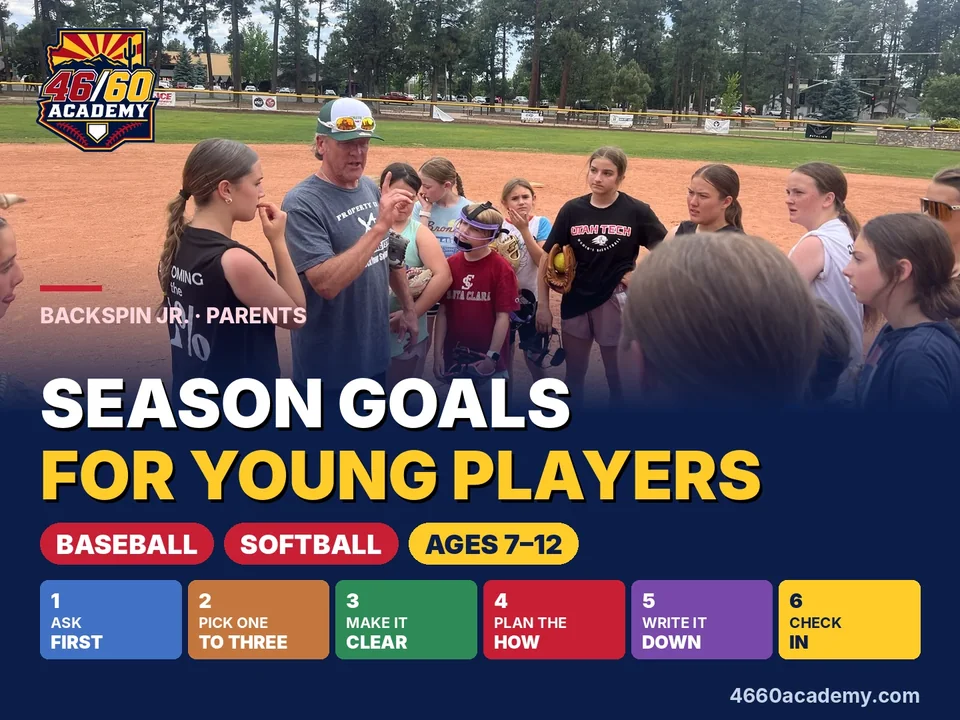
A new season is a great time to sit down with your player and ask, "What do you want to get better at this year?" A few simple goals give practice a purpose. The wrong goals, like a batting average or making the all-star team, can turn a fun season into a stressful one.
Set season goals with a young player by letting them pick one to three goals they control, like effort, a skill or a habit, instead of stats or wins. Write them down, plan how you will practice each one, and check in at mid-season and at the end.
Train it: All eight Level 2 Skill Builder programs ($49 each) → Free: Free Quick Check →Why season goals help young players
Kids from 7 to 12 love having something to aim at. A goal turns "go practice" into "let's work on catching with two hands." It also gives you something positive to talk about after a game, no matter the score.
The key is choosing goals your child can control. A 9-year-old can control how hard they run to first. They can't control where the ball goes after they hit it, or who the coach picks for the all-star team.
Coach BK puts it this way: "Two choices: A. Do everything in your control. B. Anything but A." For a young player, that means a good goal is about effort, preparation and attitude, the things they can do something about every single day.
Good goals vs. pressure goals
Here is a quick way to turn a stat goal into one your child owns.
| Instead of… | Try… |
|---|---|
| Hit .400 this season | Swing at good strikes and take a full swing every at-bat |
| Make the all-star team | Practice at home 10 minutes, three times a week |
| Never strike out | Have a plan and a routine before every pitch |
| Get to pitch | Throw strikes in the backyard target game |
| Don't make errors | Get in ready position before every pitch |
| Win the league | Cheer for teammates and hustle on and off the field |
Notice that every goal on the right can be a "yes" today, even on a day the team loses.
How to set goals with your child in 10 minutes
Do this at the kitchen table before the first practice. Keep it short and light.
- Ask first: "What was fun last season? What do you want to get better at?" Let them talk before you add anything.
- Pick one to three: one is plenty for a 7- or 8-year-old. Older kids can handle a skill goal, an effort goal and a team goal.
- Make it clear: turn "get better at fielding" into "stay low and use two hands on ground balls."
- Plan the how: decide together when you'll practice it, like two short backyard sessions a week.
- Write it down: your child writes or draws the goals on a card and hangs it on the fridge or puts it in the bat bag.
Project Play, the youth sports program from the Aspen Institute, has a free family goals worksheet that asks what skills you'd like your child to build, what you and the coach can do together, and what challenges the coach should know about. If your child is okay with it, share their goals with the coach.
Sample season goals for 8U, 10U and 12U
Use these as ideas. Your child's own words are always better.
- 8U: "Run hard to first base every time." "Keep my eyes on the ball when I catch." "Learn where to throw when the ball comes to me."
- 10U: "Be ready to swing on every good strike." "Back up throws when I'm not part of the play." "Get my glove down on ground balls."
- 12U: "Use the same routine before every pitch." "Know how many outs there are and where I'm throwing before the pitch." "Warm up my arm the right way every time."
These work for baseball and softball alike. Not sure where to start? Our free Quick Check uses six simple cards to point you to one clear first step, which makes a great first goal.
Check in at mid-season and at the end
Goals work best when you come back to them. Pick two check-in times: the middle of the season and the last week.
- Ask, don't grade: "How do you think your goal is going?" Let them answer first.
- Notice the effort: point to a real moment, like "I saw you get low on that ground ball Saturday."
- Change it if needed: if a goal is done, pick a new one. If it feels too hard, make it smaller.
- Keep it out of the car ride: talk goals at home on a calm day, not right after a game.
When a goal needs more structure, our Level 2 Skill Builder programs ($49 each) give you 16 parent-guided sessions over four weeks in one skill, from hitting and fielding to pitching and baserunning, for baseball and softball players ages 7–12.
One thing to remember
The best season goal is one your child picks, understands and can work on every day, no matter the score.
What to do this week
Sit down for 10 minutes and help your child pick one to three goals they control. Write them on a card, hang it up, and plan two short practice times this week.
Parent questions
Should I set stat goals like batting average for my kid?
We don't recommend it for ages 7 to 12. Stats depend on things kids can't control, so goals about effort, skills and habits keep the season fun and still build a better player.
How many goals should a young player have?
One to three. A 7- or 8-year-old does best with a single goal, and older kids can handle a skill goal, an effort goal and a team goal.
What if my child doesn't want to set goals?
Keep it casual. Ask what they want to get better at or what would make the season fun, and let that answer be the goal. No pressure is needed.
SEE ALL EIGHT LEVEL 2 SKILL BUILDER PROGRAMS ($49 EACH) →
Sources: Aspen Institute Project Play — Family Goals Worksheet