
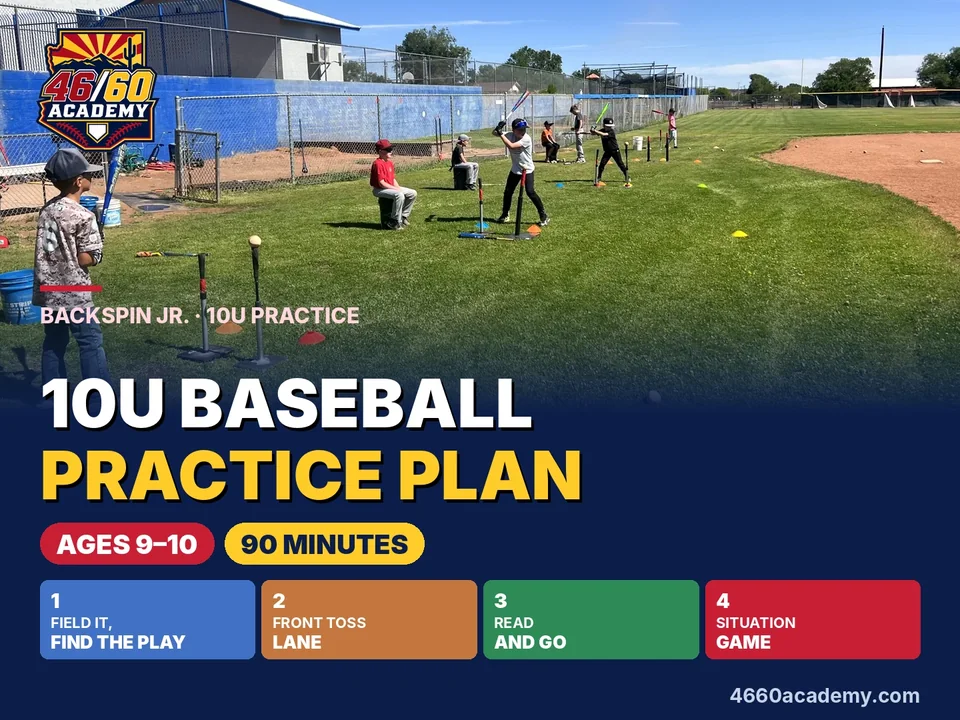
10U is a jump. Kids often pitch to each other, runners steal, and a ground ball with a runner on first means a real decision. The players are ready for it if practice gets them ready. Here's one 90-minute plan you can run every week, plus what to change as the season goes.
A good 10U baseball practice plan runs about 90 minutes: a 10-minute warm-up, a throwing and catching block, three 15-minute stations for fielding decisions, hitting and baserunning, a 15-minute situation game and a short huddle. Keep the same shape all season and add one new situation every week or two.
Train it: 46/60 Coach Playbook ($59) → Free: Free 10U Practice Plans →The 90-minute 10U baseball practice
This plan fits 10 to 13 players in three groups. Put one parent helper at each station so you can float and coach.
| Minutes | What happens | Coach's job |
|---|---|---|
| 0–10 | Huddle, dynamic warm-up, jog the bases | Say today's one goal in a sentence |
| 10–25 | Partner catch, then target throws | Accuracy before velocity |
| 25–70 | Three 15-minute stations, rotate on a whistle | Float, give one cue per player |
| 70–72 | Water | Set up the situation game |
| 72–87 | Situation game | Call the situation before every pitch |
| 87–90 | Huddle | One thing that got better today |
Running late? Shorten the stations to 12 minutes. Keep the throwing block, because arms need a real warm-up before anyone throws hard.
What happens at each 10U station?
- Fielding: Field It, Find the Play. A helper calls a situation ("runner on first, one out"), then hits or rolls a ground ball. The fielder gets in front, fields it and throws to the right base. Eight balls each. Cue: "Know the out before the pitch."
- Hitting: Front Toss Lane. A helper tosses from behind a protective screen into a net while the next hitter waits behind a cone line. Eight swings, then rotate. Cue: "Hit the middle of the ball, middle of the field."
- Baserunning: Read and Go. Runners take a lead off first if your league allows it. The helper yells "ground ball" or "fly ball," and runners go or freeze halfway. Four reads each. Cue: "Read the ball, say your job."
At the hitting station, Coach BK likes to say "Hard, down the other way means we are on our way!" For a 10-year-old, a hard line drive to the opposite field means they were on time and stayed through the ball. Cheer that one loudest.
Helmets on every hitter and runner, plenty of space between stations, and stop if a player says something hurts.
How should pitchers and catchers fit in?
Many 10U leagues use kid pitch, so pitchers need reps. Pull two or three pitchers during the station block for a short, counted bullpen with a coach watching, then send them back to their group.
- Count every pitch: follow your league's pitch-count and rest rules, and count bullpen throws as real work.
- Fastballs and changeups: Pitch Smart, the youth guidelines from MLB and USA Baseball, says to avoid other pitches at 9 to 12.
- Don't stack jobs: Pitch Smart advises against catching on days a player isn't pitching.
- Stop for pain: any arm pain ends the session. No exceptions.
Catchers need full gear for any live pitching. Teach receiving and blocking with soft balls first, and check your league's rules for when catchers need gear in the bullpen.
A 10-week 10U season map
Same 90 minutes all season. Change one piece at a time, and only move on when most of the team is ready.
| Weeks | Add this | Ready to move on when |
|---|---|---|
| 1–2 | Rotation, throwing routine, nobody on | Groups switch stations without you |
| 3–4 | Runner on first: get the force at second | Fielders point to second before the pitch |
| 5–6 | Cutoffs on balls to the outfield | Outfielders hit the cutoff more than they miss |
| 7–8 | Steals and covering second, if your league allows them | Middle infielders call who covers |
| 9–10 | Players call the situation themselves | You're mostly watching |
For the situation game, Little League suggests a 4-on-4-on-4 scrimmage with a coach pitching and score kept, so every at-bat counts. It's a great fit for the last 15 minutes. Need cutoffs explained simply? Read our guide to cutoffs and relays for kids.
What if I only have 60 minutes?
Shared fields and early sunsets happen. Here's the short version that still covers throwing, decisions and hitting.
- 0–15: Warm-up and throwing block.
- 15–45: Two 15-minute stations: Field It, Find the Play and the Front Toss Lane.
- 45–57: Situation game.
- 57–60: Huddle.
Pitch Smart says players 9 to 12 should focus on athleticism, physical fitness and fun. Keep lines short, talks under a minute and the score in the game. Want every week mapped out? The 46/60 Coach Playbook is $59 for a year: 24 lessons for 8U to 12U coaches with what to teach, cues, fixes and 60-minute station plans. Lessons 1–3 are free. Or print tonight's practice from our free 10U practice plans.
One thing to remember
One good 90 minutes with one new situation every week or two beats a brand-new plan every practice.
What to do this week
Write three station cards tonight with one drill, one cue and a rep count each. Pick this week's one situation, like runner on first, and call it in every drill.
Parent questions
How long should a 10U baseball practice be?
About 75 to 90 minutes works well for most 9- and 10-year-olds. Keep each block around 15 minutes and build in a water break.
How often should a 10U team practice?
Once or twice a week plus games is plenty for most rec teams. Two focused practices beat one long one.
What should 10U baseball practice focus on most?
Throwing accuracy, fielding with a decision and hitting a moving ball. Add one game situation at a time so players learn where the ball goes.
COMING SOON · JOIN THE WAITLIST →
Sources: Pitch Smart (MLB & USA Baseball): Pitching Guidelines, Ages 9–12 · Little League University: Keep Practices Fresh by Including Intrasquad Scrimmages