
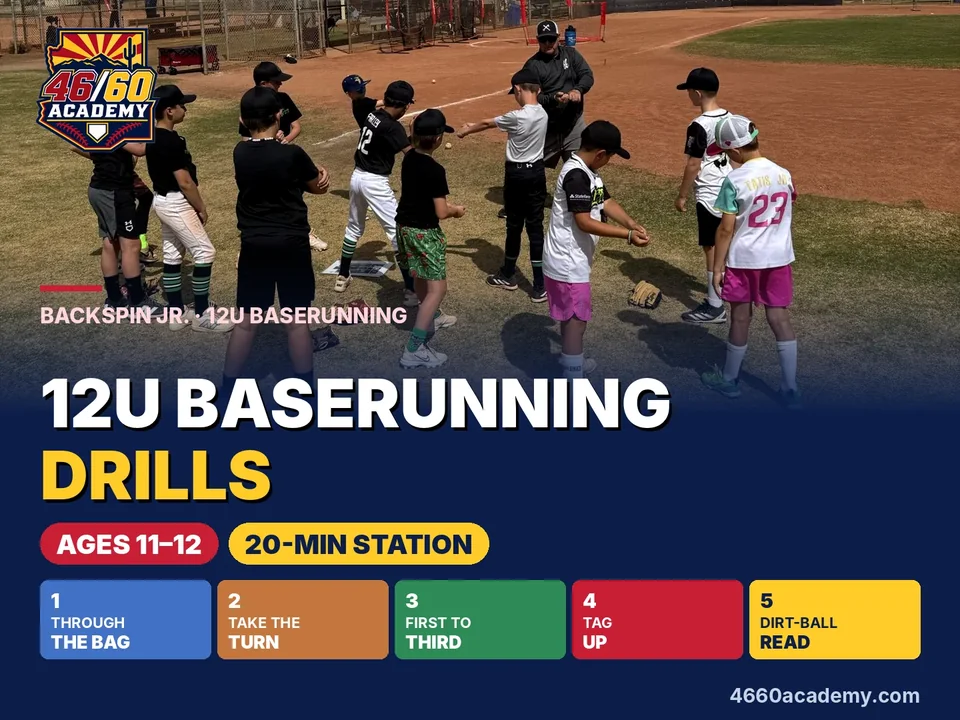
The best 12U baserunning drills teach 11- and 12-year-olds to run hard through first, take an aggressive turn, read the ball from first to third, tag up and read balls in the dirt where leads are allowed. At 12U, the game gets faster. Outfielders throw harder, catchers can throw runners out, and one smart turn can be the difference in a close game. Speed helps, but the 12U runners who score the most are the ones who think ahead.
The best 12U baserunning drills are running hard through first base, taking an aggressive turn on hits to the outfield, reading the ball from first to third, tagging up on fly balls and reading balls in the dirt where leads are allowed. Run them as a 20-minute station with helmets on, and check your league's rules on leads and slides.
Train it: Smart Baserunner (Level 2 Baserunning) →What should a 12U baserunner know?
By 11 and 12, most players can run hard. The next step is running with a plan. Before every pitch, a 12U runner should know three things.
- How many outs: with two outs, run on any contact. With fewer, read the ball first.
- Where the base coaches are: on a ball behind you, your coach is your eyes.
- The league rules: some 12U leagues let runners lead off and steal any time. Others make runners wait until the pitch reaches the batter. Check your league's rules before you teach leads.
Coach BK says it this way: "Two choices: A. Do everything in your control. B. Anything but A." For a 12-year-old runner, that means effort and attention are always in your control. Running hard on every ball and knowing the outs never depends on how fast you are.
How do 12U runners practice running through first and the turn?
- Through the bag: from the batter's box, the runner swings a bat (no ball), drops it safely and sprints to first. Hit the front edge of the base and keep running through it. Then break down and look toward the right-field side for an overthrow. Five reps.
- The turn: on a coach's call of "base hit!", the runner bends out a few steps before first, so the path curves like a banana. Touch the inside corner of the base, take two or three hard steps toward second, and find the ball. Ball in the infield? Get back. Five reps.
What to look for: no slowing down before the base, no leaping at the base, and eyes up after the turn. A runner who peeks at the ball while running to first loses steps.
How do 12U runners practice first to third and tagging up?
- First to third read: a runner starts at first. A coach at home calls out where a pretend single goes: left, center or right. Ball in front of you, like left field, you can read it yourself. Ball behind you, like right field, pick up the third-base coach early and trust the call. Six reps, mixing the calls.
- Tag-up drill: runners at second and third. A coach tosses or hits fly balls to a fielder. On a fly, runners go back to the base, then leave the moment the ball is caught. Add the rule for less than two outs: shallow fly, go partway and get back; deep fly, tag up. Six reps.
Call out the outs before every rep. Having to say "one out, tag on a fly" out loud is how the habit sticks.
How does a 12U runner read the ball in the dirt?
This one is for leagues that allow leads. If yours doesn't, practice the timing of leaving when the pitch reaches the batter instead.
- Set up: a runner takes a lead at first. A coach kneels a short distance in front of home plate with a bucket of balls, and a catcher in full gear sets up behind the plate.
- The pitch: the coach flips balls underhand to the catcher. Some are strikes, some bounce in the dirt.
- The read: on a strike, the runner shuffles a step or two and gets back. On a ball in the dirt, the runner goes hard to second.
- Score it: a point for every right read. Wrong reads cost a point.
Slides at second should be feet-first. Many youth leagues limit head-first slides, so check your league's rules. Our guide on how to teach a kid to slide safely walks through it.
How do I run a 20-minute 12U baserunning station?
| Minutes | Drill | Key cue |
|---|---|---|
| 0–3 | Light jog and quick starts | Warm up first |
| 3–7 | Through the bag | Front edge, run through |
| 7–11 | The turn | Banana path, find the ball |
| 11–16 | First to third or tag-ups | Know the outs |
| 16–20 | Dirt-ball read or a relay race | Read, then go |
Keep groups to three or four runners so nobody waits long. Helmets on for every rep, and use soft balls if anyone is throwing or tossing near runners. If a player feels pain, stop.
Want a coach-built path? Smart Baserunner, our Level 2 baserunning program, is 16 guided sessions, in the $25/month 46/60 Academy membership.
One thing to remember
At 12U, the runner who knows the outs and reads the ball beats the runner who is only fast.
What to do this week
Before each practice or game this week, ask your player how many outs there are and what they'd do on a fly ball. Then run five through-the-bag reps and five turns in the yard or at the park.
Parent questions
Can 12U baseball players lead off and steal?
Whether 12U baseball players can lead off and steal depends on the league. Some 12U leagues allow leads and steals any time, and others make runners wait until the pitch reaches the batter, so check your league's rules.
How do I teach my 12-year-old to read the third-base coach?
Teach a 12-year-old one simple rule: a ball in front of you, read it yourself; a ball behind you, pick up the third-base coach early and trust the call. Practice it with a coach calling out pretend hits.
How can my 12-year-old get faster on the bases?
Better turns and better reads save a 12-year-old more time on the bases than raw speed. Work on running through first, a curved turn and quick first steps, and keep the sessions short and fun.