
At 11 and 12, softball speeds up. The pitch comes harder, teams bunt on purpose, and runners take off the moment the ball leaves the pitcher's hand. A few drills, run every week, cover most of it.
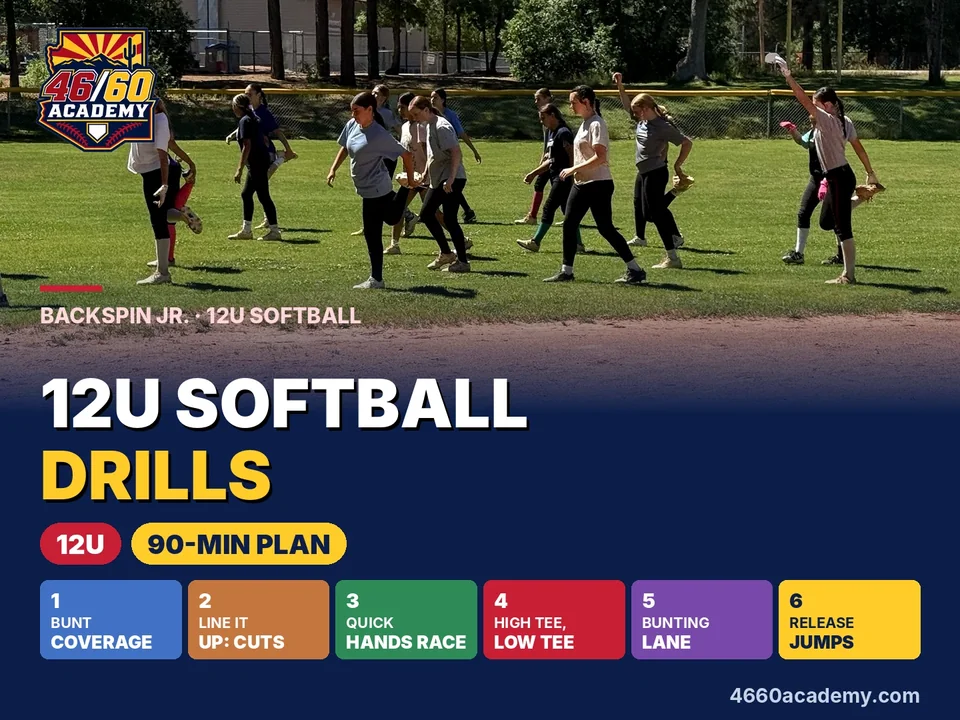
The best 12U softball drills cover the plays that decide games at this age: bunt coverage, cutoffs, quick catch-and-throw, tee and front-toss hitting with a bunting lane, and a good jump on the release. Run them as stations in a 90-minute practice so every 11- and 12-year-old gets reps instead of line time.
Train it: 46/60 Coach Playbook ($59) → Free: Free Softball Practice Plans →What changes in 12U softball?
Three things show up at once. The pitcher is a real pitcher now. The other team will bunt to test your corners. And runners get bold, because in many leagues they can leave the base as soon as the pitch is released.
Little League Softball's Major Division uses that release rule, and a runner who leaves early is out. Some local leagues make runners wait longer, so check your league's rules before you teach steals.
So these drills train fast choices: who charges, who covers, where the ball goes and when to run.
12U softball defense drills: bunt coverage and cuts
- Who's got it? (bunt coverage): full infield, nobody on base. A coach at the plate rolls or soft-bunts a ball toward third, the pitcher or first. The corners charge, the pitcher takes the middle, the second baseman sprints to cover first, and the catcher yells the base: "One! One!" Eight bunts, then rotate.
- Add a runner: once the throw to first is clean, put a runner on first. Now the catcher decides: take the sure out at first or go to second. Wrong choices are fine. Silence is not.
- Line it up (cutoffs): roll a ball to an outfielder. The cut player runs out between the outfielder and the base, both hands up, yelling her name. The player at the base tells her "Cut!" or "Let it go!" Five throws each, then switch spots. Our cutoffs and relays guide shows who goes where.
Every play has a backup. Coach BK puts it this way: "Two choices: A. Do everything in your control. B. Anything but A." For a 12-year-old, that means sprinting behind the base on every throw, even when the ball probably won't get there.
Throwing and hitting drills for 11- and 12-year-olds
Throwing comes first, every day. Most 12U innings fall apart on a throw, not a swing.
- Target catch: partners start about 30 feet apart. A good throw hits the chest without the partner moving her feet. After five good ones, both take two steps back. When throws start sailing, stop backing up.
- Quick hands race: two lines of four, about 25 feet apart. Catch, turn glove side, throw to the next player and back. First line through twice with no drops wins.
- High tee, low tee: ten swings at each height into a net. The goal is a hard line drive on both.
- Front toss behind a screen: an adult tosses from behind a protective screen. Ten swings, and the hitter tries to drive it up the middle or the other way.
- Bunting lane: set two cones a few steps inside each foul line. Five bunts per side, one point for each ball that stops in the zone.
On front toss, listen for Coach BK's favorite: "Hard, down the other way means we are on our way!" A hard ball to the opposite field tells you the hitter was on time and stayed through the ball.
You'll also see slapping at this age. A left-handed hitter takes a running step in the box and puts the ball on the ground so her speed can beat the throw. It has its own footwork and its own rules about staying in the box, so leave it to a coach who teaches it.
12U softball baserunning: get the jump on the release
- Release jumps: runners on first with one foot on the base. A coach does a full pitching motion. Runners go the instant the ball leaves the hand, take three hard steps, then jog back. A helper watches feet and calls anyone who left early.
- Read it off the bat: same setup, but the coach tosses and says "ground ball," "line drive" or "fly ball." Ground ball, go. Line drive, freeze and get back. Fly ball, go halfway.
- Circle check: after each rep, the pitcher gets the ball in the circle. Runners must commit right away to the next base or back. Our softball baserunning guide explains the circle rule in plain words.
Helmets on for every runner, every rep.
A 90-minute 12U softball practice
| Minutes | Station | Coaching point |
|---|---|---|
| 0–10 | Warm-up and target catch | Chest-high throws, back up only after five good ones |
| 10–20 | Quick hands race | Catch, turn, throw. No drops. |
| 20–40 | Bunt coverage, then cuts | Corners charge, catcher calls the base |
| 40–65 | Hitting: tee, front toss, bunting lane | Three groups, eight minutes each |
| 65–80 | Release jumps and reads | Go on the release, freeze on a liner |
| 80–90 | Mini-inning and recap | Name two smart plays and one to fix |
Pitchers and catchers need their own time with a trained adult. Catchers wear full gear for any pitching work, and pitchers follow your league's rules on how much they throw.
Want the plan on one printable page? The free softball practice plans let you set the time and focus. For a full season of what to teach and how to fix it, the 46/60 Coach Playbook is $59 for a year, and the first three lessons are free.
One thing to remember
At 12U, games are won in the little plays: the bunt you field, the cut you hit and the jump you get.
What to do this week
Run Who's got it? and release jumps at the start of your next practice, ten minutes each. At home, play 15 minutes of target catch and five bunts down each line.
Parent questions
How long should a 12U softball practice be?
About 90 minutes is plenty for most 11- and 12-year-olds, as long as every station stays busy. A tight 60 works too: warm-up, one defense block, one hitting block and a short game.
Should my 12U softball player learn to slap?
Slapping suits fast players, and it takes a lot of reps with a coach who knows it. Ask your coach whether it fits your player before you start.
Can my daughter do 12U softball drills at home?
Some of them. Target catch, bunting into cones and tee work fit a backyard with a net and soft balls. Save bunt coverage, cuts and baserunning for team practice.
COMING SOON · JOIN THE WAITLIST →
Sources: Little League University: Is a Runner Out for Leaving the Base Early in Little League Softball? · Oregon Youth Softball: Coaching 12U Players · Human Kinetics: Running slap gives left-handed batters an advantage (Softball Skills & Drills)