
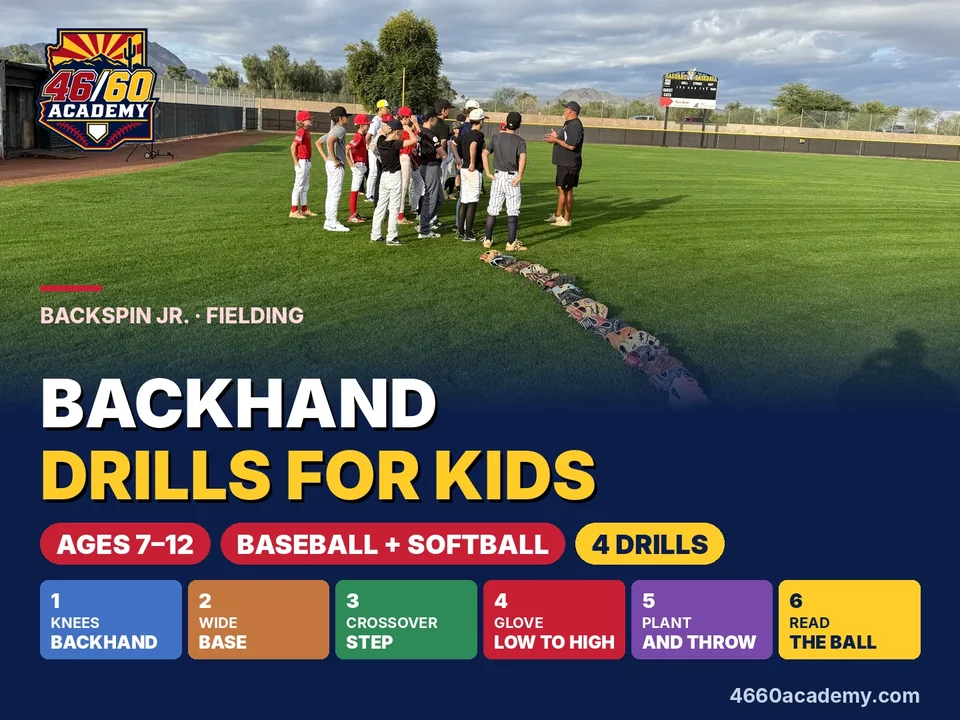
To teach a kid to backhand a ground ball, start on the knees with soft rolled balls, turn the glove over with the thumb down, then add the crossover step and a throw. The backhand is for the ground ball hit to the throwing-hand side that a player can't get in front of. Many kids stab at it, turn the glove the wrong way or give up on it, and kids as young as 7 can start learning it with soft balls rolled from a few steps away.
A backhand drill teaches a player to catch a ground ball on their throwing-hand side with the glove open and the thumb turned down, then plant and throw. Start on the knees with rolled soft balls, add the crossover step, then add a throw; 10 minutes, two or three times a week, is plenty for ages 7–12.
Train it: Complete Defender (Level 2 Fielding) → Free: Free fielding skill guide →When should a kid backhand a ground ball?
The backhand is for a ground ball to the throwing-hand side that a player can't get in front of in time. For a right-handed thrower, that's a ball to their right. For a lefty, it's a ball to their left. It works the same way in baseball and softball.
If your player has time to get in front of the ball, getting in front is still the first choice. The backhand is the answer when the ball is moving away and there isn't time. Teaching kids the difference is half the lesson.
Coach BK says it this way: "Two choices: A. Do everything in your control. B. Anything but A." For a young fielder, that means hustling to the ball and using good footwork every time, even when they might not reach it.
How do I teach a backhand step by step?
- Ready position: feet wide, knees bent, glove out in front and low.
- Crossover step: the glove-side foot crosses over toward the ball. A right-hander crosses the left foot over to go right.
- Glove open, thumb down: the glove turns over so the pocket faces the ball. Glove starts low and works up, never down at the ball.
- Catch it out front: the ball is caught out in front of the glove-side foot, with eyes watching it into the glove.
- Plant and throw: plant the throwing-side foot, get the body turned toward the target, then throw.
Most early misses come from a glove that starts too high and has to come down. Low to high is the cue to repeat.
What backhand drills work for kids, from easy to game speed?
Little League's coaching library teaches infield work as a progression: hands first on the knees, then a wide base, then footwork. Backhands follow the same order. Use soft or reduced-injury balls to start, and give everyone plenty of space.
1. Knees backhand (3 minutes, ages 7+). The player kneels, and a parent kneels or sits about 10 feet away and rolls soft balls to the backhand side. The player turns the glove over, catches it out front and shows the ball. Ten clean catches, then switch sides with a few forehands.
2. Wide-base backhand (3 minutes). Same rolls, but the player stands in a wide, bent-knee stance and doesn't move their feet. This teaches them to get low with their legs instead of bending at the waist.
3. Crossover and catch (3 minutes, ages 8+). Walk it first with no ball: ready, crossover, glove open, catch out front. Then roll balls a step or two to the backhand side so the player has to cross over to reach them. Slow and clean beats fast and sloppy.
4. Backhand, plant, throw (5 minutes, ages 9+). Roll or tap ground balls to the backhand side. The player fields, plants the throwing-side foot and throws to a partner or a net. Keep throws short and on target. For 11- and 12-year-olds, hit firmer grounders from farther away.
What should kids work on at each age?
| Age | Focus | Ball |
|---|---|---|
| 7–8 | Knees and wide-base backhands; glove open, low to high | Soft balls, rolled |
| 9–10 | Crossover step, catch out front, show the ball | Rolled and slow grounders |
| 11–12 | Backhand, plant and throw; firmer balls, longer range | Regular balls when ready |
Kids grow at different speeds, so move up a level when your player can do the current one cleanly, not on a birthday. Our free fielding skill guide lists more drills and cues for 8U, 10U and 12U.
What are common backhand mistakes, and how do I fix them?
- Glove comes down at the ball: start the glove on the ground and work up. Say "low to high."
- Stabbing from far away: use the crossover step to get closer before reaching.
- Backhanding balls they could get in front of: mix forehands, backhands and balls right at them so they learn to read it.
- Throwing off balance: plant the throwing-side foot first, then throw. A short, accurate throw beats a hard, wild one.
- Scared of the ball: go back to soft balls and the knees drill. Confidence comes before speed.
If your player wants a step-by-step plan for all of this, the Complete Defender program, in the $25/month 46/60 Academy membership, walks parents through fielding, footwork and throwing in 16 short sessions.
One thing to remember
Get in front when you can, backhand when you can't, and always start the glove low and work up.
What to do this week
Do the knees backhand drill for 3 minutes on three days this week, then add the crossover once they can catch 10 in a row. Finish each session with five backhand, plant and throws to a net or partner.
Parent questions
Which side is the backhand for a left-handed player?
The backhand is always on the throwing-hand side. For a lefty, that's a ground ball to their left, and the right foot crosses over.
Is backhanding a ground ball lazy?
Not when the ball is moving away and there's no time to get in front. It's lazy only when a player could easily get in front and chooses not to.
What age should kids learn to backhand?
Most kids can start around 7 or 8 on their knees with soft, rolled balls. Add the crossover step and throws as they show they can do each step cleanly.
SEE COMPLETE DEFENDER (LEVEL 2 FIELDING) →
Sources: Little League University — Infield Drill Progression · Little League University — Backyard Tip: Knee Ground Ball