
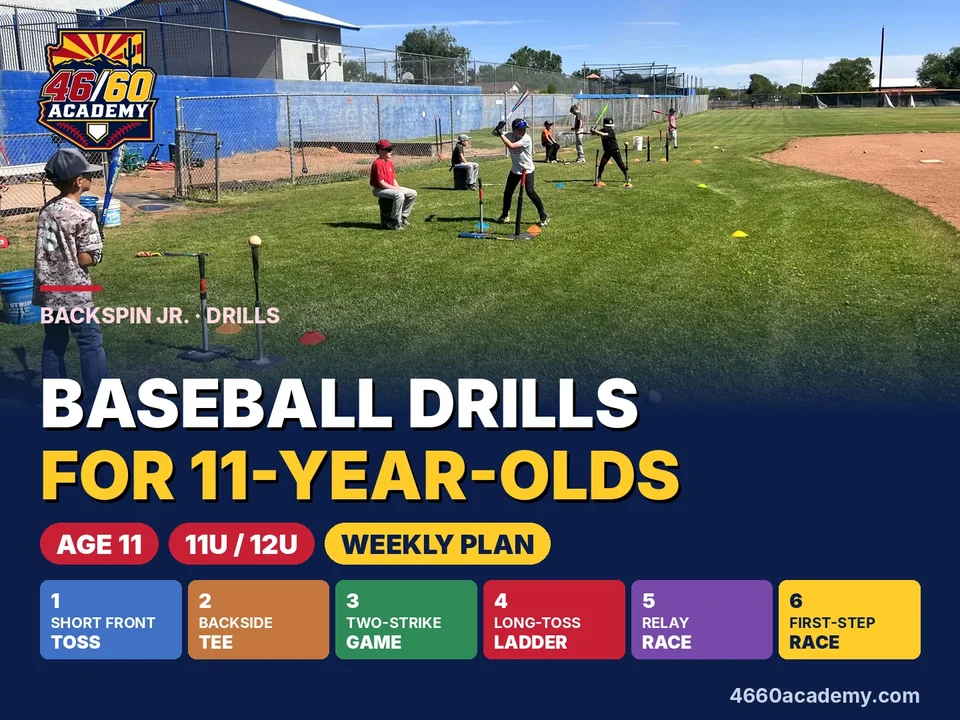
Baseball drills for 11-year-olds should train what changes at this age: faster pitching, longer throws, relays and smarter baserunning. Eleven is a funny age in baseball. Pitchers throw harder, some leagues start adding leadoffs and stealing, and a few players are already moving toward a bigger field. Your player doesn't need a brand-new skill set. They need the basics done faster, farther and with a plan.
The best baseball drills for 11-year-olds train what changes at this age: short-distance front toss to hit faster pitching, a long-toss ladder with arm care for longer throws, relay and cutoff throws, and first-step baserunning drills. Practice 20 to 30 minutes, three days a week, and keep games and fun in it.
Train it: 46/60 Coach Playbook → Free: Free 12U practice plans →What changes for an 11-year-old baseball player?
Most 11-year-olds play in a 12U or 11U division. Pitching gets faster, and batters see more pitchers who throw strikes. Depending on the league, leadoffs and steals may be allowed, and some programs offer a bigger-field division for 11- to 13-year-olds, like Little League's Intermediate (50/70) division. Check your league's rules for base distances, leads and pitching.
Bodies change too. Some 11-year-olds grow a lot this year and some don't grow yet. Both are normal. Drills should match the player in front of you, not the biggest kid on the team.
What hitting drills help an 11-year-old handle faster pitching?
Short front toss (10 minutes). Sit behind a protective screen about 15 to 20 feet away and toss firm strikes. Shorter distance makes the ball arrive quicker, so the hitter has to get the bat moving on time. Mix in a few changes of speed so they don't just guess.
Backside tee (5 minutes). Set the ball on the tee and have them drive line drives up the middle. Coach BK's cue: "Get on the backside of one, baby!" That means the barrel stays behind the ball and drives through the back of it, which is how hard line drives happen.
Two-strike game (5 minutes). In front toss, every round starts with two strikes. The hitter widens a little, chokes up if they want, and tries to put the ball in play. Count balls in play out of 10. This is where 11-year-olds learn that a short, on-time swing still wins.
What throwing and defense drills fit a bigger game?
Long-toss ladder (8 minutes). After a full warm-up, play catch at a short distance, then back up a few steps after every three good throws. Stop at the distance where throws stay on a line and on target. Don't push it every day, take rest days, and stop if the arm hurts.
If your player pitches, follow MLB and USA Baseball's Pitch Smart guidelines for 9- to 12-year-olds and your league's pitch-count and rest rules. Throwing drills count as throwing, so plan them on days the arm is fresh.
Relay race (team, 8 minutes). Two lines of three players from the outfield to a base. The ball goes outfielder to relay player to base, and the first line to finish five clean relays wins. Teach the relay player to give a big target with both arms up and turn glove-side to throw.
- Glove-side turn: catch on the glove side, turn, throw. It's faster than spinning the other way.
- Talk: the next fielder calls "Relay! Relay!" so the outfielder knows where to throw.
- Accurate over hard: a chest-high throw beats a strong throw that sails.
What baserunning drills should 11-year-olds work on?
First-step race (5 minutes). Runners start in their lead or on the bag, depending on your league. On "Go!" they turn their hips toward the next base, cross over and take three hard steps. Run it in pairs so it's a race.
Read the ball (5 minutes). A coach hits or throws grounders, line drives and fly balls while a runner stands at second. The runner yells "Go!" on a ground ball to the right side, "Back!" on a line drive and "Halfway!" on a fly ball. Eleven-year-olds who learn these reads look a step faster without running any faster.
What does a simple weekly plan for an 11-year-old look like?
| Day | Focus (20–30 minutes) |
|---|---|
| Day 1 | Backside tee, short front toss, first-step race |
| Day 2 | Warm-up, long-toss ladder, grounders to both sides |
| Day 3 | Two-strike game, read-the-ball baserunning, a fun game to finish |
| Other days | Rest, other sports, or just play catch for fun |
For team coaches, our free 12U practice plans turn these into stations for 11- and 12-year-olds. If you're coaching this group all season, the 46/60 Coach Playbook ($59, one year of access) gives you 24 lessons with cues, fixes and 60-minute station plans for 8U to 12U.
One thing to remember
Eleven-year-olds don't need new skills; they need the same basics a little faster, a little farther and done with a plan.
What to do this week
Pick three days and run the weekly plan for 20 to 30 minutes. On Day 3, count balls in play out of 10 in the two-strike game and write it down so you can beat it next week.
Parent questions
How many days a week should an 11-year-old practice baseball?
Two or three short sessions a week at home is plenty on top of team practice. Leave rest days, especially for throwing, and let them play other sports too.
Can 11-year-olds lead off and steal in baseball?
It depends on the league and division. Some 11U and 12U divisions allow leads and steals, and some don't. Check your league's rules before teaching leads.
How far should an 11-year-old long toss?
An 11-year-old should long toss only as far as throws stay on a line and on target, building out after a full warm-up. Don't push long toss every day, take rest days, and stop if the arm hurts.
COMING SOON · JOIN THE WAITLIST →
Sources: Little League — The Little League Intermediate (50/70) Baseball Division · MLB Pitch Smart — Pitching Guidelines, Ages 9–12