
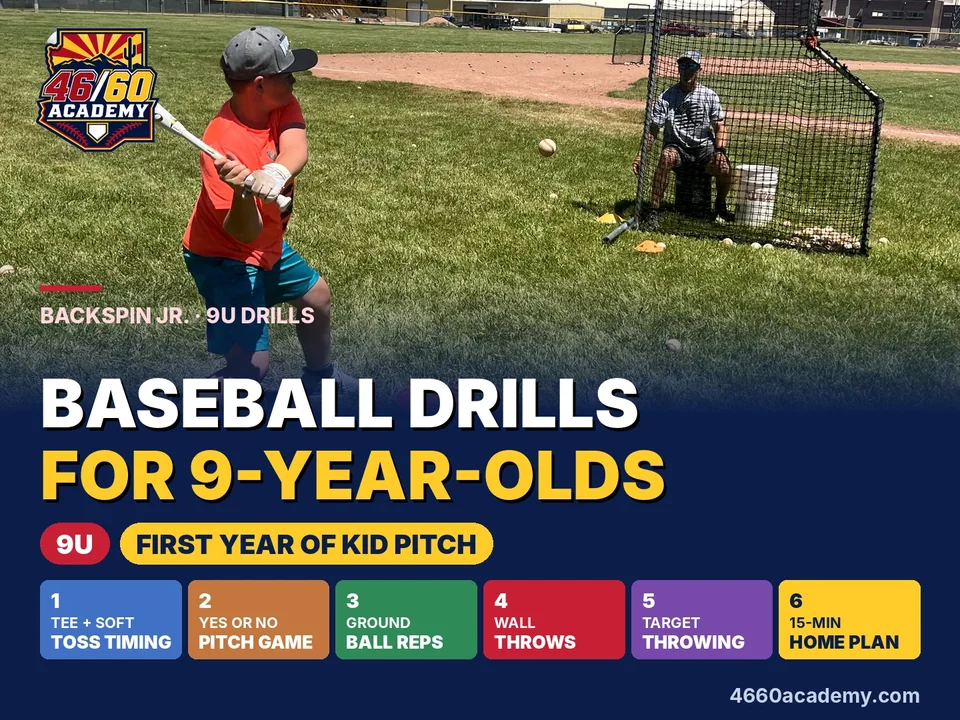
The best baseball drills for 9-year-olds are a few simple ones done often: tee and soft-toss timing work, ground balls, wall throws and target throwing after a real warm-up. Nine is a big year. In many leagues it is the first season kids pitch to each other, and suddenly the ball comes in at different speeds and in different spots. Your player does not need a hundred new drills. They need a few good ones, done often, with a smile.
A 9-year-old in the first year of kid pitch needs a short, balanced drill set: tee and soft-toss work for timing, ground balls and wall throws for defense, and target throwing after a real warm-up. At home, 15 minutes a few days a week is plenty; at practice, run small stations.
Train it: 46/60 Coach Playbook ($59) → Free: Free 10U Practice Plan →What changes for a 9-year-old this season?
Most 9-year-olds are moving from coach or machine pitch to kid pitch, or they are in their first full year of it. Formats vary, so check your league's rules for pitching, leading and stealing.
Three things usually show up fast. Hitters see slower, faster and wilder pitches. Fielders get more balls hit to them and more throws to make. And games have more stops, walks and waiting.
We tell nervous 9-year-olds this: "The ball ain't changing shape, I promise ya that." It means the pitcher may be a kid now, but it is the same ball, the same swing and the same plan you have been practicing.
What hitting drills get a 9-year-old ready for kid pitch?
Kid pitch is mostly a timing test. These drills build a calm, on-time swing. Use wiffle or foam balls at home, give one cue at a time and stop each drill while your player is still having fun.
- Tee, one cue: 10 to 15 swings with one goal, like "hit the middle of the ball." Move the tee a little inside or outside every few swings.
- Soft toss from the side: kneel safely off to the side at an angle, behind a screen if you have one, and toss easy into the zone. Ten swings, then a water break.
- Get ready early: stand about where a pitcher would be and go through a slow, pretend windup with no ball. Your hitter says "ready" and loads before your arm comes forward.
- Yes or no: toss foam balls and have your player call "yes" for a good pitch to hit and "no" for a ball, without swinging. Count how many they get right out of ten.
That last game helps a lot in year one, because 9-year-old pitchers walk plenty of batters. Swinging at good pitches and letting the wild ones go is a real skill.
What fielding and throwing drills help a 9-year-old?
At 9, more balls get put in play, and kids start making real throws to bases. These drills fit a backyard or a practice station.
- Glove down early: roll 10 soft grounders. Your player gets low, glove on the ground early, and brings the ball to the belly.
- Wall ball: throw a tennis ball against a safe wall or rebounder and field the bounce. Count clean catches in a row.
- Where is the play? before each rolled ball, call out a game situation, like "runner on first, one out," and ask where the throw goes.
- Step and throw to a target: after a warm-up, play catch at a short distance aiming for the chest. Five good throws earns one step back.
Keep throwing distances short and finish each catch session before the arm gets tired. If your 9-year-old pitches for the team, follow your league's pitch-count and rest rules and count backyard throwing as part of the week.
What does a 15-minute home routine and practice plan look like?
Two or three short sessions a week at home is plenty for most 9-year-olds. Here is a simple shape.
| Minutes | Drill | What to look for |
|---|---|---|
| 3 | Easy warm-up and short catch | Loose arm, chest-high throws |
| 4 | Tee, one cue | Balanced finish, middle of the ball |
| 4 | Soft toss or "get ready early" | Loaded before the toss |
| 4 | Glove down early and wall ball | Glove low, ball to the belly |
At team practice, run those same pieces as small stations so nobody waits in a long line. Our free 10U practice plan lays out stations for 9- and 10-year-olds you can print and take to the field.
How do I keep a 9-year-old safe and having fun?
Pitch Smart guidelines for ages 9 to 12 put fun, athleticism and fundamentals first. They also call for a proper warm-up before pitching, watching for fatigue and sticking to fastballs and changeups at this age.
- Gear: helmets on hitters and anyone near a swinging bat, soft balls for close drills and lots of space between stations.
- Arm: warm up first, keep throws short and stop right away if the arm hurts.
- Fun: end every session with a game and a high five, not a lecture.
We like this one for effort: "Two choices: A. Do everything in your control. B. Anything but A." For a 9-year-old, that means hustle, a good attitude and getting ready for every pitch are always up to them, even on a 0-for-3 day.
Coaching a 9U or 10U team this year? The 46/60 Coach Playbook is $59 for one year: 24 lessons for 8U, 10U and 12U coaches with what to teach, cues, fixes and 60-minute station plans.
One thing to remember
A few short drills done often, with one cue at a time, will carry a 9-year-old through the first year of kid pitch.
What to do this week
Pick two days and run the 15-minute routine, ending with the "yes or no" game. Before the next game, ask your player one question: "Where is the play if the ball comes to you?"
Parent questions
How long should a 9-year-old practice baseball at home?
For most 9-year-olds, about 15 minutes a few days a week is plenty. Short, focused sessions with a fun game at the end beat long ones that turn into a chore.
Should my 9-year-old practice pitching every day?
No. Young arms need rest days. Follow your league's pitch-count and rest rules, count backyard throwing too, and stop if the arm hurts.
What if my 9-year-old is scared of kid pitch?
That is common in the first year. Start with soft balls and easy tosses, praise good takes and good effort, and let confidence come from lots of calm, successful reps.
COMING SOON · JOIN THE WAITLIST →
Sources: MLB & USA Baseball Pitch Smart — Pitching Guidelines, Ages 9–12