
Seven is a fun age. Kids can finally catch a soft toss and hit a moving ball, but their focus still runs out fast. The right drills are short, simple and feel like a game.
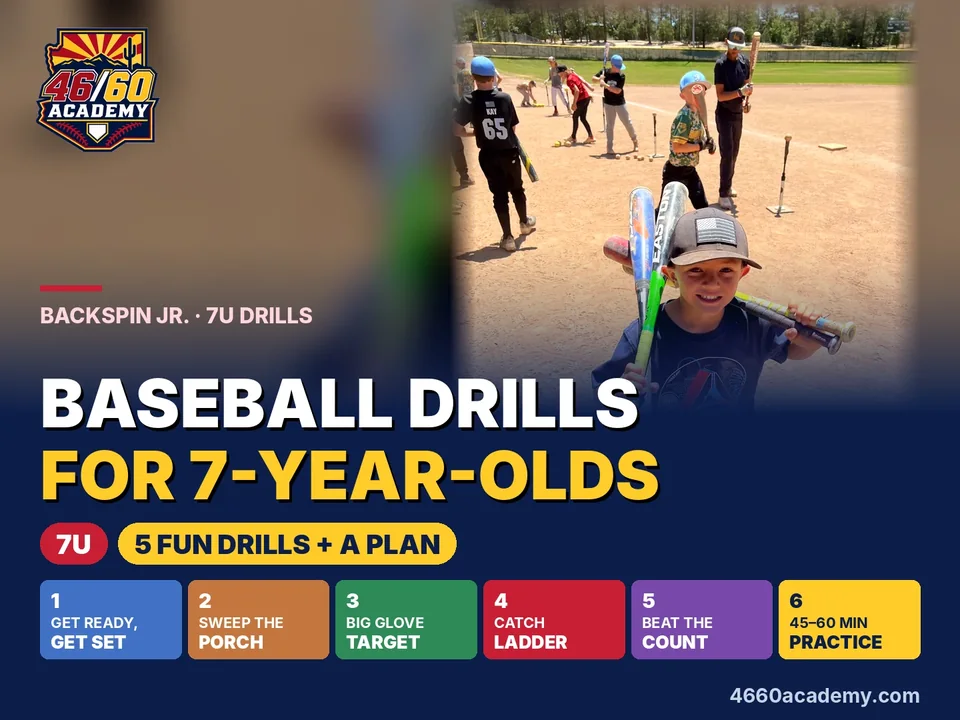
The best baseball drills for 7-year-olds are short games of about five minutes each: get-ready hitting off coach pitch, ground balls rolled right at them, throwing to a big target, a catch ladder and running through first. Use soft balls, keep groups tiny and end with a game.
Train it: 46/60 Coach Playbook ($59) → Free: Free 8U Practice Plan →What can a 7-year-old handle at practice?
Most 7-year-olds play coach pitch or machine pitch. Some leagues still use a tee for part of the game, so check your league's rules for your format.
At this age, kids can learn a ready position, a two-hand catch, a point-and-step throw and a real swing at a moving ball. What they can't do is stand in a line for long. Plan for about five minutes per drill, then switch.
- One cue per drill: "ready feet," "see it in," "point and step." One at a time.
- Tiny groups: two or three kids per spot, so nobody waits long.
- Soft balls first: softer training balls build trust and keep catches safe.
- Helmets on: anyone with a bat, near a bat or running bases wears one.
Five baseball drills for 7-year-olds
Each drill has a score, because a score keeps a 7-year-old locked in without you saying "focus."
- Get Ready, Get Set (hitting): the coach flips soft balls from a short distance, behind a screen if you have one. The hitter's job is to be loaded when the coach's arm comes up. Ten pitches; a point for every ball hit forward.
- Sweep the Porch (fielding): roll a soft ball a few steps to either side. The fielder shuffles in front, glove down, and rolls it back. Five clean stops in a row earns a high five.
- Big Glove Target (throwing): a parent holds a glove up at chest height from a short distance. Point, step, throw. Hit the glove, earn a point; three points and the parent takes one step back.
- Catch Ladder (catching): partners play catch with soft balls. Three catches in a row and both step back one step. A drop means one step closer. Nobody is out.
- Beat the Count (running): the runner starts at home and runs hard through first base while the coach counts out loud. Run through the bag, not to it. Kids race their own best count.
Short on helpers? Run Big Glove Target and Catch Ladder as one station. Both need only soft balls, a parent and someone counting out loud.
In the hitting drill, talk to them like they belong. Coach BK says "You got a bat, pitcher's got a ball… I'd bet on you every time!" For a 7-year-old, that means walk up to the plate expecting to hit it, not hoping.
A 45–60 minute practice shape for 7-year-olds
This shape works for 45 minutes and stretches to 60 by adding time to the stations. Our free 8U practice plan uses the same idea, and you can print it for the field.
| Minutes | What happens | Coach's cue |
|---|---|---|
| 5–8 | Warm-up: easy jog, shuffles, then short partner catch | Ready feet |
| 8–10 | Catch Ladder and Big Glove Target | Point and step |
| 15–20 | Three small stations: Get Ready hitting, Sweep the Porch, Beat the Count | One cue each |
| 3 | Water break | Drink, then back |
| 10–15 | Mini game: coach pitch, everyone bats, no outs counted | Run through first |
| 3 | Huddle: each player names one thing they did well | Proud of you |
Rotate stations on a whistle. One adult per station is the goal, and the hitting lane always gets the most watching. Keep everyone behind a cone line unless it's their turn to swing.
How do we do these drills at home?
Every drill above shrinks to a backyard or driveway. Ten to fifteen minutes is plenty for a 7-year-old at home. Stop while they still want more.
- Get Ready, Get Set: use foam or plastic balls and flip them from the side or from a short distance into a fence or net.
- Sweep the Porch: roll balls on grass or carpet. Count the stops out loud together.
- Big Glove Target: tape a square on a garage door or hang a towel and throw soft balls at it.
- Catch Ladder: parent and child, same rules. Let them win the last round.
Indoors, use only soft balls, clear the space and keep an adult right there. If anything hurts, stop for the day.
A quick tip: let your child be the coach for one round. Kids love calling out the cue, and teaching it helps it stick.
How do I keep a 7-year-old coming back?
Kids this age remember how practice felt more than what they learned. So start every practice with energy. Coach BK's line fits here: "It's a great day to be you!!" For a 7-year-old, it means show up happy and ready, like you belong out there.
- Praise the try: a good ready position deserves the same cheer as a clean catch.
- Rotate jobs: let a different kid be "ball captain" each night.
- Finish with a game: always. It's the part they talk about in the car.
Want every practice planned for you? The 46/60 Coach Playbook is $59 for one year: 24 lessons for volunteer coaches with what to teach, simple cues, fixes and 60-minute station plans.
One thing to remember
For a 7-year-old, five fun minutes with a score beats twenty minutes of standing in line.
What to do this week
Pick two drills from the list and run each for five minutes. Add Beat the Count at the end and let your child try to beat their own best count.
Parent questions
How long should a practice be for 7-year-olds?
About 45 to 60 minutes works well for most 7-year-olds. Break it into short blocks of 5 to 10 minutes and follow your league's field schedule.
Is my 7-year-old ready for coach pitch?
Many 7-year-olds play coach pitch or machine pitch, but formats vary, so check your league's rules. If your child can hit off a tee and track a soft toss, short front toss at home is a good next step.
What equipment do I need for 7-year-old drills?
Soft training balls, a glove, a safe youth bat, a helmet, a few cones and a tee cover most drills. Check your league's rules before buying a bat.
COMING SOON · JOIN THE WAITLIST →
Sources: Little League: Coach Pitch program