
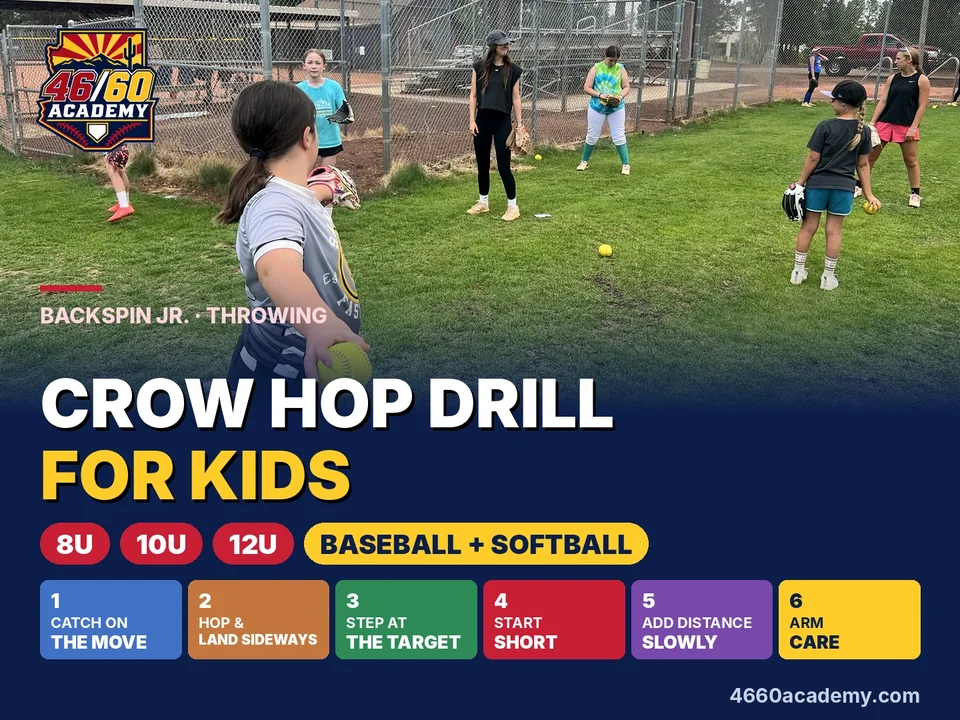
To teach the crow hop, break it into three words: hop, step, throw. Your child skips forward on the throwing-side foot, strides at the target and throws, first with no ball, then at a short distance. It fixes the flat-footed, arm-only outfield throw that bounces three times while the runner keeps going, and kids can learn it in the backyard.
A crow hop is a short skip outfielders use after a catch: the throwing-side foot comes forward and hops, landing sideways, then the glove-side foot steps at the target as the ball is thrown. Teach it slowly without a ball, then at short distance, and add distance only while throws stay on line.
Train it: Confident Thrower (Level 2 Throwing) → Free: Free throwing skill guide →What is a crow hop, and when should my kid use it?
The crow hop is a quick skip that turns the body sideways and carries it toward the target before the throw. The legs and hips help, so the arm doesn't have to muscle the ball.
Outfielders use it when they have a longer throw and a moment to set their feet: after a fly ball, or after fielding a ground ball in front of them. Infielders on a quick play usually skip it, because a fast release matters more.
Many kids are ready to learn it around 8 to 10, once they can catch a soft toss and throw with a step. Younger players can try it as a game. Go by readiness, not birthday.
It works the same in baseball and softball, because outfielders in both sports throw overhand. The goal isn't a cannon arm. The goal is a throw that gets to the infield on a line, so a runner thinks twice about taking the extra base.
How do I teach the crow hop step by step?
Teach it in four parts. We'll describe a right-handed thrower; lefties flip the feet.
- Catch and gather: ball in the glove, both hands come together at the chest, eyes on the target.
- Hop: the right foot comes forward and the player skips off it, landing on that same foot turned sideways. Now the front shoulder points at the target.
- Step: the left foot strides straight at the target.
- Throw and finish: throw over the top and let the body keep moving toward the target, with the throwing arm finishing across the body.
Give your child three words: hop, step, throw. Say them out loud together for the first few days. The rhythm sticks faster than any explanation.
Watch for three common mistakes:
- Hopping up instead of forward: it's a low skip toward the target, not a jump.
- Drifting off line: lay a rope or bat on the ground pointing at the target and hop along it.
- Rushing the arm: the ball comes out after the front foot lands, not during the hop.
What is a good backyard crow hop progression?
Keep sessions to 10 or 15 minutes. Move to the next step only when the one before looks smooth.
- Dry runs: no ball. Ten slow reps of "hop, step, freeze." Check that the front shoulder points at the target on the freeze.
- Short throws: partner a short distance away. Ten easy crow-hop throws, aiming chest high.
- Roll and hop: you roll a slow ball. Your child fields it, gathers, crow hops and throws to you or a net.
- Toss and hop: you toss an easy pop-up. Catch, gather, hop, step, throw.
- Earn the distance: after a set where most throws arrive on line, back up a few steps. If throws start sailing, move back in.
Coach BK likes to say "See that wall… knock it down!" For a young outfielder, that means throw with big, controlled intent at the target, not a wild heave.
What games make the crow hop stick?
A score keeps kids locked in without you saying "focus." Try these:
- Line-drive lane: set two lines of cones to make a lane toward the target. A throw that stays inside the lane, in the air or on one hop, scores a point.
- Beat the runner: a sibling runs from a cone to a base while your outfielder fields, hops and throws. Ball beats runner, outfielder scores.
- Hit the cutoff: a partner stands with both arms up like a cutoff player. Chest-high throws they can catch without moving score two points.
- Team relay: at practice, two lines race to pass the ball down the line with crow-hop throws. Dropped ball goes back to the start.
Praise the right thing. A low throw on one hop that reaches the target is a great throw. A high, long throw that sails over everyone is not.
At team practice, run the crow hop as a 10-minute outfield station with two or three kids per line. A coach rolls or tosses, one parent catches at the target, and kids rotate after every throw so nobody stands around.
How do I protect my child's arm while learning it?
The crow hop adds power, so it adds work for the arm. Treat crow-hop throws like real throwing.
- Warm up first: jog, arm circles, then easy short catch before any crow-hop throws.
- Start short: build distance during the session. Never start with long throws.
- Plan rest days: put days off from throwing in every week, especially during the season.
- Stop if it hurts: elbow or shoulder pain ends throwing for the day. If it keeps coming back, talk to your pediatrician.
- Follow league rules: pitchers have pitch-count and rest rules, so follow your league's rules and count crow-hop work as throwing too.
For more age-right drills, our free throwing skill guide has 8U, 10U and 12U cues. When you want a full plan, Confident Thrower is our 16-session Level 2 throwing program for baseball and softball players 7–12, included in the $25/month 46/60 membership.
One thing to remember
The legs make the throw: hop, step, then throw, and add distance only when the ball stays on line.
What to do this week
Do two 10-minute backyard sessions with a rest day between: ten dry hops, then short crow-hop throws to a partner. Finish each one with the line-drive lane game.
Parent questions
Should infielders use a crow hop?
Infielders usually skip the crow hop on a quick play, because a fast release matters more. Outfielders, with longer throws and a moment to set their feet, get the most from the crow hop.
What age should kids learn the crow hop?
Many kids are ready to learn the crow hop around 8 to 10, once they can catch a soft toss and throw with a step. Younger kids can try it as a fun footwork game.
Is the crow hop the same in baseball and softball?
Yes. Outfielders in both baseball and softball throw overhand, and the hop, step, throw footwork works the same way to get a stronger throw back to the infield.
SEE CONFIDENT THROWER (LEVEL 2 THROWING) →
Sources: Nationwide Children's Hospital — Throwing Guidelines for Young Players