
Every young player wants a strong arm. The good news is that a strong arm is built the same way a good habit is: a little at a time, with rest in between. Here is a simple throwing program parents can run in the backyard.
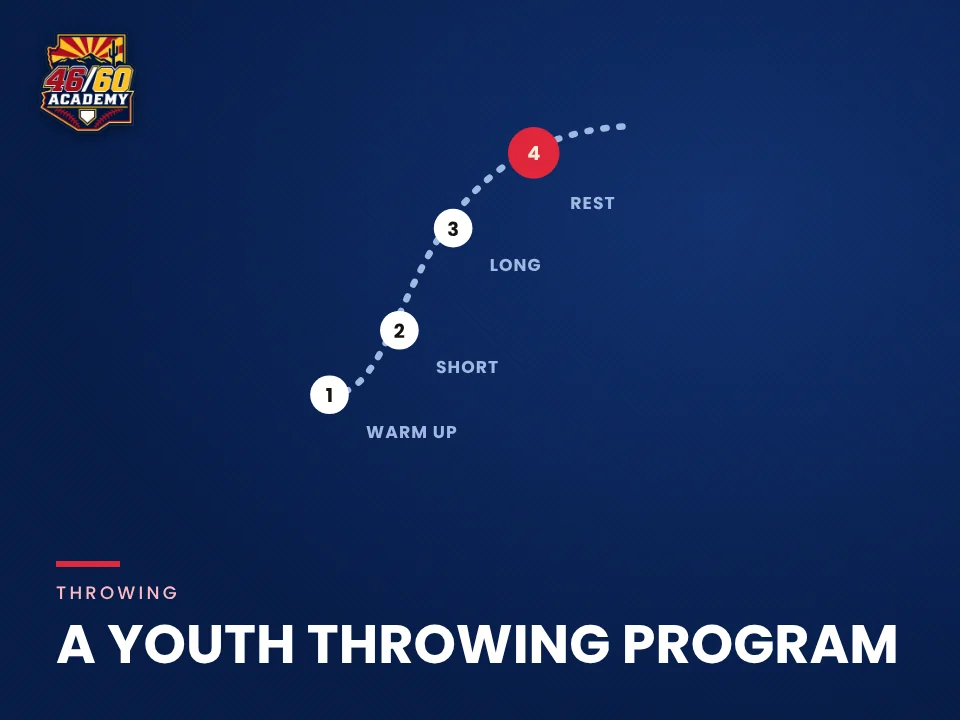
A good youth throwing program has a short warm-up, catch that starts close and moves back slowly, a few throwing days a week with rest days in between, and real time off from throwing each year. If the arm hurts, stop and check with your pediatrician.
Train it: Confident Thrower (Level 2 Throwing, $49) → Free: Free Throwing Intro Course →Start every throwing day with a warm-up
Cold arms and fast throws do not mix. Before the first throw, get the whole body moving for about 5 minutes.
- Get the body warm: a slow jog, skips or side shuffles for a minute or two.
- Arm circles: small circles forward and back, then bigger ones. Easy, not fast.
- Easy flips: soft, short tosses from a few steps apart. Ten easy throws.
- Check in: ask, "How does your arm feel?" Make that question a normal part of every day.
MLB and USA Baseball's Pitch Smart guidelines remind players to properly warm up before pitching. We use the same idea for every throwing day, not just pitching.
Short to long: how catch should build
Good catch starts close and moves back slowly. Every throw should be on purpose, at a target, with good footwork. If throws start sailing or bouncing, move closer.
| Part | What to do | Look for |
|---|---|---|
| Close (3–4 min) | A few big steps apart, easy throws to the chest | Step toward the target, follow through |
| Middle (3–4 min) | Back up a few steps at a time | Same smooth motion, still on target |
| Farther (2–3 min) | Only as far as they can throw with good form | Arcing throws, no straining |
| Back in (2 min) | Walk back in for a few easy, accurate throws | Finish with clean catches and good throws |
The farthest distance is not a goal to chase. It is just as far as your child can throw with a relaxed, smooth motion. If they have to lean back and heave it, that is too far today.
Keep it fun with a target game: one point for every throw that hits the partner's chest. Try to beat yesterday's score at the close distance before you back up.
A simple weekly throwing schedule
Young arms need rest as much as reps. A simple week might look like this during the season:
- Throwing days: a few days a week with the warm-up and short-to-long catch, counting practices and games.
- Rest days: at least one easy day between hard throwing days. Rest days can still include running, hitting off a tee or a different sport.
- Game days count: if your child plays or pitches in a game, that is a throwing day. Don't add extra throwing at home that night.
- Pitching is its own thing: follow your league's pitch-count and rest rules. Our youth pitch count guide for parents explains how to use them.
Pitch Smart also recommends avoiding playing catcher on days a player is not pitching, not pitching in more than one game on the same day, and not playing for more than one team at the same time. Check your league's rules and talk with your coach.
Time off and other sports
Building an arm is a year-round story, and part of that story is time away from throwing.
For ages 9–12, Pitch Smart recommends taking at least 4 months off from throwing every year, with at least 2–3 of those months in a row. It also recommends playing other sports during the year.
That is great news for families. Soccer, swimming, basketball and running all build an athlete. As Coach BK tells every player, "Don't collect drills. Build a complete player." A kid who moves well in lots of sports usually throws better, too.
When to stop throwing for the day
This is the most important part of any throwing program. Pain is never something to push through.
- Arm pain: stop throwing for the day. Pain in the elbow or shoulder is a reason to call your pediatrician.
- Tired arm: if throws get slower, lower or wild, or your child shakes the arm out, the day is done.
- Changed motion: if they start throwing sidearm or pushing the ball, that can be fatigue. Stop and rest.
- Not wanting to throw: a kid who usually loves catch but suddenly doesn't may be hurting. Ask gently.
Want a step-by-step plan? The free Throwing Intro Course has seven short parent-led lessons. When your child is ready for more, Confident Thrower ($49) is our 16-session Level 2 throwing program for ages 7–12.
One thing to remember
Warm up, start short, build slowly and rest on purpose; if the arm hurts, the day is over.
What to do this week
Run the warm-up and short-to-long catch on two or three non-game days, with a rest day in between. End each session by asking, "How does your arm feel?"
Parent questions
How many days a week should a 10-year-old throw?
A few days a week is plenty for most kids, with rest days in between and games counting as throwing days. Follow your league's rules for pitching and ask your coach.
Is long toss safe for young kids?
Throwing farther is fine if it builds slowly and the motion stays smooth and relaxed. Only go as far as your child can throw with good form, and stop if anything hurts.
Should my child throw in the offseason?
Some light throwing is fine, but plan real time off. Pitch Smart recommends at least 4 months off from throwing each year for ages 9–12, with 2–3 of those months in a row.
SEE CONFIDENT THROWER (LEVEL 2 THROWING, $49) →
Sources: MLB/USA Baseball Pitch Smart: pitching guidelines, ages 9–12