
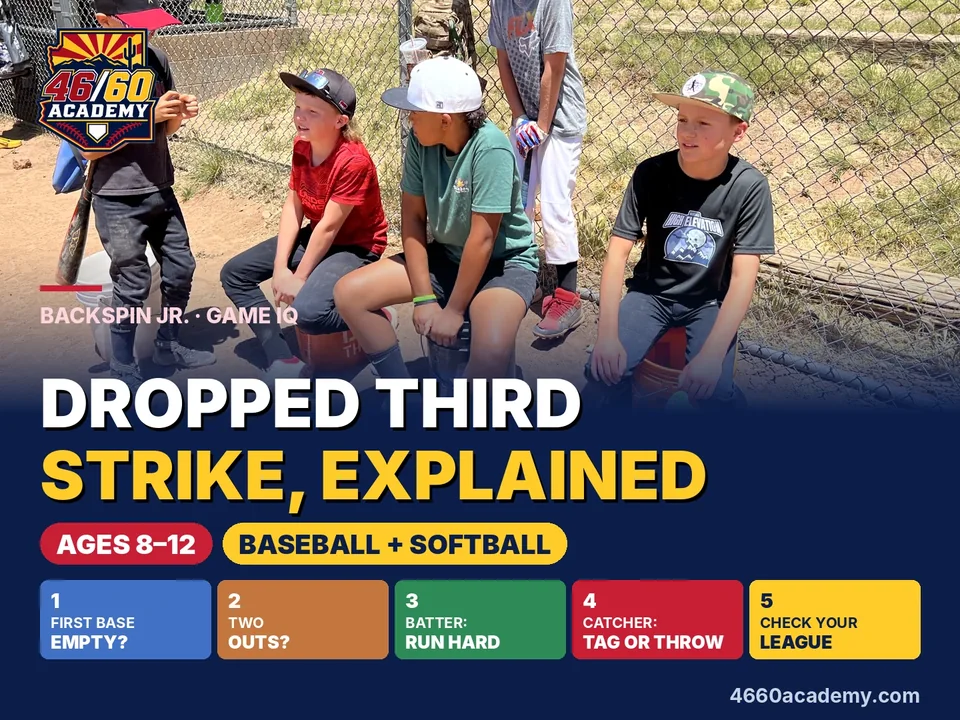
A dropped third strike is a strike three the catcher doesn't catch cleanly, and in leagues that use the rule the batter can sometimes run to first. If you've seen a strikeout bounce away from the catcher and heard the whole stands yell "Run!", that's what happened. Here's the rule in plain words, plus how to teach it to batters and catchers ages 8 to 12 in baseball and softball.
A dropped third strike happens when the catcher doesn't cleanly catch strike three, including a pitch that bounces first. In leagues that use the rule, the batter can run to first if first base is empty or there are two outs, and the defense must tag the batter or throw to first to get the out.
Train it: Game IQ Playmaker (Level 2 Baseball IQ) → Free: Free Baseball IQ Skill Guide →What is a dropped third strike?
Normally, strike three means the batter is out. But the rule says the catcher has to catch strike three cleanly. If the catcher drops it, or the pitch hits the dirt before it's caught, the strikeout isn't finished yet.
In that case, the batter may become a runner and try to reach first base. The defense then has to tag the batter or throw to first before they get there. The pitcher still gets credit for a strikeout either way.
Here's a tip for parents in the stands: on a dropped third strike, many umpires don't make the usual "out" call. Little League teaches plate umpires to point out to the side with no voice so players don't think the batter is out. If the umpire is quiet, the play may still be alive.
When can the batter run to first?
This part confuses everyone at first, so here it is in two lines. Under the rules used at higher levels, the batter can run on a dropped third strike when:
- First base is empty, no matter how many outs there are, or
- There are two outs, even if first base is taken.
If there's a runner on first and fewer than two outs, the batter is simply out. That keeps the catcher from dropping the ball on purpose to start an easy double play.
| Situation | Can the batter run? |
|---|---|
| Nobody on first, 0 or 1 out | Yes |
| Nobody on first, 2 outs | Yes |
| Runner on first, 0 or 1 out | No, batter is out |
| Runner on first, 2 outs | Yes |
Does my child's league use the dropped third strike?
Maybe not yet. Many younger divisions call the batter out on strike three whether the catcher catches it or not. For example, Little League's Tee Ball and Minor League divisions don't use it, while its older divisions do.
Fastpitch softball has its own version of the rule, and the age it starts can vary by league. Leagues also have different rules for a batter who walks toward the dugout instead of running. Check your league's rules so you know what to teach before the first game.
How do I teach the dropped third strike to batters and catchers?
Coach BK says "Two choices: A. Do everything in your control. B. Anything but A." Whether the catcher holds on to strike three isn't in your control. Running hard to first when the ball gets away is.
- Batters, look and listen: on every strike three, take one quick look at the catcher. If the ball is on the ground or the coach yells "Go!", drop the bat in the dirt and sprint to first.
- Run until someone says out: never jog back to the dugout before the play is over. Let the umpire make the call.
- Catchers, block and find it: keep balls in the dirt in front, pick it up and tag the batter if they're close.
- Catchers, clear throw to first: if the batter is running, step to the side so the throw doesn't hit the runner, then throw to first.
- First basemen, be ready: on strike three with first base open or two outs, go to the bag and give the catcher a target.
Practice it with a quick game: a parent or coach rolls a ball a few feet from the catcher and yells "Strike three!" The batter runs to first and the catcher tries to tag or throw. Use a soft ball, and keep the batter running in foul ground so nobody gets hit by the throw.
What if the bases are loaded?
With two outs and the bases loaded, every runner is forced to run. On a dropped third strike, the catcher can pick up the ball and simply step on home plate for the out. It's one of the easiest outs in baseball, and one of the easiest to forget. Make sure your catcher knows it.
One thing to remember
On a dropped third strike, the play isn't over until someone makes the out, so batters run hard and catchers finish the play.
What to do this week
Ask your coach whether your league uses the dropped third strike. Then play the "Strike three!" game in the yard for 10 minutes, letting your child be the batter and the catcher a few times each.
Parent questions
Does a dropped third strike count as a strikeout?
Yes. The pitcher still gets a strikeout and the batter is still charged with one, even if the batter reaches first. That's why a pitcher can sometimes get more than three strikeouts in an inning.
Can my child run on a dropped third strike in coach pitch?
Usually not. Many younger divisions call the batter out on strike three no matter what the catcher does. Check your league's rules.
Is the dropped third strike the same in softball?
Fastpitch softball has a similar rule, but details and the age it starts can be different. Ask your coach or check your league's rules.
SEE GAME IQ PLAYMAKER (LEVEL 2 BASEBALL IQ) →
Sources: Wikipedia — Uncaught third strike (summarizes MLB Official Baseball Rules 5.05 and 5.09 and Little League divisions) · Little League University — Uncaught Third Strike (obvious) Mechanic · MLB.com — Odd, but not out: Baseball's most bizarre rule · Livestrong — Rules for a Dropped Third Strike in Softball