
You raised your hand at the parent meeting, and now you're the T-ball coach. Good news: you don't need to know much baseball to do this well. You need a simple plan, a few parent helpers and a lot of patience.
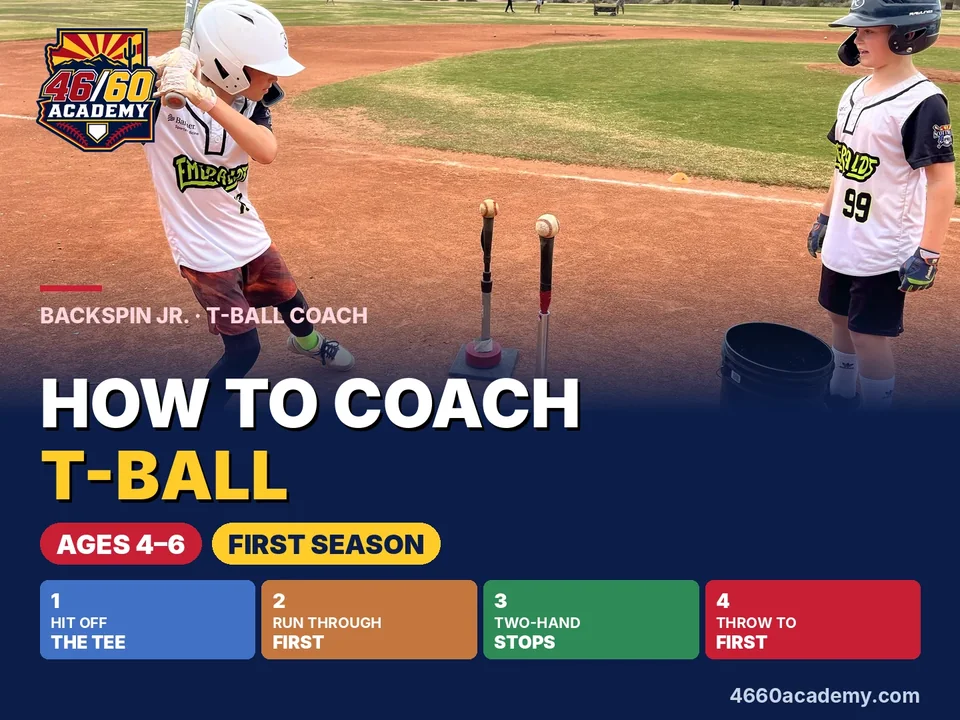
To coach T-ball, teach four things all season: hit off the tee, run to first, stop the ball with two hands and throw to first. Keep practices short with small groups and stations, let every kid play lots of spots, and measure success by whether they want to come back next year.
Train it: 46/60 Coach Playbook ($59) → Free: Free Practice Plan Builder →What is my real job as a T-ball coach?
Your job is to give 5- and 6-year-olds a happy first season. Little League says its main goal is growing good people, not star ballplayers. A first-year T-ball coach writing for Little League put it simply: at this age, focus on keeping kids interested and engaged.
That means a good season is not about wins. It's kids who smile, try hard, listen a little better each week and ask to play again next spring.
Coach BK likes to start the day with this one: “It's a great day to be you!!” For a T-ball player, it means show up with energy and know you belong out there.
What should I teach in a T-ball season?
Pick four skills and repeat them all season. Kids this age learn by doing the same fun thing many times, not by hearing something new every week.
| Skill | What it looks like | One cue |
|---|---|---|
| Hitting off the tee | Feet set, eyes on the ball, big swing | “Hit the back of the ball.” |
| Running to first | Drop the bat, run hard, run through the bag | “Run through first.” |
| Stopping the ball | Get in front, glove down, two hands | “Alligator hands.” |
| Throwing to first | Point, step, throw to the first baseman | “Where's the ball going? First!” |
Skip the rest for now: cutoffs, double plays, signs and long talks about rules. Those come later. If a kid drops the bat, runs to first and the fielder throws there, that's a big win in T-ball.
How do I run a T-ball practice?
Short and busy. About 45 minutes is plenty. Little League's coach pitch program suggests one coach for no more than four players, and that works in T-ball too. Ask three parents to help before the first practice.
- Warm-up game (5 minutes): run the bases, or run to the base the coach calls out.
- Three stations (8 minutes each): tee hitting, ground ball rolls with soft balls, and partner throwing. Rotate on a whistle.
- Water break (3 minutes).
- Mini game (10 minutes): everyone hits, everyone runs, every fielder throws to first.
- Team huddle (2 minutes): one thing we did great, then a team cheer.
Keep lines to three kids or fewer and give waiting kids a job, like resetting the tee or pointing to first. Helmets on for every hitter and runner, a swing circle nobody walks into, soft balls for throwing, and stop if anything hurts.
What happens at a T-ball game?
T-ball games look a lot like practice with a crowd. Many leagues have every player bat each inning, rotate players through the field and don't keep score. Rules vary a lot, so check your league's rules on innings, outs, positions and whether coaches can help on the field.
- Post the batting order on a clipboard so you're not deciding in the moment.
- Rotate positions every inning so no one is stuck in the far outfield all season.
- Put a coach in the field if your league allows it, to point and say “throw to first.”
- Expect chaos: kids will pile onto one ball, sit in the grass or chase a butterfly. That's T-ball. Smile and reset.
When something goes wrong, use the mistake ritual from Little League's program: a quick throw-away motion and “Toss it! Get ready for the next play.” It teaches kids to let a mistake go in two seconds.
How do I keep T-ball parents on my side?
Send a short message before the first practice: the schedule, what to bring (glove, water, comfortable shoes), and your goal for the season, which is fun and learning. Most parents just want their kids to have a good time and make friends.
Ask parents to cheer effort, not results, and to let the coaches do the coaching during games. Give helpers a simple station card with the drill and the cue, and they'll come back every week.
Coach BK has another line that works for parents and kids: “Two choices: A. Do everything in your control. B. Anything but A.” For a T-ball player, what they control is listening, hustling and trying again after a miss.
When your players move up to coach pitch and kid pitch, the 46/60 Coach Playbook gives volunteer coaches lessons, cues and station plans for 8U to 12U, and the first three lessons are free.
One thing to remember
Teach four simple skills all season, keep every kid moving, and judge your season by how many kids want to play again.
What to do this week
Recruit three parent helpers, send your welcome message and print a 45-minute station plan. At the first practice, teach only one thing: hit it, drop the bat and run through first.
Parent questions
How long should T-ball practice be?
About 45 minutes for most 5- and 6-year-olds. Short stations, a water break and a mini game keep them focused.
Do they keep score in T-ball?
Many leagues don't keep score at this age, and many have everyone bat each inning. Rules vary, so check your league's rules.
What equipment does a T-ball coach need?
Batting tees, a few bats in different sizes, batting helmets, bases, cones and a bucket of soft balls are a great start. Your league may provide some of it, so ask before you buy.
COMING SOON · JOIN THE WAITLIST →
Sources: Little League: My First Year as a Little League Tee Ball Coach · Little League: Coach Pitch 12-Week Program