
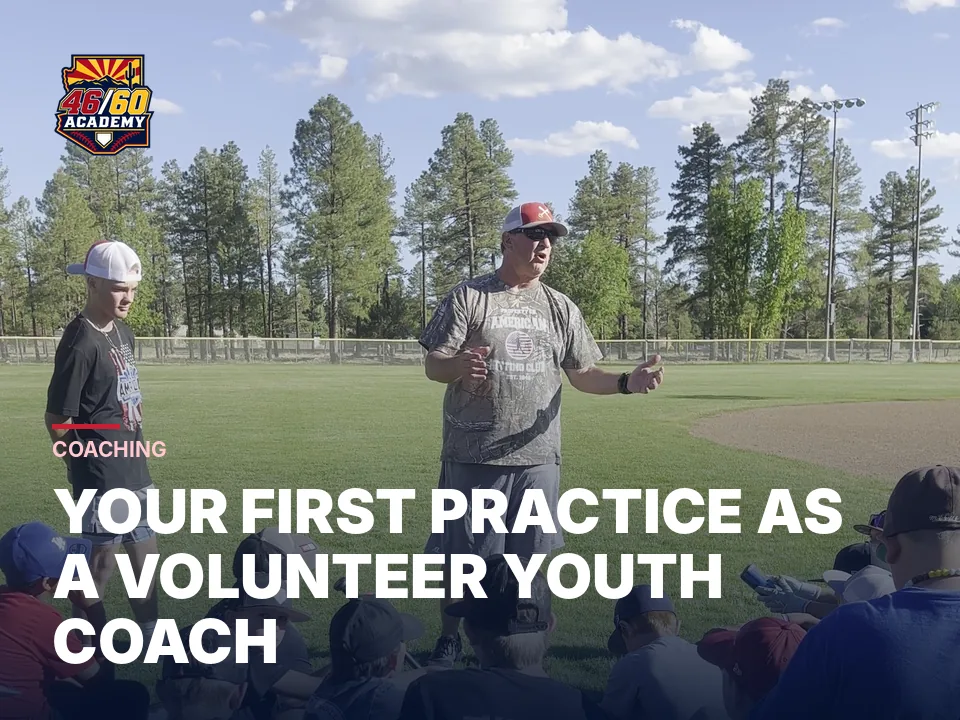
You said yes. Now you have a bag of balls, a roster of 10 or 12 kids, and a field for about an hour. Here's a simple plan to make your first practice as a volunteer coach safe, busy and fun.
Run your first practice in stations: a short welcome and warm-up, then three rotating groups for throwing and catching, fielding and hitting, and finish with a team game. Keep lines to two or three kids, talk less, and end with a quick parent huddle.
Train it: 46/60 Coach Playbook ($59) → Free: Free Practice Plan Builder →Before day one: what to get ready
A little prep makes the first practice feel easy. You don't need fancy gear. You need a plan and a few helpers.
- Gear: A bucket of balls, a few soft or foam balls, a batting tee, cones or bases, and a first-aid kit.
- Helpers: Ask two or three parents to run a station. Give each one a simple card with the drill and one cue.
- Info: Each child's emergency contact and any medical notes, like allergies or asthma.
- Water: Remind families to send a full water bottle. Plan shade and breaks, especially in hot weather.
- Plan on paper: Use our free practice plan builder to lay out stations and times, then print it.
Also read your league's rules. Field size, pitching rules and equipment rules differ by league and age, so check your league's rules before practice starts.
A ready-to-run 60–75 minute first practice
This plan works for most 8U–12U teams. For a 60-minute practice, use the shorter times. For 75 minutes, stretch each station a bit.
| Time | Block | What happens |
|---|---|---|
| 0–5 min | Welcome | Names, one fun question, two team rules: listen and hustle. |
| 5–15 min | Warm-up | Jog, skips, side shuffles, arm circles, then short, easy catch with a partner. |
| 15–30 min | Station 1 | Throwing and catching: partner catch at a short distance, then a target game. |
| 30–45 min | Station 2 | Fielding: rolled ground balls, field and throw to a coach at a cone. |
| 45–60 min | Station 3 | Hitting: tee work into a fence or net, soft toss with foam balls. |
| 60–70 min | Team game | Baserunning relay or a simple scrimmage game. |
| 70–75 min | Huddle | One thing we learned, one shout-out, team cheer. |
Split the team into three groups of three or four. Each group starts at a different station, and you rotate on a whistle. That way nobody waits long and every coach works with a small group.
For age-specific drills and printable plans, our free 8U practice plan is a great next step once your first practice is done.
How do I keep 10 kids moving the whole time?
The fastest way to lose a group of 9-year-olds is a long line. Keep lines to two or three kids, and give the waiting kids a job.
- Talk for 30 seconds, then go: Show the drill once, give one cue, and let them try.
- Give everyone a ball: More balls means more touches and less standing around.
- Make it a game: Count catches in a row, hit a cone, beat the clock.
- Praise effort out loud: "Great hustle!" and "Nice try!" go a long way.
- Move on while it's fun: End a drill before kids get bored, not after.
Learn every name on day one and use it. A child who hears "Nice throw!" with their own name attached feels seen, and kids who feel seen listen better. Name tags on helmets or shirts can help for the first week.
At the hitting station, keep the energy up. As Coach BK tells every player, "It's a great day to hit!!" Say it at the start of practice and watch the smiles.
Safety basics for every practice
Safety comes first, every time. A few simple habits protect kids and give parents confidence in you.
- Spacing: Keep hitting stations far from other groups. Only the batter holds a bat; everyone else stands behind a fence or a safe line.
- Soft balls: Use foam or soft balls for close-range hitting drills and with newer players.
- Short throws: Warm up first and keep throwing distances short on day one.
- Water and shade: Plan regular breaks. In heat, take more breaks than you think you need.
- Stop for pain: If a child says something hurts, they sit out and you tell a parent.
- Adults supervise: Never leave kids alone, and make sure every child is picked up before you leave.
Walk the field before kids arrive. Look for holes, rocks, sprinkler heads and loose gear. It takes two minutes and prevents a lot of twisted ankles.
Running a quick parent meeting
Take five to ten minutes at the end of the first practice to meet the parents. Keep it friendly and short.
- Introduce yourself and say why you're coaching.
- Share your goals: have fun, learn skills, play hard, be a good teammate.
- Explain how you'll communicate: one group text or app, and when you'll send updates.
- Ask for help: station helpers, a snack schedule, someone to keep the book.
- Set one simple rule: parents cheer from the fence and leave coaching to the coaches during games.
If you want a full season of lessons, cues, fixes and 60-minute station plans, the 46/60 Coach Playbook ($59, one year of access) has 24 lessons built for 8U–12U volunteer coaches. Lessons 1–3 are free.
One thing to remember
A great first practice is safe, busy and fun, so kids leave excited to come back.
What to do this week
Build your first practice in the free practice plan builder and print it. Ask two parents to run stations, and plan a five-minute parent huddle at the end.
Parent questions
How long should a youth baseball practice be?
For 8U–12U, 60 to 75 minutes is usually plenty. Shorter, busy practices keep young players focused better than long ones.
What if I've never coached baseball before?
That's okay. Plan stations, keep instructions short, and focus on fun and effort. Kids mostly need a safe, organized coach who cares.
How many parent helpers do I need?
Two or three helpers lets you run three stations with small groups. Give each one a simple card with the drill and one cue.