
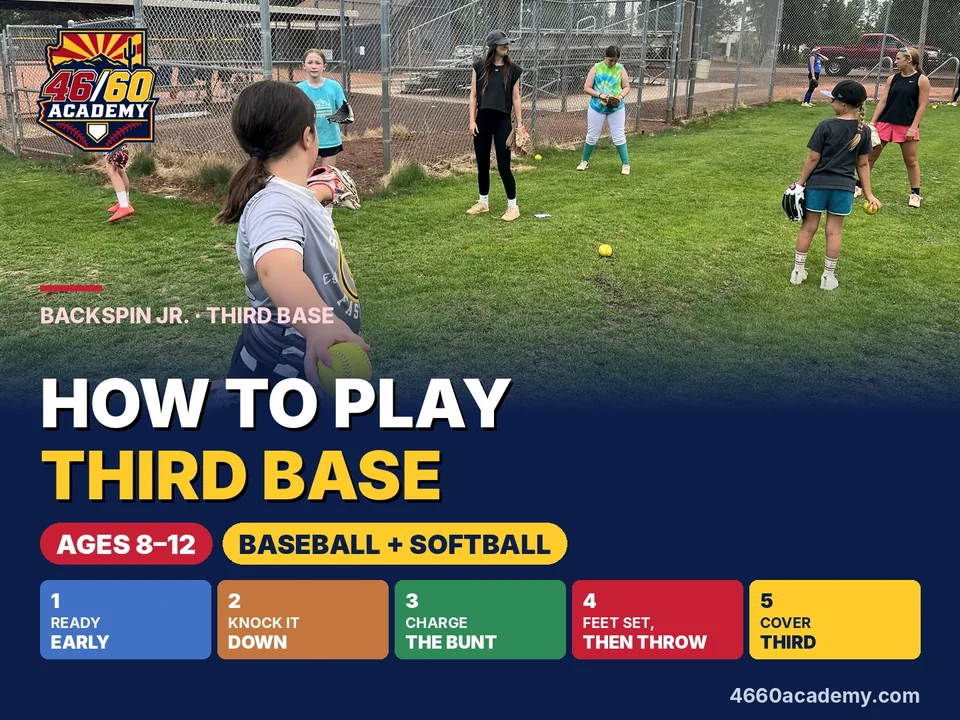
To play third base, a kid gets into a low ready position early, keeps hard-hit balls in front, charges bunts and sets their feet before the long throw to first. Third base is called the hot corner for a reason: hard-hit balls get there in a hurry. The job itself is simple once a young player knows what to do, and here's how to help your 8- to 12-year-old play it with confidence in baseball or softball.
To play third base, a kid stands a few steps off the bag, gets into a low ready position before every pitch and keeps hard-hit balls in front, even if that means knocking them down. Third basemen charge bunts and slow rollers, and they set their feet before the long throw across the diamond to first.
Train it: Complete Defender (Level 2 Fielding) →Where does a third baseman stand?
The third baseman plays near third base, a few steps off the bag toward shortstop and usually even with the base or a little behind it. For most 8- to 12-year-olds, a good starting spot is a step or two inside the foul line and about even with the bag.
Move in a few steps when a bunt is possible, like with a runner on first and less than two outs, or when the batter is fast. Move back a step against a big hitter. Your coach will set the spot, so teach your player to look to the dugout and check their position before every pitch.
Why do third basemen need to be ready early?
Third base is close to home plate, so hard-hit balls get there fast. MLB's glossary says third basemen ideally have quick reactions and a strong, accurate arm, and must be ready for bunts. For a young player, that means being ready before the ball is hit, not after.
- Get set early: feet a little wider than the shoulders, knees bent, weight on the balls of the feet and the glove out in front.
- Little hop as the pitch arrives: a small step or hop as the ball reaches the plate gets the feet moving so they can react.
- Eyes on the hitting zone: watch the ball come into the bat, not the batter's face.
Coach BK says "Two choices: A. Do everything in your control. B. Anything but A." For a young third baseman, being low and ready on every single pitch is fully in their control, even when the ball never comes their way.
What does a third baseman do on each play?
- Knock it down: a hard ground ball doesn't have to be caught cleanly. Keep it in front with the glove and the chest turned to the ball, pick it up and you can still get the out.
- Charge the bunt: on a bunt or slow roller, run in hard. Field it with two hands when you can, then set your feet before you throw.
- Make the long throw: it's a long way from third to first. Point the front shoulder at first and throw through the target. If you can't set your feet, hold the ball.
- Cover third: when a runner might come to third, get to the bag and give the thrower a target.
- Call the pop-up: on a pop-up you and the shortstop can both reach, talk early and loud so only one of you goes for it.
Who covers which base on bunts and steals changes by team and age group, so ask your coach how your team does it.
What third base drills can kids do at home or practice?
Use soft or safety balls, especially indoors, and give your player plenty of room. Warm up the arm first, keep long throws to a small handful and stop if anything hurts.
- Ready-hop game (3 minutes): say "pitch" and have your player do their little hop. Then roll the ball quickly to the left, right or straight at them. Score a point when they're set before the ball leaves your hand.
- Knock-down rolls (5 minutes): from 20 to 30 feet, roll firm grounders. The goal is to keep every ball in front. A knocked-down ball they pick up counts the same as a clean catch.
- Bunt charge (5 minutes): set a ball still on the grass about 15 feet in front of them. They charge, field it with two hands, set their feet and throw to you or a net.
- Hold or throw? (3 minutes): roll a few balls far to their left. If they can set their feet, they throw. If not, they hold it up and yell "Hold!" Praise the smart holds.
Is third base different in softball?
The jobs are the same, but the field is smaller, so everything happens faster. Softball third basemen often play in closer to the plate to handle bunts and slappers, which means even less time to react.
Many softball infielders wear a fielder's face mask, and some baseball families like one too. Ask your coach and check your league's rules. Rotate positions while kids are young, too. A player who has also tried shortstop, first base and the outfield understands what everyone else needs from the hot corner.
One thing to remember
A young third baseman wins by being ready early, keeping the ball in front and only throwing when the feet are set.
What to do this week
Do the ready-hop game and the bunt charge twice this week for 10 to 15 minutes. Keep long throws to a small handful and cheer every ball they knock down and keep in front.
Parent questions
Is third base a good position for a young player?
Yes, for a kid who likes action and is comfortable reacting to hard-hit balls. Many young players try third along with other spots. If your child is nervous about the ball, start with soft balls and slow rolls and build up.
Does a third baseman need a strong arm?
A dependable arm helps because the throw to first is long. Good footwork matters just as much. A player who sets their feet and throws through the target will beat a strong arm that rushes.
Should my child wear a face mask at third base?
Many softball infielders wear a fielder's face mask, and some baseball players do too. It's a family choice. Talk with your coach and check your league's rules about equipment.
SEE COMPLETE DEFENDER (LEVEL 2 FIELDING) →
Sources: MLB.com Glossary — Third Baseman · Little League University — Infield Drill Progression (content provided by USA Baseball) · MOJO Sports — Softball Positions Explained