
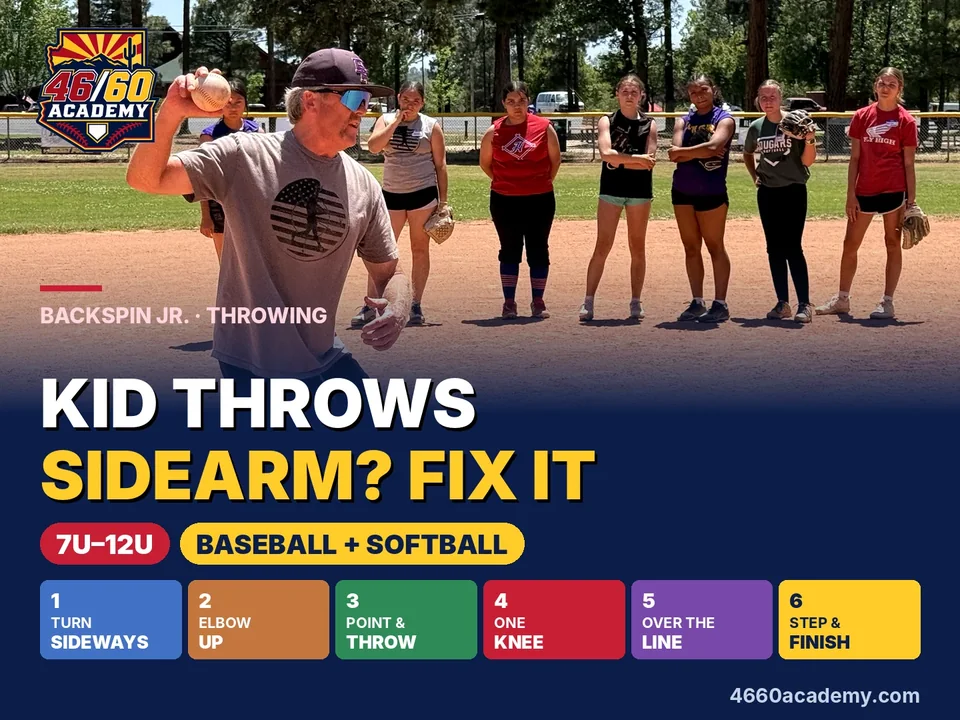
To fix a kid's sidearm throw, turn them sideways to the target, get the elbow up to about shoulder height, step at the target and finish across the body, using short, easy throws. Lots of 7 to 12 year olds throw sidearm. It usually starts with the feet and body, which makes it very fixable.
When a kid throws sidearm, it usually comes from facing the target, a tired arm or a ball that feels too heavy, so the elbow drops below the shoulder. Fix it by turning sideways, getting the elbow up to about shoulder height, stepping at the target and finishing across the body, with short, easy throws.
Train it: Confident Thrower (Level 2 Throwing) → Free: Free throwing skill guide →Why does my kid throw sidearm?
Sidearm means the arm swings around from the side with the elbow below the shoulder, instead of coming over the top or from a high three-quarter slot. In young players it usually comes from one of these:
- Facing the target. When the chest faces the target from the start, the only way to throw is to sling the arm around the side.
- A tired arm. Late in a practice or after lots of throws, the elbow sinks.
- A ball that feels too heavy or too far. Throwing from too far away makes kids muscle it with the whole arm.
- Copying. They saw an infielder throw on the run and think that's how every throw looks.
Older infielders sometimes drop the arm on a quick throw on the run. That's a different skill. For everyday throws, we want the elbow up.
Is throwing sidearm bad for kids?
A sidearm throw now and then isn't an emergency. But a low elbow is harder to aim, the ball tails away from the target, and it puts the arm in a weaker position.
Stanford Medicine Children's Health lists improper technique, repetition and trying to do too much, too fast among the causes of youth throwing injuries. That's why we fix the form with short, easy throws, not more throws.
If your player has elbow or shoulder pain, stop throwing and check with your pediatrician before working on any fix.
How do I fix a sidearm throw step by step?
Use these steps on every throw at 20 to 30 feet before backing up.
- Turn sideways: the glove shoulder points at the target, so the chest isn't facing your partner from the start.
- Point the glove: the glove arm reaches out toward the target.
- Get the elbow up: the throwing hand is up with the ball facing away and the elbow at about shoulder height, like an "L."
- Step at the target: the glove-side foot steps right at your partner.
- Finish across the body: the throwing hand ends down by the opposite knee, like reaching into the other pocket.
- Keep it short: 10 to 15 throws per drill, and stop before the arm gets tired and the elbow starts to sink.
What drills get a sidearm thrower's arm up?
Do these at a short distance, 20 to 30 feet, with a soft or regular ball depending on age. Ten to fifteen throws per drill is plenty.
- Point and throw: stand sideways, glove shoulder pointing at the target, glove arm out at the target. The throwing hand is up with the ball facing away, elbow at about shoulder height, like an "L." Throw from there.
- One knee: throwing-side knee down, glove-side knee up and pointing at the partner. From one knee, a sidearm throw hits the ground fast, so kids naturally bring the arm up.
- Over the line: stand next to a fence, net or rope about head high and throw over it to your partner. Throwing over something helps a sidearm thrower get the arm up.
- Step and finish: stand sideways, step at the target with the glove-side foot, throw, and finish with the throwing hand down by the opposite knee, like reaching into the other pocket.
Is the sidearm fix the same in softball and baseball?
Yes. Softball pitching is underhand, but softball players throw overhand everywhere else on the field, and the throwing basics match baseball: turn sideways, elbow up, step at the target, follow through.
A softball is bigger, and younger players with small hands sometimes drop the arm to control it. Use a size-appropriate ball for your league, keep the distance short and let the grip be a little deeper in the hand if needed.
How long does it take to fix a sidearm throw?
Most kids look better in a few short sessions, but the old habit comes back when they're tired or rushing. Plan on a few weeks of quick, regular reps.
| Week | Do this (10–15 minutes, 3 days) |
|---|---|
| 1 | Point and throw, then one knee |
| 2 | Over the line, then step and finish |
| 3 | Step and finish, then normal catch, backing up a few steps |
| 4 | Normal catch, and a ground ball into a throw |
Coach BK reminds players: "Two choices: A. Do everything in your control. B. Anything but A." For a young thrower, the feet, the turn and the elbow are all in their control, every single throw.
For more age-right throwing work, try our free throwing skill guide. For a full plan, Confident Thrower is our 16-session Level 2 throwing program for baseball and softball players 7–12, included in the $25/month 46/60 membership.
One thing to remember
A sidearm throw usually starts with facing the target; turn sideways, get the elbow up and step at your partner.
What to do this week
Play catch three times this week for 10 to 15 minutes at a short distance. Do the point-and-throw and one-knee drills first, then normal catch, and stop when the arm gets tired.
Parent questions
How high should a kid's elbow be when throwing?
A kid's elbow should be about shoulder height when throwing, so the arm makes an "L" with the hand above the elbow. Far below the shoulder is sidearm, and the exact arm slot varies a little from kid to kid.
My kid only throws sidearm when tired. What should I do?
If your kid only throws sidearm when tired, end practice before the arm gets tired. A dropping elbow late in practice is a signal to stop throwing, not to keep going.
Can sidearm throwing cause arm pain?
Throwing injuries in kids are linked to poor technique, too much throwing and doing too much too fast. If your player has elbow or shoulder pain, stop throwing and see your pediatrician.
SEE CONFIDENT THROWER (LEVEL 2 THROWING) →
Sources: Stanford Medicine Children's Health — Throwing Injuries · Coaches Insider — Every Player's Worst Enemy: The Low Elbow