
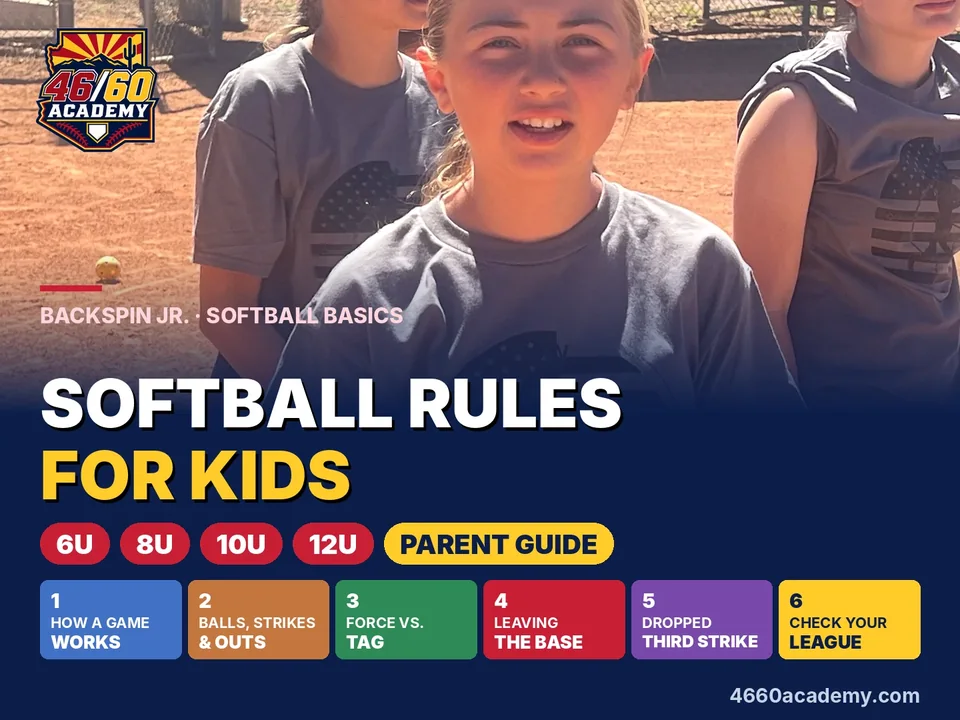
Softball rules for kids come down to a few basics: three outs ends a half-inning, three strikes is an out, four balls is a walk, and a runner scores by touching all four bases. The big differences from baseball are underhand pitching from a circle and stricter rules on leaving the base. If this is your family's first softball season, here are the rules that explain most of what you'll see, in plain words.
Softball rules for kids start with the basics: teams take turns batting, three outs ends a half-inning, three strikes is an out, four balls is a walk, and a runner scores by touching all four bases. The big differences from baseball are underhand pitching from a circle and stricter rules on leaving the base.
Train it: Game IQ Playmaker (Level 2 Baseball IQ) → Free: Free Game IQ skill guide →How does a softball game work?
Here is the whole game in kid words:
- Two teams take turns. One team bats while the other plays defense.
- Three outs and switch. When the defense gets three outs, the teams trade places. Both teams batting once is one inning.
- Score by going around. A runner who touches first, second, third and home scores a run.
- Most runs wins. How many innings, time limits and mercy or run-limit rules all depend on your league, so check your league's rules.
Fair or foul works like baseball. A ball hit between the two chalk foul lines is fair, and the batter runs. A ball outside them is foul, and the batter hits again. The lines count as fair.
Walk the foul lines with your player once before a game. Stand on the chalk and say "fair." Step off it and say "foul." Young kids remember what they have stood on, and it saves a lot of confused running later.
What are balls, strikes and the four ways to make an out?
The pitcher throws underhand from a pitching circle in the middle of the infield. At the youngest levels, a coach or machine may pitch instead. Pitching distance and pitching rules change by age, so check your league's rules.
The strike zone is roughly over the plate, from about the chest down to the knees in the batter's normal stance. Each rulebook words it a little differently, and the umpire makes the call. Three strikes is an out. Four balls is a walk to first. A foul ball counts as a strike until there are two strikes; foul bunts can be different, so ask.
Outs happen four main ways:
- Strikeout: three strikes on the batter.
- Catch: a ball caught in the air, fair or foul.
- Force out: a fielder with the ball touches the base a runner has to run to, before the runner gets there.
- Tag out: a fielder touches a runner with the ball while the runner is off a base.
Force out or tag out?
A runner is forced when she has to run because the batter or another runner needs her base. Then the defense only has to step on that base. That's why most outs at first base are force outs.
If the runner doesn't have to run, there's no force, and the defense must tag her. Once the defense gets an out on a runner behind her, the force on the runner ahead goes away too.
Teach it in the yard. Set out four bases, put your player on first and you be the batter. Ask: "Ground ball. Do you have to run?" Then move her to second with nobody on first and ask again. Two minutes, a few nights, and it clicks.
A car-ride quiz works too. Call out a play, like "pop-up caught by the shortstop," and your player answers "out" or "safe" and why. Kids who know the answer before the play happens move faster and worry less on the field.
When can a runner leave the base in softball?
This is the rule that surprises baseball families most. In many youth softball leagues, there are no baseball-style leadoffs. Runners must keep a foot on the base until the pitcher releases the ball, and leaving early can be an out.
Some younger divisions are stricter and make runners wait until the pitch reaches the batter. Many leagues also use a circle rule, sometimes called the look-back rule: once the pitcher has the ball in the circle and no play is happening, runners must quickly go to the next base or go back.
| Rule | What to ask your league |
|---|---|
| Leaving the base | Can runners leave on release, or only when the pitch reaches the batter? |
| Stealing | Is stealing allowed at this age, and to which bases? |
| Circle rule | Does it apply here, and how is it enforced? |
| Game length | How many innings, any time limit, and is there a mercy or run-limit rule? |
The habit to teach: foot on the bag until the ball leaves her hand. Then go or come back fast.
What surprises parents? Dropped third strike, courtesy runners and more
- Dropped third strike: at some ages, if the catcher doesn't cleanly catch strike three, the batter may run to first when first base is open or there are two outs. Many younger divisions don't use it. Check your league's rules.
- Courtesy runners: some leagues let a substitute run for the pitcher or catcher so they can get ready for the next inning. Ask whether yours does.
- Coach pitch to kid pitch: rules on walks, pitches per batter and stealing often change as players move up. Read the new rule sheet each season.
Coach BK puts it this way: "Two choices: A. Do everything in your control. B. Anything but A." Knowing the rules is something your player controls, so learning them is part of doing everything in her control.
For quick drills that build game sense, try our free Game IQ skill guide. When you want a full plan, Game IQ Playmaker is our 16-session Level 2 program on situations and decisions for baseball and softball players 7–12, included in the $25/month 46/60 membership.
One thing to remember
Three outs and switch, touch all four bases to score, and keep a foot on the bag until the pitch is released.
What to do this week
Find your league's rule sheet and read the base-running and game-length sections together. Then set out bases in the yard and quiz force outs with three quick plays.
Parent questions
Can you lead off in youth softball?
In most youth fastpitch leagues, no. Runners stay on the base until the pitcher releases the ball, and some younger divisions make them wait until the pitch reaches the batter. Check your league's rules.
What is the circle rule in softball?
When the pitcher holds the ball inside the pitching circle and no play is happening, runners must quickly go to the next base or return to their base. Leagues word and enforce it a little differently, so ask your umpire or league.
Is the softball strike zone the same as baseball?
The idea is the same: over the plate, between roughly the chest and the knees. Each rulebook words it slightly differently, and the umpire decides, so teach your player to swing at strikes and let the umpire call the rest.
SEE GAME IQ PLAYMAKER (LEVEL 2 BASEBALL IQ) →
Sources: Little League — Is a Runner Out for Leaving the Base Early in Little League Softball? · Little League — Softball Base Running: The Circle Rule