
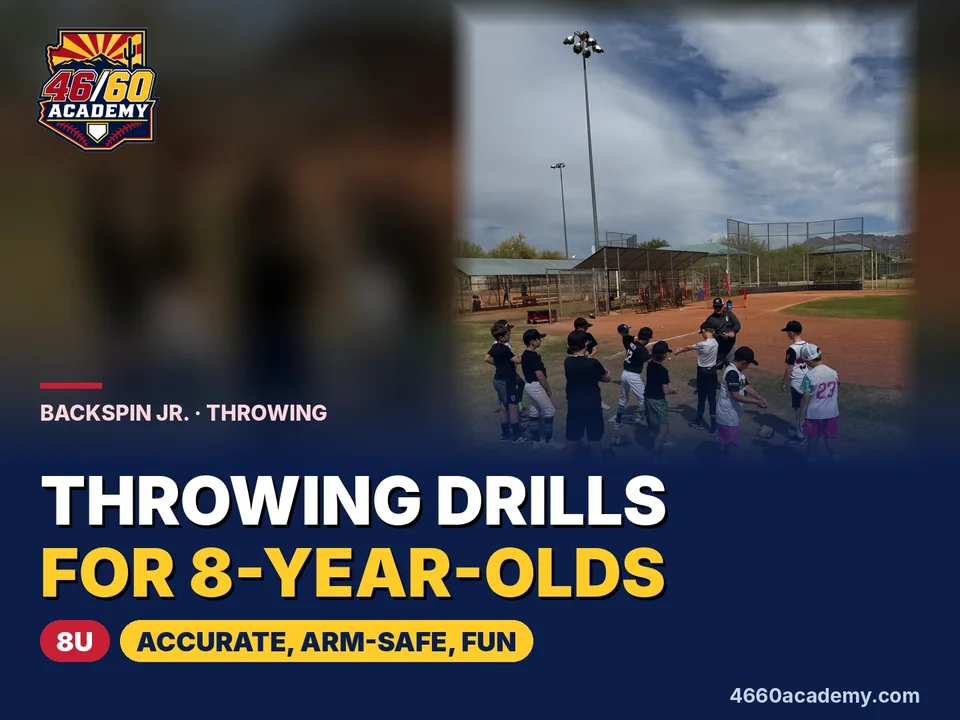
Eight is a great age to learn to throw the right way. Most kids this age can catch a soft toss and want to throw it hard, but the ball still goes everywhere. At 46/60 we fix that the same way every time: a few short drills, done a few times a week, until wild throws start finding the glove.
The best throwing drills for 8-year-olds are short and simple: a grip check, one-knee throws, point-and-step throws, target throws and a scoring game of catch. Warm up first, keep the distance short until throws are accurate, use soft balls indoors and stop if the arm hurts.
Train it: Confident Thrower (Level 2 Throwing, $49) → Free: Free Throwing Skill Guide →What do 8-year-olds need from throwing drills?
An 8-year-old does not need a long-toss program or a radar gun. They need lots of short, successful throws with the same simple pieces every time: grip, turn sideways, point, step and throw. We'd rather see 20 throws that hit the chest than 50 that sail over a head.
- Short distances: start close enough that most throws hit the partner's chest.
- Short sessions: 10 to 15 minutes of throwing is plenty at this age.
- Soft balls to start: use foam or soft-core balls indoors or with a nervous catcher.
- One cue at a time: say one thing, like "glove at the target," not five.
Coach BK says "Belief is the most powerful human force." For an 8-year-old, belief comes from a pile of throws that hit the glove, so start close and let the wins stack up.
These drills work for baseball and softball. The ball size is different, so check your league's rules for the right ball.
How should my 8-year-old warm up before throwing?
Sports doctors at the American Orthopaedic Society for Sports Medicine recommend warming up before throwing, starting with short, easy tosses and building up slowly. Get the body moving first with a light jog, skips and arm circles, then play easy catch from close range.
Watch for two warning signs. If throws start getting weaker or wilder, the arm may be tired, so end the day. If the arm hurts, stop right away. Youth players should never throw through pain, and a sore arm that keeps coming back is worth a visit to your pediatrician.
Five throwing drills for 8-year-olds
- Grip check: fingers on top across the seams, thumb underneath, ball held in the fingers instead of jammed in the palm. Small hands may need three fingers on top, and that's fine. Do five quick grabs out of the glove before every catch.
- One-knee throws: throwing-side knee on the ground, glove-side knee up and pointed at the partner. Turn the shoulders, point the glove and throw. This takes the legs out so your child feels the upper body work. About 10 throws from a short distance.
- Point and step: stand sideways, glove-side shoulder at the target. Point the glove, step toward the target and throw, finishing with the throwing hand down by the opposite knee. Ten throws, then back up one big step only if most hit the chest.
- Target throws: Little League's backyard throwing accuracy drill sets a target such as a bucket or helmet in front of a fence and has the player throw at it from different spots. Use a laundry basket or cone, start close and give a point for every hit.
- Catch and quick throw: partner tosses, your child catches with two hands, finds the grip, turns sideways and throws back. This joins catching and throwing the way a real play does. Slow is fine. Clean beats fast.
Five minutes on two of these drills is a good day. You do not need all five every time.
A scoring game that makes catch fun
Kids this age will throw all day if there is a score. Play Bullseye: a throw to the chest is 2 points, a throw the partner catches without moving their feet is 1 point, and anything else is 0. First to 15 wins, then switch.
Coach BK likes to say "Two choices: A. Do everything in your control. B. Anything but A." For an 8-year-old, that means you can't control every throw, but you can control your grip, your point and your step every single time. Praise those three, not just the points.
Keep it light. Once the game turns into a fight about missed throws, call it a day and play again tomorrow.
A 15-minute throwing practice for 8-year-olds
| Minutes | What to do | What to look for |
|---|---|---|
| 0–4 | Jog, skips, arm circles, easy close catch | Loose arm, no hard throws yet |
| 4–6 | Grip check and one-knee throws | Fingers on top, glove points first |
| 6–9 | Point and step | Sideways start, step at the target |
| 9–12 | Target throws or catch and quick throw | Most throws on target |
| 12–15 | Bullseye game | Fun, then stop while the arm feels good |
Two or three of these sessions a week, with rest days in between, is plenty for most 8-year-olds. Follow your league's pitching and rest rules if your child also pitches, and encourage other sports during the year so the arm gets real breaks.
One thing to remember
At 8, a short throw that hits the glove is worth more than a long one that sails.
What to do this week
Pick two short sessions this week. Do the warm-up, one-knee throws and point-and-step, then finish with a game of Bullseye and stop while your child still wants more.
Parent questions
How far should an 8-year-old be able to throw?
There is no number your child needs to hit. Focus on throwing accurately from a short distance first, then back up a step at a time only when most throws hit the target.
How many throws a day is okay for an 8-year-old?
Keep throwing sessions short, about 10 to 15 minutes after a warm-up, with rest days in between. If your child pitches, follow your league's pitch-count and rest rules, and stop any time the arm hurts.
Should I use a real baseball or softball for throwing drills?
Soft or foam balls are great indoors, for beginners and for nervous catchers. Move to the regular league ball outside once your child can catch and throw it with control.
SEE CONFIDENT THROWER (LEVEL 2 THROWING, $49) →
Sources: AOSSM: Baseball Injuries (warm-up, fatigue and never throw with pain) · Little League University: Backyard Tip — Throwing Accuracy Drill