
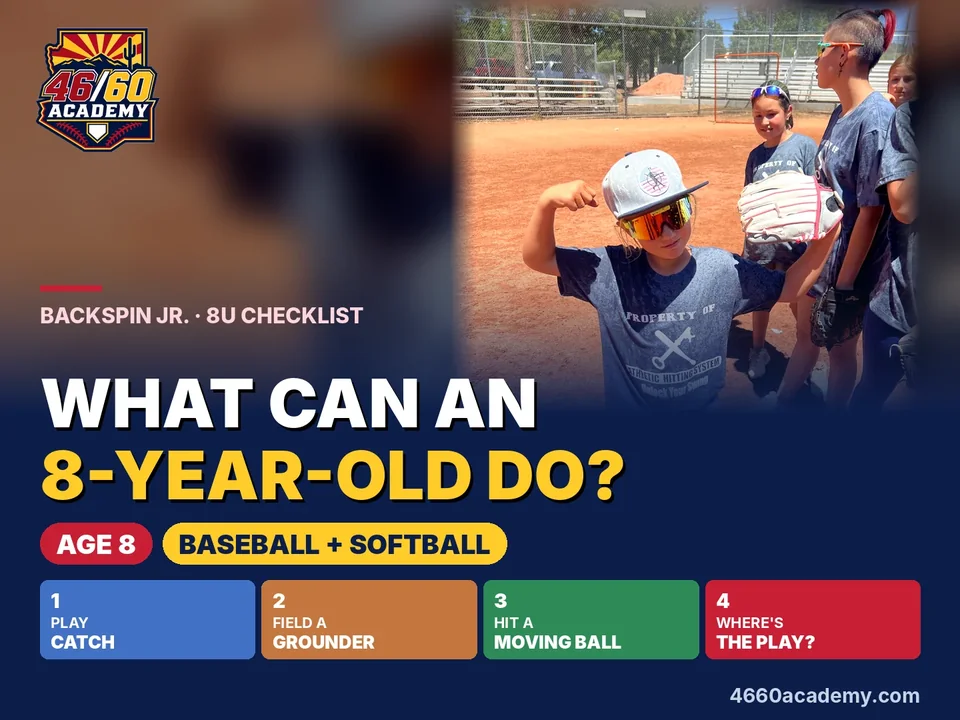
Eight is a big year. Kids move up from tee ball, the ball starts coming faster, and the other team suddenly knows where to throw it. Parents start comparing, too. Here's the honest list of what an 8-year-old should be able to do, and what can wait.
An 8-year-old baseball player should be able to play catch with a partner, throw by stepping toward a target, field a ground ball in front of the body, hit a pitched or tossed ball some of the time, run through first base and know where the force out is. Pitching, power and positions can wait.
Train it: 46/60 Coach Playbook ($59) → Free: Free Quick Check →The six skills that matter at 8
MLB and USA Baseball's Pitch Smart guidelines say players 8 and under should focus on athleticism, physical fitness and fun, and on learning the rules, general techniques and teamwork. That's the target. Here's what it looks like on the field.
- Play catch: catch a partner's throw from a few big steps away with two hands, glove up for high throws and glove down for low ones. Six or seven catches out of ten is a good 8U day.
- Throw on target: turn sideways, point the glove, step toward the target and finish the arm across the body. Hitting the partner's chest beats throwing far.
- Field a ground ball: move the feet to get in front of it, glove on the dirt early, two hands, then set the feet before throwing.
- Catch an easy fly ball: a short, soft toss, both hands up, catching it in front of the face. Lots of 8-year-olds aren't there yet, and that's fine.
- Hit a moving ball: make contact off a coach toss or machine some of the time and off a tee most of the time.
- Run the bases right: drop the bat, run through first, round the bag on a hit to the outfield and listen to the base coach.
What game smarts should an 8-year-old know?
Two things, and they're bigger than they sound. If your player knows these, they're ahead of most of the field.
- Where's the play? Before every pitch, a fielder can point to where the ball goes if it's hit to them. With nobody on, it's first base.
- Force or tag? When a runner has to run, step on the base. When they don't, tag the runner.
Play a backyard game: you call out "runner on first, ground ball to you!" and your player points to second. Ten calls in a row and they've got it. Want the full 8U, 10U and 12U picture? See our baseball skills by age checklist.
Is the list different for softball?
Not much. Catching, throwing, fielding, hitting a moving ball and running the bases look almost the same for an 8-year-old softball player. Softball does move faster on the bases and the ball is bigger, so quick feet and two hands matter even more.
The big difference is pitching. Fastpitch pitching is underhand and takes its own teaching from someone who knows it. Ball size, pitching format and bases vary by league, so check your league's rules.
What can wait until 9 or 10?
Lots of parents worry their 8-year-old is behind. Most aren't. Kids grow and change fast at this age, and the list below is not on the 8U test.
| Can wait | Why |
|---|---|
| Pitching a lot | Pitch Smart says follow pitch-count limits and rest rules, and throw only fastballs and changeups. |
| One position | Trying every spot builds a smarter, more complete player. |
| Hitting for power | Solid contact first. Power shows up as kids grow. |
| Playing on two teams at once | Pitch Smart advises against it at this age. |
| One sport all year | Pitch Smart recommends playing other sports during the year. |
Moving from coach pitch to kid pitch can feel scary. Coach BK tells kids "The ball ain't changing shape, I promise ya that." For an 8-year-old, that means same ball, same swing, same plan, even when a kid is the one throwing it. Little League's Minor division can be coach pitch, machine pitch or player pitch, so check what your league uses.
How can I help at home in 15 minutes?
Short and fun beats long and serious. Stop while your player still wants more.
- Four minutes of catch: count catches in a row and back up one step after every five.
- Four minutes of grounders: roll them left and right so the feet have to move.
- Four minutes of hitting: tee or soft toss into a net, nobody near the swing.
- Three minutes of "Where's the play?": you call the situation, they point and throw to a bucket at the right base.
Use soft balls near windows, warm up the arm before throwing hard and stop if anything hurts. Coach BK says "Belief is the most powerful human force." Real confidence comes from those little sessions adding up. Helping coach the team? The 46/60 Coach Playbook ($59, one year of access, lessons 1–3 free) gives you what to teach, cues and 60-minute station plans for 8U to 12U. Not sure where to start? Take our free Quick Check.
One thing to remember
At 8, the goal is a kid who catches, throws, fields, hits, runs hard and knows where the ball goes.
What to do this week
Play "Where's the play?" for three minutes on two different days. Then do one round of catch and count catches in a row, and write the best number on the fridge.
Parent questions
Is my 8-year-old behind in baseball?
Probably not. Skills at 8 change fast, and a player who struggles with fly balls in spring often catches them by fall with a few short sessions a week.
How far should an 8-year-old be able to throw?
Accuracy matters more than distance at 8. A good goal is hitting a partner's chest from a comfortable distance, then backing up only when the throws stay on target.
Should my 8-year-old pitch?
Some leagues use kid pitch at 8 and some don't, so check your league's rules. If your child pitches, keep it short, warm up first, follow pitch-count and rest rules and stop if the arm hurts.
COMING SOON · JOIN THE WAITLIST →
Sources: MLB and USA Baseball — Pitch Smart: Pitching Guidelines, Ages 8 and Under · Little League Baseball divisions (minor league coach-pitch, machine-pitch and player-pitch options)