
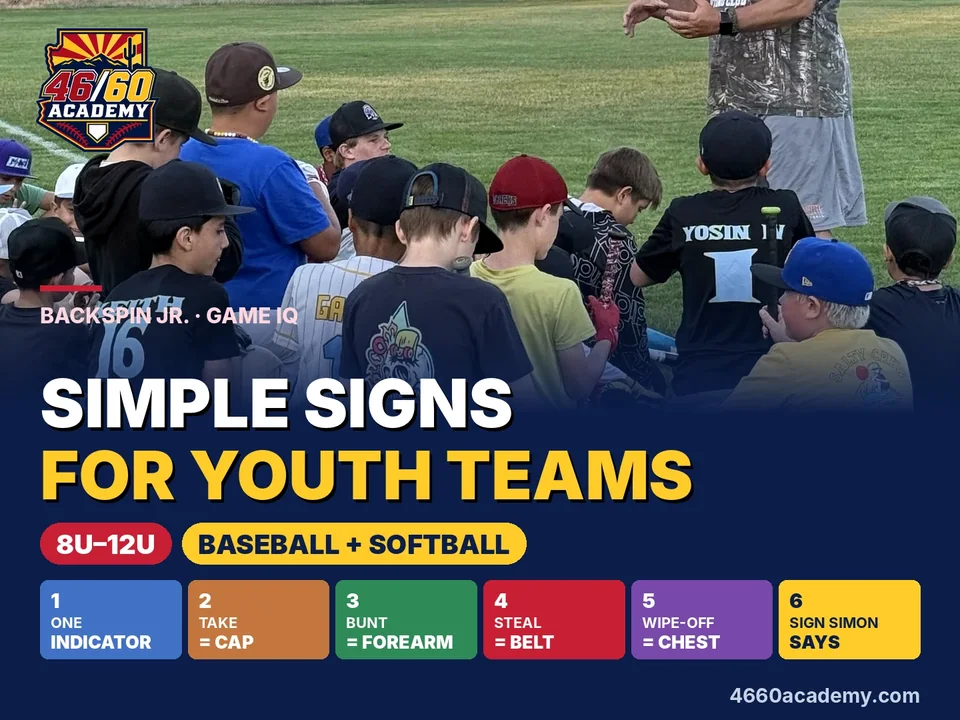
Simple baseball and softball signs for youth teams start with three to five plays plus a wipe-off sign, taught with one easy indicator. You've seen it: the third base coach touches his cap, belt and arm, and the batter looks back with no idea what just happened. Signs are supposed to help young players, not confuse them. Here's how to keep them simple enough for 8U to 12U kids to get right.
Simple signs for youth teams start with just three to five plays, like take, bunt and steal where allowed, plus one sign that cancels everything. Use one easy indicator, say each sign out loud in practice, and add more only after every player gets them right. For 8U and under, talking usually works better than signs.
Train it: Game IQ Playmaker (Level 2 Baseball IQ) → Free: Free Game IQ skill guide →When should a youth team start using signs?
For coach pitch and most 8U teams, you usually don't need signs at all. Young players watch the ball, not the coach, and a friendly voice works better. Little League's advice for base coaches is to use clear hold and go signals and back them up with voice cues for younger players.
Around 9 or 10, when kids pitch and steals or bunts may be allowed, a few signs start to help. Check your league's rules on stealing and leads first, because there's no point teaching a steal sign if your division doesn't allow steals.
How many signs can 8U to 12U kids handle?
| Age | Signs to start with |
|---|---|
| 8U | Mostly voice: "Go!", "Stop!", "Back!" plus hold and go arm signals |
| 9–10 | 3 signs: take, bunt, steal (if allowed), plus a wipe-off |
| 11–12 | 4–5 signs with one indicator: take, bunt, steal, hit-and-run, slap or squeeze only if practiced |
The rule of thumb is simple: only use a sign every player on the roster can read every time. One missed bunt sign costs more than the advantage of a fancy system.
What does a simple starter sign sheet look like?
Here is an easy set that works for baseball and softball. Change the touches to whatever your team likes.
- Indicator: touch the letters on your jersey. Only the touch right after the indicator counts. No indicator, no play.
- Take (don't swing): touch the bill of the cap.
- Bunt: slide a hand down the forearm.
- Steal (if allowed): touch the belt.
- Wipe-off (cancel everything): brush hand across the chest.
Give the batter and runners one simple way to answer, like touching their helmet, so you know they saw it. If a player isn't sure, they call time and step out. That's never wrong.
How do I practice signs so kids remember them?
Signs stick when kids practice them, not when they hear them once. Try these:
- Sign Simon Says (5 minutes): the team stands in a line. A coach flashes signs with and without the indicator. Players shout the play or "Nothing!" Anyone who's wrong does five jumping jacks and stays in.
- Live reps: in batting practice, give a sign before every pitch so players get used to looking at the coach between pitches.
- Pocket card: give each family a copy of the sign sheet so kids can quiz each other in the car.
- Change rarely: keep the same signs all season unless the other team is clearly reading them.
Coach BK says, "Two choices: A. Do everything in your control. B. Anything but A." Looking at the coach before every pitch is something every kid controls, even on a day they don't get a hit.
What sign mistakes do youth coaches make most?
- Too many signs too soon. Start with three and add one at a time.
- Signs too fast. Go slow enough that a 9-year-old can see each touch.
- Getting mad at a missed sign. Treat it as a teaching moment and practice it at the next practice.
- No time to look. Teach batters to step out and check the coach after each pitch, and runners to look before each pitch.
For more simple game-sense drills, use our free Game IQ skill guide. When you want a full plan, Game IQ Playmaker is our 16-session Level 2 program on situations and decisions for baseball and softball players 7–12, included in the $25/month 46/60 membership.
One thing to remember
Use only the signs every player can read every time, practice them like a skill, and keep a wipe-off sign so nobody gets stuck.
What to do this week
Pick three signs and one indicator from the sheet above. Teach them with Sign Simon Says for five minutes at each practice this week, and hand out a copy to every family.
Parent questions
How many signs should a 10U team have?
Three plays plus a wipe-off sign is plenty for most 10U teams: usually take, bunt and steal if your league allows it. Add more only when every player reads the first ones correctly.
Do youth softball teams use the same signs as baseball?
The idea is the same, and many teams use touch signs with an indicator. Softball teams may add slap or squeeze plays at older ages. Use only plays your league allows and your players have practiced.
What if the other team steals our signs?
At 8U to 12U, it rarely matters much. If you think they're reading them, change the indicator, not every sign, so your own players stay comfortable.
SEE GAME IQ PLAYMAKER (LEVEL 2 BASEBALL IQ) →
Sources: Little League — Coaching the Bases · Coaches Insider — Tackling Signs & Signals for Enhanced Communication (softball)