
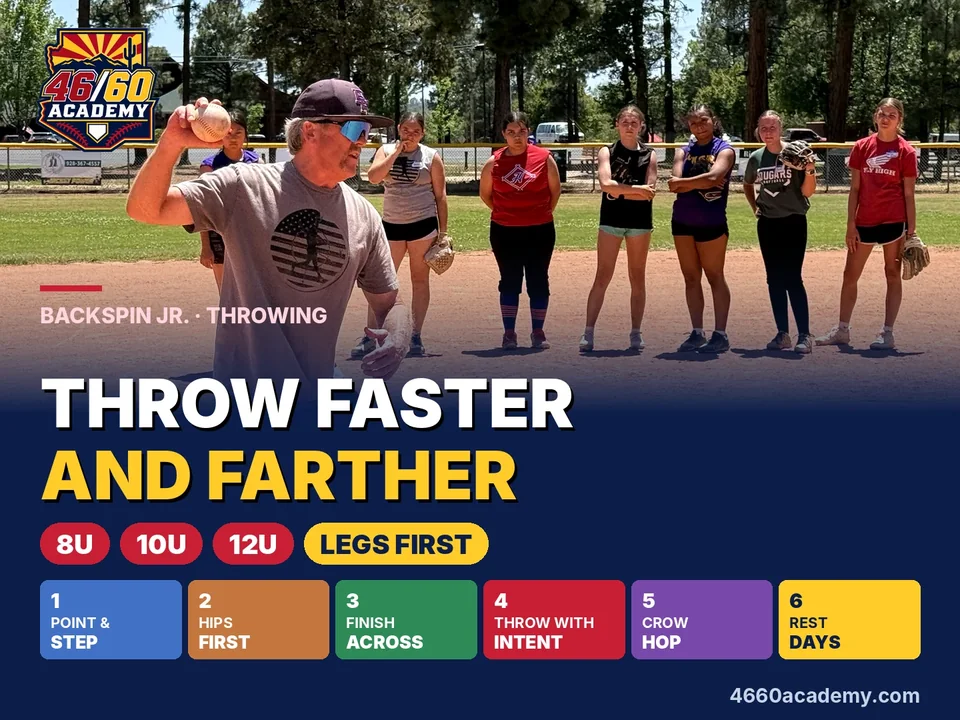
To help a kid throw a baseball faster and farther, teach the legs to do the work: turn sideways, step straight at the target and let the hips turn before the arm. Add a crow hop for long throws and protect the arm with rest days. Most young throwers already have more speed in them than they show, because they throw with just the arm.
To help a kid throw a baseball faster and farther, teach the legs to do the work: turn sideways, step straight at the target and let the hips turn before the arm. Add a crow hop for long throws, play catch a few days a week with rest days in between, and build the athlete instead of chasing radar-gun numbers.
Train it: Confident Thrower (Level 2 Throwing) → Free: Free throwing skill guide →Where does a faster throw really come from?
A strong throw starts at the ground. The legs push, the hips turn, the shoulders follow, and the arm is the last thing to go. When that order happens, the arm gets fast without the child forcing it.
Most young throwers skip the first steps. They face the target square, don't step, and push the ball with the arm alone. That throw is slow, and it puts all the work on the shoulder and elbow.
Coach BK puts it this way: "See that wall… knock it down!" For a young thrower, that means throw with real intent at a target, using the whole body, not just the arm.
How do I help my kid throw harder safely, step by step?
- Point and step on a line: lay a jump rope or tape toward the target. Turn sideways, point the glove, step on the line, then throw. A straight step sends the energy at the target.
- Let the hips go first: after the step, the belly button turns to the target before the arm comes through. Slow it down with no ball first, then add the ball.
- Finish across the body: the throwing hand ends near the opposite knee and the back foot comes around. A full finish adds speed and takes stress off the arm.
- Throw at a target with intent: a few throws at a chest-high target, trying to hit it hard, then relax. Accuracy first, then add speed.
- Build the athlete: running, jumping, skipping and playing other sports build the legs and core that power a throw. MLB and USA Baseball's Pitch Smart guidelines for ages 9–12 say to focus on athleticism, fitness and fun.
How can a kid throw a baseball farther?
Distance comes from the feet. For long throws from the outfield, teach the crow hop: a small hop that turns the body sideways and carries momentum toward the target. Our crow hop drill for kids walks through it step by step.
- Throw on a line, with a little arc: a long throw can bounce once on the way to the base. A strong one-hop throw beats a high, slow rainbow.
- Back up slowly: play catch short to long, and only as far as your child can throw with a smooth, relaxed motion.
- Walk back in: finish with a few easy, accurate throws at a short distance.
What should you not do with a young arm?
- Don't chase radar-gun numbers. Nationwide Children's Hospital advises avoiding radar guns for young pitchers, who start caring about how hard they throw instead of how well.
- Skip heavy and weighted balls. Pitch Smart notes weighted-ball programs may add speed but can also raise injury risk.
- Don't throw through pain. If the arm hurts, stop and check in with your pediatrician.
- Count the hard throws. Games and pitching count as throwing days. Follow your league's pitch-count and rest rules.
A simple weekly plan for a stronger arm
| Day | What to do | Time |
|---|---|---|
| Day 1 | Warm-up, point-and-step on a line, short-to-long catch | 15 min |
| Day 2 | Rest from throwing: run, jump, play another sport | Any |
| Day 3 | Warm-up, target throws with intent, crow hop throws | 15 min |
| Day 4 | Rest or a game day (a game counts as throwing) | — |
"Two choices: A. Do everything in your control. B. Anything but A." For a young thrower, that means showing up for the warm-up and the rest days, not just the fun throws.
One thing to remember
A faster, longer throw comes from the legs and the step, not a harder arm.
What to do this week
Play catch twice this week for 15 minutes with a rest day in between. Use a tape line for point-and-step on the first day and add the crow hop on the second.
Parent questions
How fast should a 10-year-old throw a baseball?
It varies a lot by size, age and experience, so don't compare your child to a number. Focus on good footwork and an accurate, relaxed throw; speed comes with growth and practice.
Do weighted balls help kids throw harder?
We don't use them with 7–12 year olds. Pitch Smart notes weighted-ball programs can add speed but may also raise injury risk, so build the legs, footwork and athleticism instead.
How long does it take to throw harder?
Better footwork can show up in a few weeks of regular catch. Real arm strength builds over seasons as kids grow, so keep it steady and keep the rest days.
SEE CONFIDENT THROWER (LEVEL 2 THROWING) →
Sources: MLB/USA Baseball Pitch Smart: pitching guidelines, ages 9–12 · MLB/USA Baseball Pitch Smart: Maximize Performance (weighted balls) · Nationwide Children's Hospital: Throwing guidelines for young players