
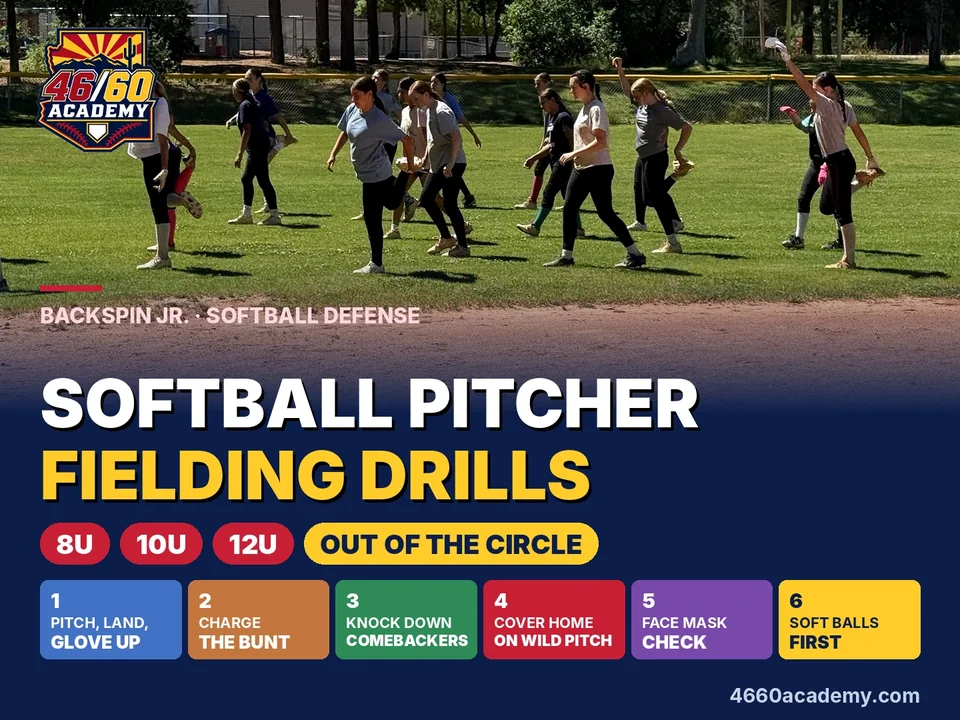
To teach softball pitcher fielding, have her finish every pitch balanced with her glove up, then field like an infielder: charge bunts, knock down comebackers and cover home on wild pitches. Your daughter works hard on her pitching. Then a bunt trickles in front of the circle, or a ball comes right back at her, and nobody has ever shown her what to do. The good news: fielding out of the circle is simple to teach.
Teach a softball pitcher to finish her pitch balanced with her glove up, then field like an infielder: charge bunts in front of the circle, protect herself and knock down comebackers, and cover home on wild pitches. Start with rolled soft balls, add reps slowly, and use a face mask where your league requires or recommends one.
Train it: Complete Defender (Level 2 Fielding) → Free: Free softball practice plans →Why does a softball pitcher need fielding drills?
In softball, the pitcher stands closer to the batter than any other fielder except the catcher. That means she sees a lot of bunts, slow rollers and hard balls hit right back at her.
Many young pitchers finish their motion off balance, turned sideways or looking down. When the ball comes back, they are not ready. A few minutes of fielding work each week fixes that.
At 8U, many leagues use coach pitch or machine pitch with a player standing in the circle. That player is still the pitcher on defense, so these drills help her too. Check your league's rules for how your division works.
How should a pitcher finish so she's ready to field?
Everything starts with the finish. We call it pitch, land, glove up. After the release, she lands balanced, squares her shoulders toward the batter and brings her glove up in front of her chest.
- Pitch: finish the full motion. Don't cut it short to get ready faster, or the pitch suffers.
- Land: both feet on the ground, knees soft, weight on the balls of her feet.
- Glove up: glove out front, eyes on the hitter, ready to move left, right or in.
- Freeze check: in practice, call "freeze" after a pitch. Can she hold her balance for a two count? If she tips over, slow down the finish.
Have her throw a few easy pitches into a net or to a catcher with nobody hitting. After each one, she shows you her ready finish. Ten good finishes is a great start.
Softball pitcher fielding drills that work for 8U–12U
Use soft or reduced-impact balls at first, and keep every drill at a pace she can win. Short lines, lots of reps, and a little game at the end.
- Bunt pounce (8U–12U): she pitches without a ball, lands ready, and a coach rolls a ball in front of the circle. She charges, fields it with two hands, sets her feet and throws to first. Five reps, then switch to rolls toward each foul line.
- Knock it down (8U–10U): from a short distance, a coach tosses soft balls underhand at her glove side, then her throwing side, then at her belly. The goal is to knock the ball down in front, pick it up and throw. No hard hits yet.
- Comeback reaction (10U–12U): once she handles tosses, a coach hits easy one-hoppers back at the circle with a soft ball. Glove up, body in front, knock it down. Add speed only when she is calm and confident.
- Cover home (10U–12U): with a pretend runner on third, the catcher lets a ball go to the backstop. The pitcher sprints to the plate, points and yells "Ball!" to help the catcher find it, catches the throw and tags with her feet off to the side of the plate.
- Pitcher's points game: mix all of the above in a random order. One point for a ready finish, one point for a clean play. First to ten picks the next drill.
Our free softball practice plans have stations where you can slip one of these drills in for five minutes each practice.
Bunts, comebackers and covering bases: who does what?
Every team does bunt defense a little differently, so learn your coach's plan. A common setup in youth softball looks like this, with one or two simple jobs for the pitcher.
| Play | Pitcher's job | Simple cue |
|---|---|---|
| Bunt in front of the circle | Charge, field with two hands, listen to the catcher's call, throw | Two hands, set feet, throw |
| Bunt toward a foul line | Go get it if the corner can't, or get out of the way and cover the middle | Listen for the call |
| Comebacker | Protect herself first, knock it down, pick it up, throw to first | Glove up, body in front |
| Ball to the right side | Help cover first if that's your team's plan (often the second baseman covers) | Know your job before the pitch |
| Wild pitch, runner on third | Sprint to home, call for the ball, tag from the side | Feet out of the way |
The catcher usually has the best view, so teach your pitcher to listen for the catcher's call on bunts. One clear voice beats three kids yelling different bases.
How do I keep my young pitcher safe in the circle?
Safety comes first, and it also builds confidence. A pitcher who trusts her gear and her glove is a pitcher who stays in front of the ball.
- Face masks: many families and coaches choose a fielder's face mask for pitchers and corner infielders, and some leagues require one. Check your league's rules.
- Softer balls first: start with soft or reduced-impact balls and rolled or tossed balls before anything is hit.
- Short sessions: a few minutes of fielding at the end of a pitching session is plenty. Follow your league's pitching rest rules.
- Stop if it hurts: if she gets hit or has pain anywhere, stop and check on her. Adults supervise every rep.
Coach BK likes to say, "Belief is the most powerful human force." For a young pitcher, that means her confidence on a comebacker comes from the safe, real reps she has already done in practice.
Want a step-by-step plan for the whole defense, including the circle? Complete Defender is our 16-session fielding program for ages 7–12, and it's in the $25/month 46/60 membership.
One thing to remember
The moment the ball leaves her hand, your pitcher becomes a fielder, so teach her to land balanced with her glove up every single time.
What to do this week
At your next catch session, have her show you ten ready finishes: pitch, land, glove up. Then roll five soft balls in front of her for the bunt pounce drill and finish with three cover-home reps.
Parent questions
Should my 10-year-old softball pitcher wear a face mask?
Many families choose one for pitchers, and some leagues require it. Check your league's rules, and if she wears one, practice in it so it feels normal on game day.
Who covers first base on a bunt in softball?
It depends on your team's bunt defense. On many youth teams the corners charge and the second baseman covers first, but ask your coach so your daughter knows her job before the pitch.
How often should a young pitcher practice fielding?
A few minutes, two or three times a week, is plenty. Add it to the end of pitching practice and keep the reps short and successful.
SEE COMPLETE DEFENDER (LEVEL 2 FIELDING) →
Sources: Coaches Insider: Drills for the pitcher as a defensive player (softball) · Athletic Business: More Softball Pitchers Adopt Face Masks