
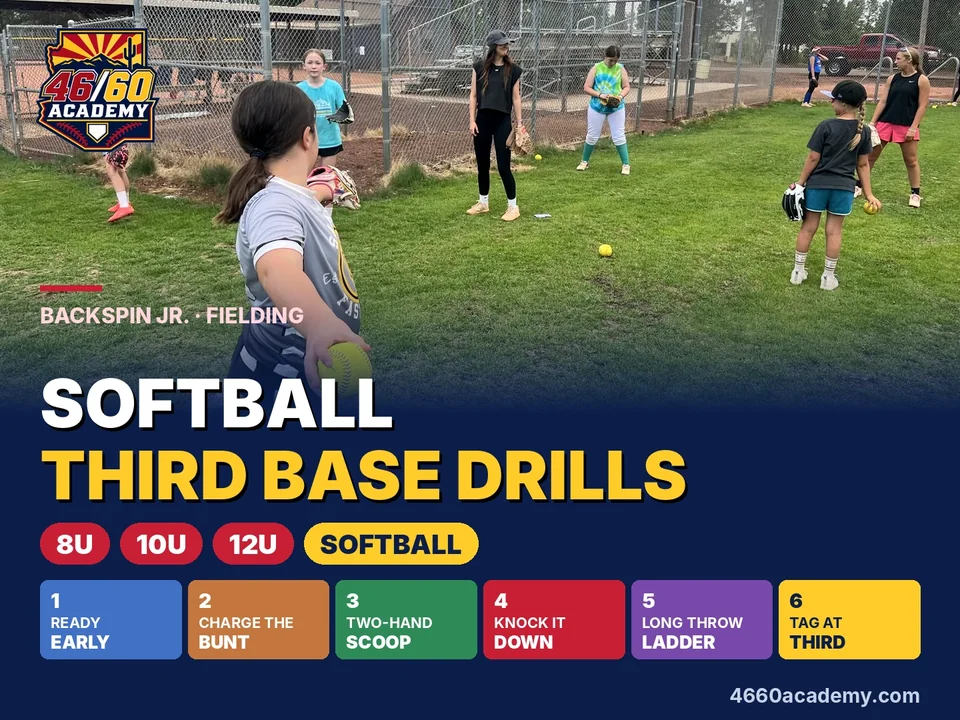
The best softball third base drills for kids build a ready position before every pitch, a fast bunt charge, the habit of knocking hard hits down in front, and a long throw with the feet set. Your daughter just got moved to third base, and the first hard grounder made the whole bleacher jump. These drills build the habits that make it feel calm instead of scary.
The best softball third base drills for kids train four things: a low ready position before every pitch, charging bunts and scooping with two hands, knocking hard hits down and keeping them in front, and setting the feet before the long throw to first. Start with soft balls, short distances and slow speeds.
Train it: Complete Defender (Level 2 Fielding) → Free: Free fielding skill guide →What makes third base different in softball?
Softball is played on a small diamond, and the batter is close to third base, so everything happens quickly. A third baseman often plays a little in front of the bag, ready to sprint in on a bunt, and still has to handle a ball hit hard right at her.
That's why the job comes down to three things: be ready early, go get the slow ones, keep the hard ones in front. Then make a good throw, or hold the ball when there's no play.
Safety first. Many young corner infielders wear a fielder's face mask, and some leagues require one, so check your league's rules. Use softer training balls for the reaction drills below until your player is comfortable.
How does a third baseman get ready and charge bunts? (Drills 1 and 2)
Ready, set, hop (3 minutes). Your player stands in her third base spot. Each time you lift your arm like a pitcher, she takes a small step or hop into her ready position: feet wider than her shoulders, knees bent, weight on the balls of her feet, glove out in front. Do 10 in a row. You're looking for her to be set before the pitch, not after.
Bunt charge (5 minutes). Roll a ball slowly toward the spot between third base and the pitcher's circle. She charges hard, slows down as she gets close, and scoops with glove and throwing hand together. Then she plants her back foot and throws to a partner or net at first.
- Sprint, then gather: fast at first, short choppy steps near the ball.
- Two hands: glove down, throwing hand closes on top, like an alligator mouth.
- Feet before arm: plant, turn the front shoulder to first, then throw.
- Reps: 8 to 10, with a rest between each so she charges full speed.
How do I help a third baseman handle hard hits? (Drill 3)
Hard hits are what scare young third basemen. The fix isn't to be fearless. It's to know that a ball knocked down in front is a win, because she can still pick it up and throw.
Knockdown game (5 minutes). Kneel about 20 to 30 feet away and toss or roll soft balls a little harder each round: to her glove side, at her, and to her backhand. She scores a point for every ball that stays in front of her, caught or not. Keep it fun, and only speed up when she's winning most of them.
Coach BK says it this way: "Belief is the most powerful human force." For a 10-year-old at third, that belief comes from lots of easy wins first, then a few hard ones she knows she can handle.
How does a young third baseman make the long throw and the tag? (Drills 4 and 5)
Long throw ladder (6 minutes). The throw from third to first is one of the longest throws in the infield. Start at half the distance. She fields a rolled ball, takes a step toward her target with her front foot, and throws chest high. Each time she makes three good throws in a row, she backs up a few steps. Stop at the distance where her throws stay accurate, not where she has to heave it.
Arm care matters here. Warm up first, keep throw counts low, take rest days, and stop if her arm hurts. A tired arm is how kids start pushing the ball and losing accuracy.
Tag at third (4 minutes). She straddles the base. A partner throws to her from the outfield side while a runner jogs in. She catches, drops her glove to the front corner of the base, and lets the runner slide into the tag. Then she pulls the glove away and looks for the next play.
What does a 25-minute third base practice look like for 8U to 12U?
| Minutes | Drill | What to watch |
|---|---|---|
| 0–5 | Warm-up and easy catch | Loose arm, short throws |
| 5–8 | Ready, set, hop | Set before the pitch |
| 8–13 | Bunt charge | Two hands, feet before throw |
| 13–18 | Knockdown game | Ball stays in front |
| 18–24 | Long throw ladder | Step to target, chest-high throw |
| 24–25 | One tag at third, then done | Glove to the base |
For 8U, cut the distances way down and use softer balls the whole time. For 11- and 12-year-olds, add bunts rolled to different spots and let her decide whether there's a play.
Want more? Our free fielding skill guide has age-right drills for every position. When you want a full plan, Complete Defender is our 16-session Level 2 fielding program for baseball and softball players 7–12, included in the $25/month 46/60 membership.
One thing to remember
At third base, a ball knocked down in front is a win; ready early, charge the slow ones, then set your feet before the throw.
What to do this week
Do the 25-minute plan twice this week with soft balls. On the third day, play only the knockdown game and count how many balls she keeps in front.
Parent questions
Should my daughter wear a face mask at third base?
Many young softball corner infielders wear a fielder's face mask at third base, and some leagues require one. A mask can also help a nervous player stay in front of the ball. Check your league's rules.
Where should a softball third baseman stand?
A softball third baseman usually stands a few steps off the line and a little in front of the base, so she can charge a bunt. She moves back when a hitter is likely to swing away, and the coach may move her depending on the batter.
How do I help my kid who is scared of hard grounders at third?
Start a scared third baseman with soft balls and slow rolls, then speed up only when she's catching most of them. Teach her that knocking the ball down in front is a good play, so she's not trying to be perfect.
SEE COMPLETE DEFENDER (LEVEL 2 FIELDING) →
Sources: NPR — Softballers Face A Fielder's Choice: When To Wear A Face Mask · TeamSnap — Softball Skills: Bunt Defense Drill