
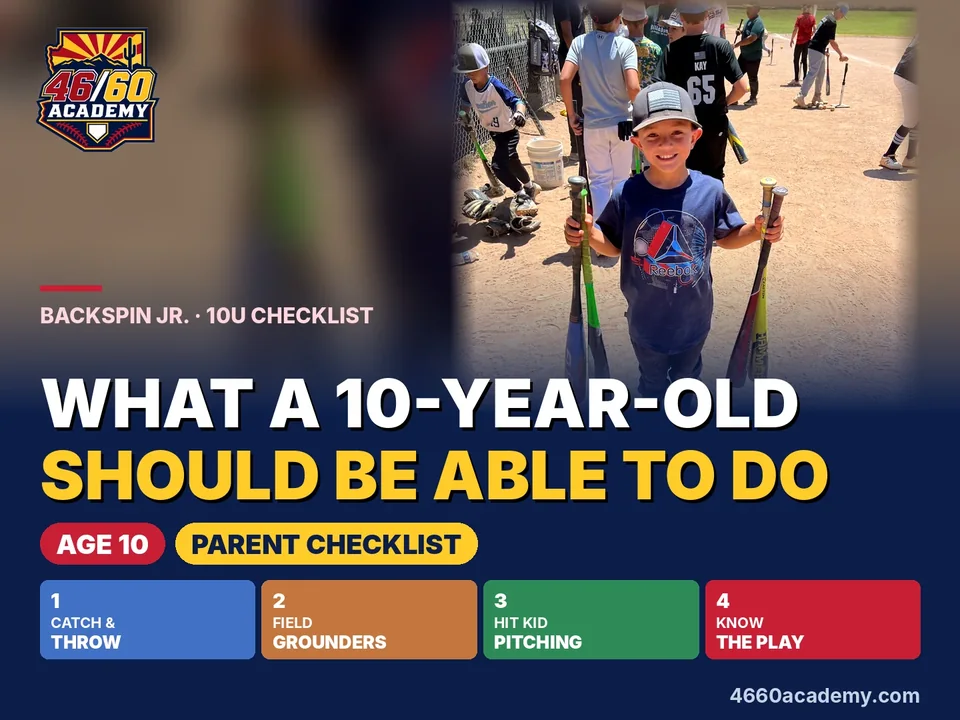
Ten is when baseball starts to feel like real baseball. In many leagues kids pitch to kids, runners can steal, and the ball gets hit harder. Here's the honest list of what a 10-year-old should be able to do, and what can wait until 12.
A 10-year-old baseball player should be able to catch and throw accurately to a partner at practice distances, field a moving ground ball and get rid of it, catch a routine fly ball, put a ball in play against kid pitching, run the bases with their head up and know where the play is before every pitch.
Train it: 46/60 Coach Playbook ($59) → Free: Free 10U Practice Plans →The six skills that matter at 10
MLB and USA Baseball's Pitch Smart guidelines for ages 9–12 say to focus on athleticism, fitness and fun, and on learning the rules, general techniques and teamwork. Here's what that looks like for a 10-year-old.
- Catch every kind of throw: a partner's throw at chest, above the head and in the dirt, with the glove turning the right way. Two-hand catches when there's time.
- Throw on a line: feet sideways, glove pointed at the target, step and follow through. Most throws should reach the partner's chest without a big rainbow.
- Field a moving ground ball: move the feet to get in front of it, glove down early, then shuffle and throw. A 10-year-old should handle balls hit right at them and start moving to the ones a few steps away.
- Catch a routine fly ball: get under it, call it loudly and catch it with two hands up. Tougher ones on the run still come and go at this age.
- Put the ball in play against kid pitching: swing at strikes, take balls way out of the zone and make contact more often than not in practice.
- Run the bases with the head up: run hard through first, find the ball when rounding a base and pick up the base coach.
What game smarts should a 10-year-old know?
At 8, kids learn where the force out is. At 10, the game asks a little more. These three are the big ones.
- Know the play before the pitch: how many outs, where the runners are and where the ball goes if it's hit to them.
- Back up and cover: nobody stands still on a hit. Fielders run to a base, back up a throw or get in line as the cutoff.
- Know the count: two strikes means protect the plate. Many 10U leagues add stealing and the dropped third strike, so check your league's rules and teach your player what applies.
Play "What if?" in the car. You say "one out, runner on second, grounder to you," and your player tells you the play. Want to see how 10U fits between 8U and 12U? Our baseball skills by age checklist lays it out.
What changes when kids start pitching to kids?
Kid pitch is the biggest jump at 10. Pitches come from different speeds and spots, there are more walks, and some hitters get nervous in the box. That's normal.
Coach BK tells hitters "The ball ain't changing shape, I promise ya that." For a 10-year-old, that means a harder thrower doesn't need a new swing. Same ball, same swing, same plan: be ready early and swing at strikes.
If your child pitches, the arm comes first. Pitch Smart says to warm up properly, set and follow pitch-count limits and rest periods, throw only fastballs and changeups, and not pitch in more than one game on the same day. Exact pitch counts depend on your league, so check your league's rules, and stop any time the arm hurts.
What can wait until 11 or 12?
Ten-year-olds grow and change at very different speeds. A player who looks behind in April can look very different by fall. These things are not on the 10U test.
| Can wait | Why |
|---|---|
| Curveballs and sliders | Pitch Smart says to avoid pitches other than fastballs and changeups at 9–12. |
| One position | Playing several spots builds a smarter, more complete player. |
| Hitting for power | Hard contact first. Strength shows up as kids grow. |
| Two teams at once | Pitch Smart advises against playing for multiple teams at the same time. |
| Baseball all year | Pitch Smart recommends at least four months off from throwing each year and playing other sports. |
How can I help my 10-year-old at home?
Twenty minutes, two or three days a week, is plenty. Keep it moving and stop while they still want more.
- Five minutes of catch: warm up close, then back up one step after every five throws that hit the chest.
- Five minutes of grounders: roll or toss them a few steps left and right so the feet have to work, then a throw to a target.
- Five minutes of hitting: tee or soft toss into a net, with only the hitter near the swing.
- Five minutes of "What if?": you call outs and runners, they point to the play and say who backs up.
Use soft balls near windows and stop if anything hurts. Coaching the team this season? The 46/60 Coach Playbook ($59, one year of access, lessons 1–3 free) gives volunteer coaches what to teach, cues, fixes and 60-minute station plans for 8U to 12U. For printable plans you can use tonight, grab our free 10U practice plans.
One thing to remember
At 10, the goal is a kid who catches and throws on target, moves to the ball, competes in the box and knows the play before the pitch.
What to do this week
Play "What if?" on two car rides this week. Then play catch once and count how many throws in a row hit the chest, and try to beat it next time.
Parent questions
Is my 10-year-old behind in baseball?
Probably not. Kids grow at very different speeds at 9 and 10, and short, regular practice at home closes most gaps faster than parents expect.
How hard should a 10-year-old throw?
Accuracy and healthy habits matter far more than speed at 10. Look for throws that reach a partner on a line, and keep the focus on warming up and resting the arm.
Should my 10-year-old play travel ball?
Some 10-year-olds love it and some are happier in rec. Look at your child's love for the game, the family's schedule and the team's approach before deciding, and avoid playing for two teams at once.
COMING SOON · JOIN THE WAITLIST →
Sources: MLB and USA Baseball — Pitch Smart: Pitching Guidelines, Ages 9–12 · Little League Baseball divisions